Editor’s Note (27 Mar 2026): The site was first posted on 24 Aug 2010 as the Fracking Resource Guide using a wide variety of publicly available bibliographic resources. It was updated regularly through 4 May 2012. So far, 324 out of 527 articles of the original corpus have been updated to WordPress. The initial conversion work was done using Python to read CSV data from the original Drupal 6 Fracking Resource Guide. (CSV stands for Comma-Separated Values, a common plain-text file format (
.csv) used to store tabular data like spreadsheets or databases.) Bulk editing of the older website began in 2023. The restoration of the archive relied on links preserved by archive.org and enhanced the discovery of information by mapping the dataset with enriched taxonomies and a playful interactive interface: Biblio. You can support this ongoing project by contributing to Earthstage:Palau Edition and help us to continue providing the worldwide public with curated information about our carbon energy economy: it’s history and its impact on our politics and knowledge. This new website will be updated monthly.Neil Zusman, Mixplex LLC
Fracking (fracing, hydraulic fracturing), or hydrofracking, is a method of mining for natural gas which greatly increases the efficiency of extracting shale gas from the ground. In 2019, under the first Trump administration, the United Staes Geological Survey of the U.S. Department of the Interior reported that shale beds in New York, particularly the Marcellus Shale, contain more natural gas than previously estimated.
U.S. Geological Survey. U.S. Department of the Interior. USGS Estimates 214 trillion Cubic Feet of Natural Gas in Appalachian Basin Formations: New Estimates for Marcellus and Point Pleasant-Utica Shales. 3 Oct 2019. USGS.
“Watching our estimates for the Marcellus rise from 2 trillion to 84 trillion to 97 trillion in under 20 years demonstrates the effects American ingenuity and new technology can have,” said USGS Director Jim Reilly. “Knowing where these resources are located and how much exists is crucial to ensuring our nation’s energy independence.”
Drill Baby Drill?
President-elect Donald Trump said that when he takes office he will “immediately” reverse President Joe Biden’s recent executive action making more than 625 million acres of U.S. coastal waters off limits for new offshore drilling. But Trump’s intent to quickly “unban” any future oil and gas drilling in those areas may not be as simple as he suggests.
D’Angelo Gore. How Trump May Be Able to Stop Biden’s Ban on New Offshore Drilling. 14 Jan 2025. FactCheck.
The 527 articles in the original Fracking Resource Guide began while I served as the Reference Librarian at Tompkins Cortland Community College in Dryden, New York.
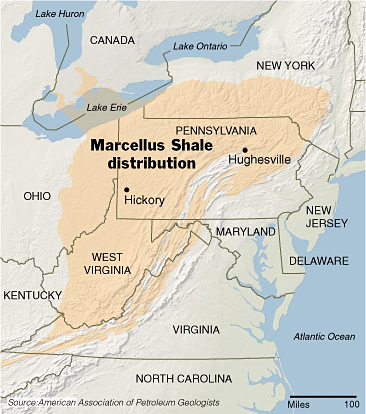
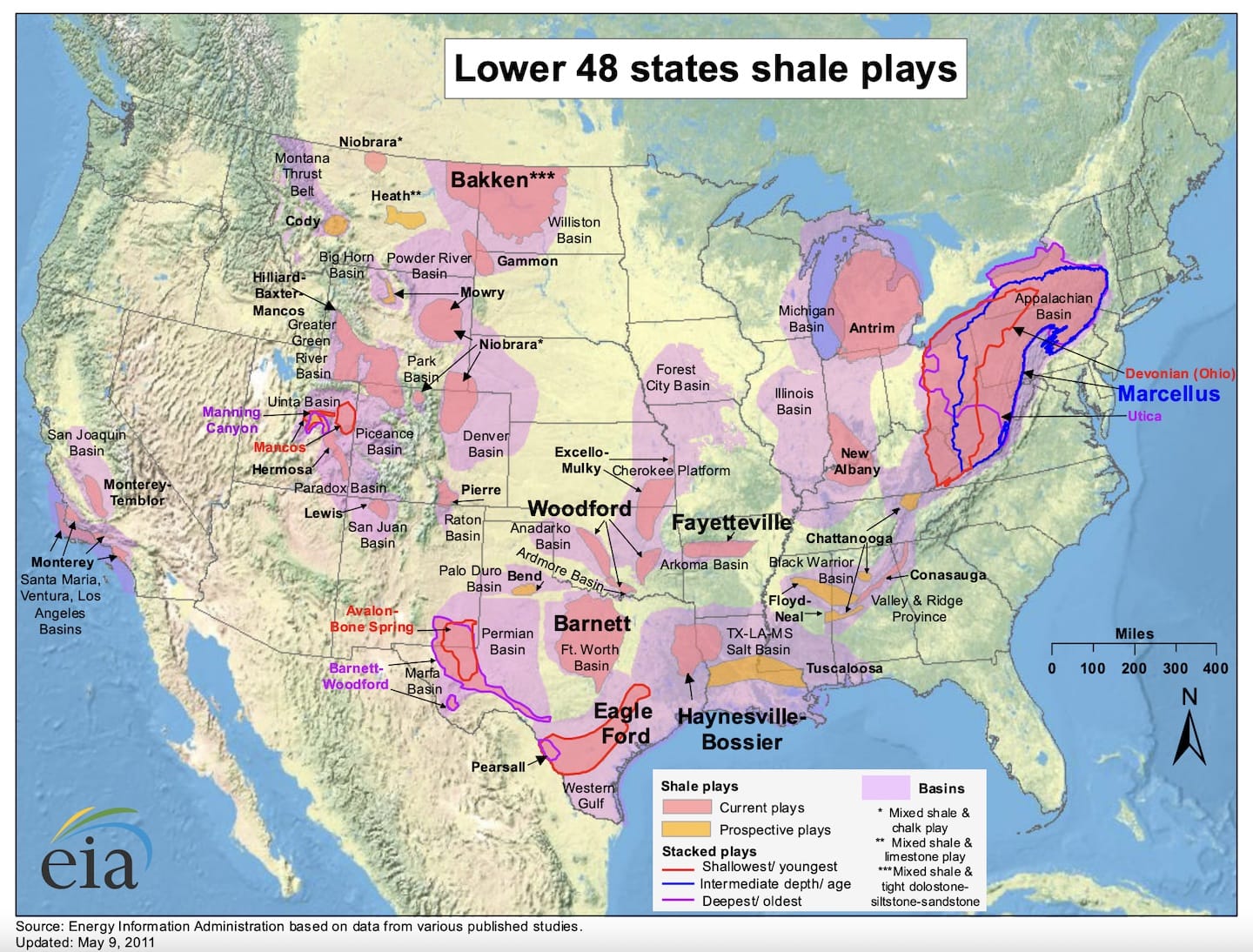
Shale gas in the United States is an available source of unconventional natural gas. Led by new applications of hydraulic fracturing technology and horizontal drilling, development of new sources of shale gas has offset declines in production from conventional gas reservoirs, and has led to major increases in reserves of U.S. natural gas. Largely due to shale gas discoveries, estimated reserves of natural gas in the United States in 2008 were 35% higher than in 2006.[1]
In 2007, shale gas fields included the #2 (Barnett/Newark East) and #13 (Antrim) sources of natural gas in the United States in terms of gas volumes produced.[2] The number of unconventional natural gas wells in the U.S. rose from 18,485 in 2004 to 25,145 in 2007 and is expected to continue increasing[3] until about 2040.
The economic success of shale gas in the United States and rapid growth in the amount produced after 2009 has led to rapid development of shale gas in Canada, and, more recently, has spurred interest in shale gas possibilities in Europe, Asia, and Australia. It has been postulated that there may be a 100-year supply of natural gas in the United States, but only 11 years of gas supply is in the form of proved reserves.[4]
Shale gas in the United States. Wikipedia.
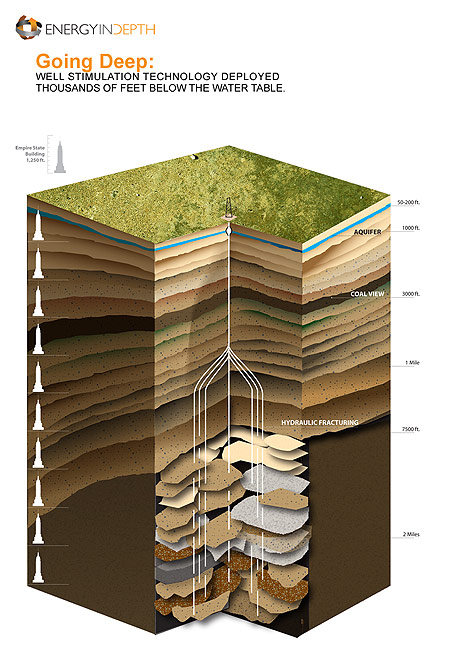
Can we benefit by this new source of natural gas without it affecting our water and lifestyle?
The diagram below, provided by Energy in Depth, an Oil and Gas Industry website, portrays a clean, quiet, well site. The reality however, as seen in the diagram provided at the bottom of this page by The Colorado Independent and Pro Publica is different.
Hydraulic fracturing uses millions of gallons of water, chemicals and lubricants. Where does all this water come from? The contents of the underground injection fluids used in fracking is a trade secret. In 2005, fracking was exempted from regulation by the Safe Drinking Water Act (1974) leaving it up to the states to monitor and regulate a rapidly increasing number of fracked wells.
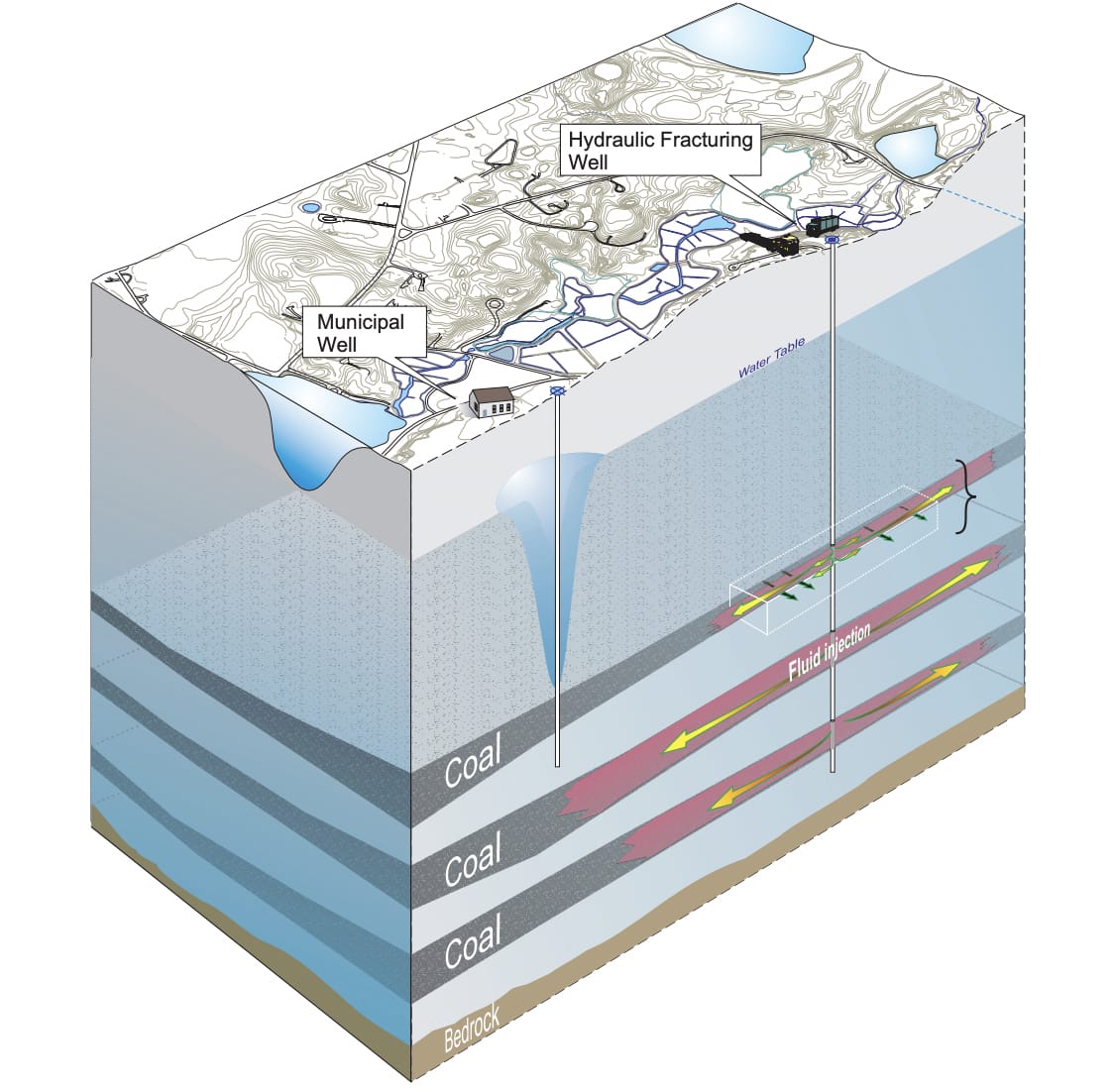
Source: (no longer available since it has been “debunked” (see directly below, Weston Wilson); Environmental Protection Agency (EPA), “Evaluation of Impacts to Underground Sources of Drinking Water by Hydraulic Fracturing of Coalbed Methane Reservoirs Study (2002)”.
The corrected version was posted to the EPA website here: https://permanent.access.gpo.gov/lps21800/www.epa.gov/safewater/uic/cbmstudy/pdfs/completestudy/executive-summary.pdf
The U.S. Environmental Protection Agency (EPA) was criticized in 2004 by Weston Wilson, an EPA scientist for “bad science” in this Fracking Study which led the EPA to mislead Congress to pass the Energy Policy Act of 2005 (PDF, 511 pages, 3.1MB).
Acts of Congress are often designated as public laws when they are intended to protect all members of society in areas of interaction not limited to contract and tort laws. Most U.S. Consumer Protection laws are written as Acts of Congress. Consumer Protection laws are a form of government regulation that protect the interests of consumers.
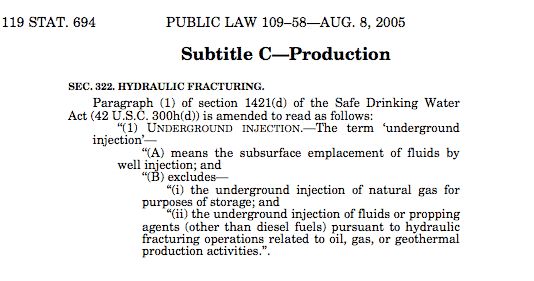
Section 322 of this Law amended the Safe Drinking Water Act (SDWA) to exempt all fracturing fluids except diesel from EPA regulations.
See also: Kristina Marusic. How the “Halliburton Loophole” lets fracking companies pollute water with no oversight. 18 May 2023. Environmental Health News.

Fracking companies used more than 282 million pounds of hazardous chemicals from 2014 to 2021 with no federal oversight, according to a new study.
The study, published in Environmental Pollution, is the first to examine the “Halliburton Loophole,” which exempts fracking from federal regulation under the Safe Drinking Water Act.
The provision, passed by Congress as part of the Energy Policy Act of 2005, was endorsed by then-Vice President Dick Cheney, who formerly served as the CEO of Halliburton. The company patented fracking technologies in the 1940s and is still one of the top suppliers of fracking fluids in the world.
The study found that from 2014 through 2021, 62% to 73% of reported fracking jobs each year used at least one chemical that’s categorized as harmful to human health and the environment under the Safe Drinking Water Act.
These chemicals include carcinogens like formaldehyde, arsenic and benzene; possible carcinogens like acrylamide and naphthalene; and ethylene glycol, which can damage the kidneys, nerves and respiratory system.
Kristina Marusic. How the “Halliburton Loophole” lets fracking companies pollute water with no oversight. 18 May 2023. Environmental Health News.
Read the New York Times editorial, 11/3/2009, on the Halliburton Loophole.
Among the many dubious provisions in the 2005 energy bill was one dubbed the Halliburton loophole, which was inserted at the behest of you guessed it then-Vice President Dick Cheney, a former chief executive of Halliburton.
It stripped the Environmental Protection Agency of its authority to regulate a drilling process called hydraulic fracturing. Invented by Halliburton in the 1940s, it involves injecting a mixture of water, sand and chemicals, some of them toxic, into underground rock formations to blast them open and release natural gas.
Hydraulic fracturing has been implicated in a growing number of water pollution cases across the country. It has become especially controversial in New York, where regulators are eager to clear the way for drilling in the New York City watershed, potentially imperiling the city’s water supply. Thankfully, the main company involved has now decided not to go ahead.
The safety of the nation’s water supply should not have to rely on luck or the public relations talents of the oil and gas industry. Thanks in part to two New Yorkers Representative Maurice Hinchey and Senator Charles Schumer Congress last week approved a bill that asks the E.P.A. to conduct a new study on the risks of hydraulic fracturing. An agency study in 2004 whitewashed the industry and was dismissed by experts as superficial and politically motivated. This time Congress is demanding “a transparent, peer-reviewed process.”
An even more important bill is waiting in the wings. Cumbersomely named the Fracturing Responsibility and Awareness of Chemicals Act, it would close the loophole and restore the E.P.A.’s rightful authority to regulate hydraulic fracturing. It would also require the oil and gas industry to disclose the chemicals they use.
The industry argues that the chemicals are proprietary secrets and that disclosing them would hurt their competitiveness. It also argues that the process is basically safe and that regulating it would deter domestic production. But if hydraulic fracturing is as safe as the industry says it is, why should it fear regulation?
New York Times editorial, 11/3/2009, on the Halliburton Loophole.
Federal regulators currently do not have access to a full accounting of the types and quantities of chemicals used in hydraulic fracturing fluids. On February 18, 2010 the Congressional Energy and Commerce Committee sent letters to eight companies in the fracking business requesting information on the chemicals used in fracturing fluids and the potential impact of the practice on the environment and human health. On March 18, 2010 the EPA announced that it is re-allocating $1.9 million for a comprehensive study of hydraulic fracturing. On April 7, the EPA Science Advisory Board (SAB) met for two days to provide advice on EPA’s Office of Research and Development (ORD) proposed approach to be used to frame the hydraulic fracturing study design and the areas that will be addressed by research relevant to hydraulic fracturing. Public comments were included but will not be permanently online.
The Fracturing Responsibility and Awareness of Chemicals (FRAC) Act was introduced on 6/9/2009 in the Senate to amend the Safe Drinking Water Act and reverse the hydraulic fracturing exemption. Debate on this legislation is expected later in 2010.
This legislation will not prohibit mining and drilling companies from operating, however it will remove their exemption under the Safe Drinking Water Act which allows companies to keep secret the chemicals and toxins they use in this process. Businesses involved in hydraulic fracturing projects can still continue to use a combination of water and sand or ceramic beads to increase oil and natural gas production.
This website, Fracking Resource Guide annotates evidence, opinions, and observations on whether or not the potential economic benefits for the companies doing business in the Marcellus Shale outweigh the potential harm to our other public and private interests.
Almost all of the links lead to free internet resources. There are also references to scholarly books and journal articles that your local or school librarian can help you locate. You’ll find background information on fracking from reliable authors; links to companies; expert opinions; public opinions for and against fracking; government reports, politics, pending legislation and regulations; legal issues, and press reports. Use the menu at the top and bottom of these pages and the search box to navigate these resources.
Editor’s Note: If we bust these myths about global warming and fossil fuels – the growing scarcity of our oil supply, and can replant a trillion or more trees, by Freeman Dyson‘s estimates to remove all the carbon dioxide from the atmosphere then we only have to worry about methane from cattle, gas flaring and the melting of the tundra permafrost to prevent humanity from reaching the “tipping-point” of our destruction. We, as a planet, not an amalgam of nations, would need to do this now, havoing failed on yesterday, with 2050’s dark tomorrow looming, as India, China, Brazil, and the rest of the Global South industrialize and compete for dwindling resources. The Earth will undoubtedly survive, but humanity won’t.
Global Warming must be addressed by all governments, NGO’s, citizen activists, and corporations. Skytruth is one of the global organizations helping to minimize or even stop environmental damage from gas flaring and methane leaks before it occurs. See also: Drilling Isn’t Safe. (Neil Zusman,2010-11-21.)
See my book review (4/29/2012): Wilber, Tom. Under the Surface: Fracking, Fortunes and the Fate of the Marcellus Shale. Ithaca: Cornell University Press, 2012. Print.
See: Gold, Thomas. The Deep Hot Biosphere. New York: Copernicus, 1999. Print. My article about this book is here: The Deep Hot Biosphere: The Myth of Fossil Fuels.

Neil Zusman (2010-08-24)
(Editor’s Note. 28 Dec 2023 – 30 Dec 2024. Updated.) To learn more about the restoration of this website, Earthstage: Palau Edition and the Fracking Resource Guide, visit our About section.
See: Cornell 2011 Energy Conference
See: U.S. Speaker Nancy Pelosi: The Gavel: Draining The Swamp
See: Chevron Human Energy Stories | Addressing Climate Change
See: Halliburton
See: Before the Big Spill
See: Ceres Principles – Corporate Environmental Conduct
See: The top five stories of the year [2010] for climate hawks
See: BP chief hails American breakthrough in gas supplies from shale rocks
See: Fueling Washington
See: The Next Drilling Disaster?
See: Natural Gas Industry Shills Use the Media to Mislead the Public – Here’s How to Spot Them
See: Hubbert Clip
See: Gasland – The Debate
See: Gasland vs Big Oil and Gas
See: Affirming Gasland
See: U.S. Environmental Protection Agency (EPA): Weston Wilson Whistle Blower Letter
See: NETL: Secure & Reliable Energy Supplies
See: Energy Policy Act of 2005-Critique
See: EPA Findings on Hydraulic Fracturing Deemed “Unsupportable”
See: Coalbed Methane Development: The Costs and Benefits of an Emerging Energy Resource
See: Natural gas: the commodity world’s ugly duckling
See: Energy & Commerce Committee Investigates Potential Impacts of Hydraulic Fracturing
See: The Deep Hot Biosphere : The Myth of Fossil Fuels
See: Tales from the Ice: Explaining Rapid Climate Change
See: Fracking Mobilizes Uranium in Marcellus Shale, UB Research Finds
See: American Petroleum Institute
See: Energy in Depth – SourceWatch
See: Natural Gas Industry Shills Use the Media to Mislead the Public – Here’s How to Spot Them
See: FracFocus Chemical Disclosure Registry
See: Global Warming
See: Beware The Green Dragon! | Right Wing Watch
See: House committee votes to deny climate change
See: Global Warming Frequently Asked Questions
See: Society of Environmental Journalists (SEJ) Members’ Blogs and Websites
See: Eaarth: Making a Life on a Tough New Planet | 350.org Founder Bill McKibben
See: Action Center | Republicans for Environmental Protection (REP America)
See: Bluedaze – Drilling Reform for Texas
See: Fracked: Barnett Shale drilling chemicals found in blood and organs
See: Fracking: Implications for Human and Environmental Health
See: Dish Mayor Calvin Tilman Testifies at Railroad Commission – Oil and Gas Lawyer Blog
See: Health Issues Follow Natural Gas Drilling In Texas
See: Under the surface : fracking, fortunes and the fate of the Marcellus Shale
See: Poison Fire
See: The Yes Men | Climate Pledge of Resistance
See: Drill, Baby, Drill!: The chant of the political naif
See: Global Warning | The environment and national security
See: WikiLeaks Saudi Cables Prompt Questions Over Peak Oil | Neon Tommy
See: E.P.A. Proposes New Emission Standards for Power Plants
See: Chu Names Panel to Study Fracking
See: Climate Co-benefits and Child Mortality Wedges
See: Art of the common-place: the agrarian essays of Wendell Berry