
Founded in 1919, Halliburton is one of the world’s largest providers of products and services to the oil and gas industry. It employs more than 50,000 people in nearly 70 countries.”
See also: Halliburton’s web site on Hydraulic Fracturing
See also: Soucewatch article on Halliburton.
“Halliburton is under Justice Department Securities and Exchange Commission over allegations of improper dealings in Iraq, Kuwait and Nigeria”.
U.S. Securities and Exchange Commission. SEC Charges KBR and Halliburton for FCPA Violations. 11 Feb 2009. Washington, D.C.
FOR IMMEDIATE RELEASE
2009-23Washington, D.C., Feb. 11, 2009 — The Securities and Exchange Commission today announced settlements with KBR, Inc. and Halliburton Co. to resolve SEC charges that KBR subsidiary Kellogg Brown & Root LLC bribed Nigerian government officials over a 10-year period, in violation of the Foreign Corrupt Practices Act (FCPA), in order to obtain construction contracts. The SEC also charged that KBR and Halliburton, KBR’s former parent company, engaged in books and records violations and internal controls violations related to the bribery.
U.S. Securities and Exchange Commission. SEC Charges KBR and Halliburton for FCPA Violations. 11 Feb 2009. Washington, D.C.
See also: New York Times Editorial on the “Halliburton Loophole”. (2009)
See also: LA Times, “Halliburton’s Interests Assisted by White House.” (2004)
See also: John Collins Rudolf. “E.P.A. Subpoenas Halliburton on Fracking.” NYT Green Blog. Nov. 9, 2010.
See also: Barry Meier and Clifford Krauss. “Inquiry Puts Halliburton in a Familiar Hot Seat”. NYT Business Day. October 28, 2010.
See also: Clifford Kraus. Halliburton Office Move Is Criticized. 13 Mar 2007. New York Times.
Halliburton has been the Pentagon’s largest private contractor in Iraq and a lightning rod for criticism of the Bush administration’s failures in prosecuting the war. It has been subject to a variety of investigations over suspicions it mishandled billions of dollars in contracts to build bases, serve food and provide other support to the American presence since the invasion in 2003.
Clifford Kraus. Halliburton Office Move Is Criticized. 13 Mar 2007. New York Times.
See also: Dauda Garuba. “Halliburton, Bribes and the Deceit of ‘Zero-Tolerance’ for Corruption in Nigeria.” African Community of Practice on Managing for Development Results. (cop-mfdr-africa.org). August 26, 2010.
EPA Update. November 9-10 2010
On November 9, 2010, EPA announced that eight out of the nine hydraulic fracturing companies that received voluntary information requests in September agreed to submit timely and complete information to help the Agency conduct its study on hydraulic fracturing. However, the ninth company, Halliburton, has failed to provide EPA the information necessary to move forward with this important study. As a result, and as part of EPA’s effort to move forward as quickly as possible, today EPA issued a subpoena to the company requiring submission of the requested information that has yet to be provided.
See also: Letter sent by EPA to Halliburton PDF (2pp, 516K).
See also: The subpoena sent by EPA to Halliburton PDF (11pp, 3.5M).
See also: David Wethe and Margaret Cronin Fisk. Halliburton’s $1.1 Billion Spill Agreement Avoids Bigger Payouts. 2 Sep 2014. Bloomberg via GCaptain.
The oilfield services company, accused of doing defective work on BP Plc’s Macondo well before it exploded in 2010, killing 11 men and dumping millions of barrels of crude oil into the Gulf of Mexico, said today the agreement resolves “a substantial majority” of its liability in the disaster.
David Wethe and Margaret Cronin Fisk. Halliburton’s $1.1 Billion Spill Agreement Avoids Bigger Payouts. 2 Sep 2014. Bloomberg via GCaptain.
Update:
See also: FCPA Blog | UK Court Won’t Block Telser Extradition
Judson Berger. “Nigeria Drops Bribery Charges Against Cheney, Halliburton After $250M Deal Struck.” Canada Free Press. Dec. 21, 2010.
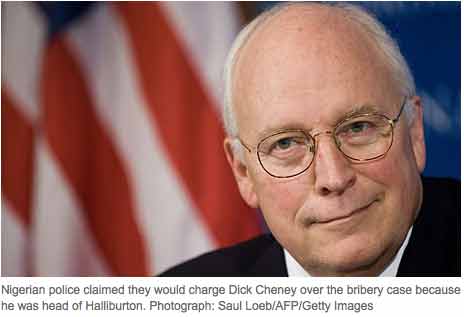
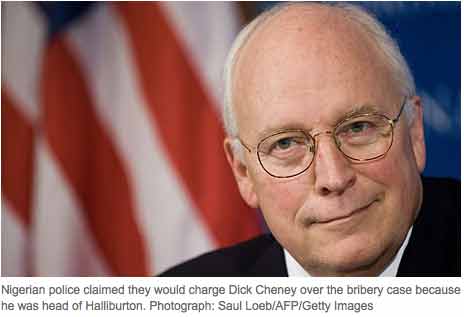
Nigeria’s government has reportedly dropped bribery charges against former Vice President Dick Cheney and Halliburton, the energy firm he once headed, after the company agreed to pay a hefty settlement.
See also: Halliburton Investor Relations Ballot – UNITED STATES SECURITIES AND EXCHANGE COMMISSION. Washington, D.C. 20549 SCHEDULE 14A Proxy Statement Pursuant to Section 14(a) of the Securities Exchange Act of 1934
WHEREAS, Halliburton has been accused by Defense Department auditors and members of Congress of serious irregularities relating to the performance of the company’s contractual obligations in Iraq, including inflated prices for delivered goods, overcharges, and false charges for services not rendered, (“Bribery Network to Bloat War Costs is Alleged”, New York Times, 7/21/07; “Halliburton Overcharged $108 Million, Report Says”, 3/15/05; “Questionable Iraq Contracts May Exceed $10 Billion”, Bloomberg News Services, 2/15/07), and
WHEREAS, Halliburton has been charged in civil actions filed in the US with participating in human rights abuses relating to treatment of its contract employees, including collusion in suppression of evidence relating to abuses and human trafficking (“Federal Appeals Court Revives Lawsuits Against Halliburton, Subsidiary in Deadly Iraq Ambush” Associated Press 5/29/08; “KBR, Partner in Iraq, Sued in Human Trafficking Case”, Washington Post 8/28/08; “Halliburton Hit in Rape Lawsuit”, New York Daily News, 12/11/07),
THEREFORE, shareholders request that the company establish a committee of independent directors to review allegations of financial misconduct and human rights abuses on the part of the company and it’s employees in Iraq, and to report to shareholders on it’s findings with recommendations for improved oversight of the company’s international operations.
The Board of Directors recommends a vote AGAINST this proposal. Halliburton’s statement in opposition is as follows:
The matters referred to above relate to KBR, Inc.’s operations in Iraq. When we owned KBR, we reported extensively in our Forms 10-K and 10-Q on matters associated with KBR’s work in Iraq. We no longer own KBR, having completed the separation of KBR from us over two years ago, on April 5, 2007. If additional information regarding KBR is appropriate, then KBR would need to provide that information. We have explained this to the Funds.
The Board believes that it would be inappropriate for us to comment on matters involving another company.
The Board of Directors recommends a vote AGAINST the proposal. Proxies solicited by the Board of Directors will be voted against the proposal unless instructed otherwise.
Halliburton Investor Relations Ballot – UNITED STATES SECURITIES AND EXCHANGE COMMISSION. Washington, D.C. 20549 SCHEDULE 14A Proxy Statement Pursuant to Section 14(a) of the Securities Exchange Act of 1934
See also: Emily Pierce. Quiet on Halliburton Bemoaned. 20 May 2005. Roll Call.
The Senate Homeland Security and Governmental Affairs Committee has held no hearings on whether civilian contractors in Iraq — particularly Halliburton, the company Vice President Cheney used to head — have mismanaged and overcharged the government by billions of dollars, much to the consternation of Senate Democrats.
Chairwoman Susan Collins (R-Maine) has steadfastly refused to hold hearings on the issue in the more than two years since the start of the war in Iraq, despite — Collins says because of — multiple executive branch investigations of Halliburton subsidiary Kellogg, Brown and Root.
“We should not be in our committee spineless,” Sen. Frank Lautenberg (D-N.J.) said in a recent interview. “We should go ahead and investigate this.”
Since May 9, 2003, Lautenberg, a junior member of the panel, has sent five letters to Collins requesting hearings on various alleged misdeeds of KBR and Halliburton.
In his most recent letter on April 26, Lautenberg outlined several issues the committee could probe, including:
• An April 2005 State Department report that found major cost overruns and “poor performance” by Halliburton on a $1.2 billion contract to repair Iraqi oil fields.
• The Defense Department’s decision to override its own auditors when it decided in February not to withhold payments from Halliburton until questions about overcharges were answered.
• Allegations by an Army Corps of Engineers whistleblower that Halliburton was unfairly and improperly awarded its no-bid contract with the U.S. government.
• Findings by Pentagon auditors that Halliburton overcharged the government $61 million for gasoline imports in Iraq as well as $27.4 million for troops’ meals in Iraq.
• Allegations that Halliburton employees received $6.3 million in kickbacks from Kuwaiti businessmen in exchange for subcontracting deals.
• Allegations that KBR employees abandoned trucks, each costing $85,000, due to flat tires and other repairable problems.
• Revelations by the former Coalition Provisional Authority’s inspector general that KBR lost track of more than $18 million in equipment.
…“One of the most important historical roles of the United States Congress is to provide oversight,” Dorgan said, noting that then-Sen. Harry Truman (D-Mo.) investigated allegations of war profiteering during World War II even though the president, Franklin Delano Roosevelt, was also a Democrat.
“The minute you mention Halliburton everybody thinks you want to investigate Vice President Cheney,” Dorgan said. “But, no, we’re investigating waste, fraud and abuse.”
Emily Pierce. Quiet on Halliburton Bemoaned. 20 May 2005. Roll Call.
See also: Peter W. Singer. Outsourcing the Fight. 5 Jun 2008. Brookings.
In 1992 a relatively little-known, Texas-based oil services firm called Halliburton was awarded a $3.9 million Pentagon contract. Its task was to write a classified report on how private companies, like itself, could support the logistics of U.S. military deployments into countries with poor infrastructure. Conspiracy theories aside, it is hard to imagine that either the company or the client realized that 15 years later this contract (now called the Logistics Civilian Augmentation Program or LOGCAP) would be worth as much as $150 billion.
The use of private contractors in U.S wars dates back to the sutlers, merchants who followed behind Revolutionary and Civil War armies selling incidentals to the troops like jam or whiskey. But the size and scope of the private military industry today is unprecedented. In Iraq alone, there are some 180,000 private military contractors performing functions that once would have been handled by soldiers in uniform.
…There also aren’t enough eyes and ears working on behalf of the government client to monitor contractor performance. In 1998, there was one financial auditor for every $642 million in Pentagon contracts. Today, there is one auditor for every $2.03 billion in contracts.
These auditors aren’t just required to catch false billings and cost overruns, but also to ensure quality. That soldier’s electrocution didn’t happen because of malice; it happened, as an internal Pentagon e-mail revealed, because KBR’s inspections were never reviewed by a “qualified government employee,” and the Army wasn’t aware of “the extent of the severity of the electrical problems.”
Finally, the Pentagon needs to use its massive buying power to shape and sanction the market, much like Wal-Mart does to wring out efficiencies and send warnings to any vendors that think to cross it. For example, the new LOGCAP contract, potentially worth up to $150 billion, went to KBR, DynCorp and Fluor. Yet, as the Project on Government Oversight found, these same three companies have been cited for 29 cases of serious misconduct in the last decade–a category of allegations that includes false claims against the government, violations of the Anti-Kickback Act, fraud and conspiracy to launder money.
Peter W. Singer. Outsourcing the Fight. 5 Jun 2008. Brookings.
See also: Democratic Policy Committee. Fact Sheet: Halliburton’s Iraq Contracts Now Worth
over $10 Billion. Halliburton Watch.
See also, original Waxman document: Democratic Policy Committee. Major Findings: DPC Oversight Hearings on Waste, Fraud, and Corruption in Iraq. Rep. Henry A. Waxman Ranking Minority Member Committee on Government Reform. U.S. House of Representatives. December 9, 2004.
Investigations and Audits
At the same time that the value of Halliburton’s contracts is increasing, auditors are finding extensive problems with Halliburton’s billings, and criminal investigations of Halliburton and its employees continue.
Auditors from the Defense Contract Audit Agency (DCAA), the Government Accountability Office (GAO), and the Coalition Provisional Authority Inspector General (CPA IG) have repeatedly and consistently criticized multiple aspects of Halliburton’s activities in Iraq. In nine different reports, these government auditors have found widespread, systemic problems with almost every aspect of Halliburton’s work in Iraq, from cost estimation and billing systems to cost control and subcontract management.
Key findings from these audits include the following:
Democratic Policy Committee. Major Findings: DPC Oversight Hearings on Waste, Fraud, and Corruption in Iraq. Rep. Henry A. Waxman Ranking Minority Member Committee on Government Reform. U.S. House of Representatives. December 9, 2004.
- In December 2003, a DCAA draft audit reported that Halliburton overcharged the Defense Department by $61 million to import gasoline into Iraq from Kuwait through September 30, 2003. (4)
- On December 31, 2003, a DCAA “Flash Report” audit found “significant” and “systemic” deficiencies in the way Halliburton estimates and validates costs. According to the DCAA audit, Halliburton repeatedly violated the Federal Acquisition Regulation and submitted a $2.7 billion proposal that “did not contain current, accurate, and complete data regarding subcontract costs.” (5)
- On January 13, 2004, DCAA concluded that Halliburton’s deficiencies “bring into question [Halliburton’s] ability to consistently produce well-supported proposals that are acceptable as a basis for negotiation of fair and reasonable prices,” and it urged the Corps of Engineers to “contact us to ascertain the status of [Halliburton’s] estimating system prior to entering into future negotiations.” (6)
- In a May 13, 2004, audit, DCAA reported “several deficiencies” in Halliburton’s billing system that resulted in billings to the government that “are not prepared in accordance with applicable laws and regulations and contract terms.” DCAA also found “system deficiencies resulting in material invoicing misstatements that are not prevented, detected and/ or corrected in a timely manner.” The report emphasized Halliburton’s inadequate controls over subcontract billings. The auditors “identified inadequate or nonexistent policies and procedures for notifying the government of potential significant subcontract problems that impact delivery, quality, and price” and determined that Halliburton “does not monitor the ongoing physical progress of subcontracts or the related costs and billings.” (7)
- On June 25, 2004, the CPA IG found that, as a result of poor oversight, Halliburton charged U. S. taxpayers for unauthorized and unnecessary expenses at the Kuwait Hilton Hotel. According to the IG, the overcharges would have amounted to $3.6 million per year. (8)
- A July 26, 2004, CPA IG audit report found that Halliburton “did not effectively manage government property” and that the company’s property records “were not sufficiently accurate or available to properly account for CPA property items.” The IG “projected that property valued at more than $18.6 million was not accurately accounted for or was missing.” (9)
- In July 2004, GAO found ineffective planning, inadequate cost control, and insufficient training of contract management officials under LOGCAP in Iraq. GAO reported that, when Halliburton acted as a middleman for the operation of dining halls, costs were over 40% higher. (10)
- In an August 16, 2004, memorandum, DCAA “identified significant unsupported costs” submitted by KBR, a Halliburton subsidiary, and found “numerous, systemic issues . . . with KBR’s estimates.” According to DCAA, “while contingency issues may have had an impact during the earlier stages of the procurements, clearly, the contractor should have adequate supporting data by now.” When DCAA examined seven LOGCAP task orders with a combined proposed value of $4.33 billion, auditors identified unsupported costs totaling $1.82 billion. (11)
- On November 23, 2004, the Special Inspector General for Iraq Reconstruction (formerly the CPA IG) examined a $569 million LOGCAP task order and found that Halliburton “did not provide . . . sufficiently detailed cost data to evaluate overall project costs or to determine whether specific costs for services performed were reasonable.” The IG concluded that the Army “did not receive sufficient or reliable cost information to effectively manage” the task order. (12) Multiple criminal investigations of Halliburton’s Iraq contracts are also ongoing. The Justice Department is investigating Halliburton’s admission that two of its employees received up to $6.3 million in kickbacks to steer LOGCAP subcontracts to a Kuwaiti contractor. (13) The Defense Department Inspector General, the FBI, and the Justice Department are investigating allegations of fraud and overcharging for gasoline under the RIO contract. (14)
See also: Halliburton Controversies and Criticisms on Wikipedia
Controversies and criticism
Iraq War
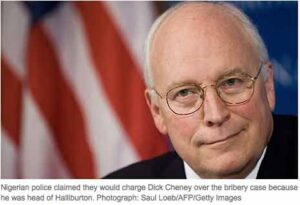
Halliburton has become the object of several controversies involving the Iraq War and the company’s ties to former U.S. Vice President Dick Cheney. Cheney retired from the company during the 2000 U.S. presidential election campaign with a severance package worth $36 million.[52] As of 2004, he had received $398,548 in deferred compensation from Halliburton while Vice President.[53] Cheney was chairman and CEO of Halliburton Company from 1995 to 2000 and has received stock options from Halliburton.[54]
In the run-up to the Iraq War, Halliburton was awarded a $7 billion contract for which only Halliburton was allowed to bid.[55]
Bunnatine Greenhouse, a civil servant with 20 years of contracting experience, had complained to Army officials on numerous occasions that Halliburton had been unlawfully receiving special treatment for work in Iraq, Kuwait and the Balkans. Criminal investigations were opened by the U.S. Justice Department, the Federal Bureau of Investigation (FBI) and the Pentagon’s inspector general. These investigations found no wrongdoing within the contract award and execution process.[citation needed]
In one of Greenhouse’s claims, she said that military auditors caught Halliburton overcharging the Pentagon for fuel deliveries into Iraq. She also complained that Defense Secretary Donald Rumsfeld‘s office took control of every aspect of Halliburton’s $7 billion Iraqi oil/infrastructure contract. Greenhouse was later demoted for poor performance in her position.[56] Greenhouse’s attorney, Michael Kohn portrayed her performance reviews as punishment for criticizing the administrations, he stated in The New York Times that “she is being demoted because of her strict adherence to procurement requirements and the Army’s preference to sidestep them when it suits their needs.”[57]
Deepwater Horizon explosion
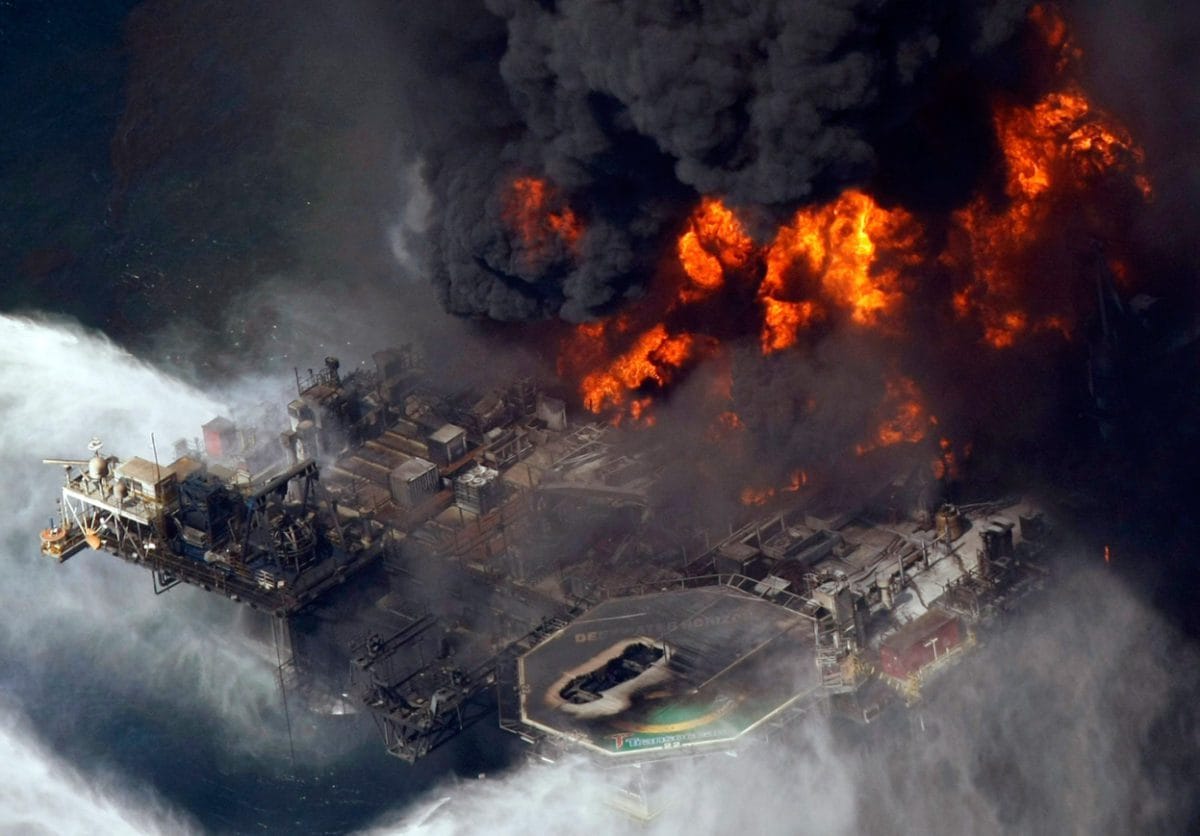
An internal report released in 2010 by BP into the Deepwater Horizon explosion claimed that poor practices of Halliburton staff had contributed to the disaster. Investigations carried out by the National Commission on the BP Deepwater Horizon Oil Spill and Offshore Drilling found that Halliburton was jointly at fault along with BP and Transocean for the spill. The cement that Halliburton used was an unstable mixture, and eventually caused hydrocarbons to leak into the well, causing the explosion that started the crisis.[58]
Halliburton pleaded guilty to destroying evidence after the April 2010 Deepwater Horizon disaster; the company destroyed computer simulations it performed in the months after the accident, simulations that contradicted Halliburton’s claim that it was BP who had not followed Halliburton’s advice. BP had employed Halliburton to oversee the process by which cement is used to seal casing in oil and gas wells, thereby preventing leaks. Government investigators had ordered companies involved in drilling the well to preserve all relevant evidence.[59]
Allegations of corruption in Nigeria
In early December 2010, the Nigerian government filed corruption charges against Cheney in connection with his role as the chief executive of Halliburton.[60][61] The case relates to an alleged $182 million contract involving a four-company joint venture to build a liquefied natural gas plant on Bonny Island in southern Nigeria.[62] Earlier in 2009, KBR, a former subsidiary of Halliburton, agreed to pay $402 million after admitting that it bribed Nigerian officials, and Halliburton paid $177 million to settle allegations by the U.S. Securities and Exchange Commission without admitting any wrongdoing.[63][64] In mid-December 2010, the case was settled when Nigeria agreed to drop the corruption charges against Cheney and Halliburton in exchange for a $250 million settlement.[63] According to Femi Babafemi, the spokesperson for the Economic and Financial Crimes Commission, the $250 million would include approximately $130 million frozen in a Swiss bank, and the rest would be paid as fines.[62]
The Federal Contractor Misconduct Database details 10 instances of misconduct since 1995 under which Halliburton has agreed to pay settlements of $791 million.[65] A further 22 instances of misconduct relate to the company’s former subsidiary KBR.[66]
Environmental issues
In 2002, Toxics Release Inventory (TRI) reports were completed to measure the amount of chemicals emitted from Halliburton’s Harris County, Texas facility. The TRI is a publicly available EPA database that contains information on toxic chemical releases and waste management activities reported annually by certain industries as well as federal facilities. The facility had 230 TRI air releases in 2001 and 245 in 2002.[67]
On June 7, 2006, Halliburton’s Farmington, New Mexico facility created a toxic cloud that forced people to evacuate their homes.[68]
Halliburton may also be implicated[69] in the oil spills in the Timor Sea off Australia in August 2009 and in the Gulf of Mexico in April 2010 for improper cementing. Halliburton staff were employed on the Transocean operated Deepwater Horizon oil rig in the Mexican Gulf. Halliburton staff completed cementation of the final production well 20 hours prior to the Deepwater Horizon drilling rig explosion, but had not yet set the final.[70]
In July 2013, Halliburton Co agreed to plead guilty to charges that it destroyed evidence relating to the 2010 Deepwater Horizon oil spill. This incurred a $200,000 fine; the firm also agreed to three years of probation and to continue cooperating with the criminal probe into the spill.[71] In September 2014, the company agreed to pay $1.1 billion in damages to settle the majority of claims against it relating to the explosion, removing the uncertainty which had hung over the company for the previous four years
Jamie Leigh Jones incident
Jamie Leigh Jones testified at a Congressional hearing that she had been gang-raped by as many as seven co-workers in Iraq in 2005 when she was an employee of KBR, and then falsely imprisoned in a shipping container for 24 hours without food or drink.[72][73] KBR was a subsidiary of Halliburton at the time. Jones and her lawyers said that 38 women have contacted her reporting similar experiences while working as contractors in Iraq, Kuwait, and other countries. On September 15, 2009, the fifth Circuit Court of Appeals ruled in favor of Halliburton, in a 2 to 1 ruling, and found that her alleged injuries were not, in fact, in any way related to her employment and thus, not covered by the contract. This decision effectively meant that the mandatory arbitration clause in her contract did not apply.[73]
These incidents have tainted the public perception of Halliburton, with a consumer study rating it as the fifth least reputable company in America.[74]
Sale of KBR
On April 15, 2006, Halliburton filed a registration statement with the Securities and Exchange Commission to sell up to 20 percent of its KBR stock on the NYSE under the ticker symbol “KBR”, as part of an eventual plan for KBR to be a separate company from Halliburton.[75]
In November 2006, Halliburton began selling its stake in KBR, its major subsidiary, and by February 2007 had completely sold off the subsidiary. In June 2007, several days after Stewart Bowen, the Special Inspector General, released a new report, the Army announced that KBR would share another $150 billion contract with two other contractors, Fluor and Dyncorp, over the next 10 years.[76]
Baghdad incident
In accordance with the law of armed conflict and to maintain non-combatant status, Halliburton does not arm its truck drivers. Trucks are often the target of insurgent attacks. On September 20, 2005, a convoy of four Halliburton trucks was ambushed north of Baghdad. All four trucks were struck by improvised explosive devices and were disabled. Their US National Guard escort was thought to have abandoned the disabled vehicles, leaving the drivers defenseless. Three of the four truck drivers were killed by the insurgents while the surviving driver caught the event on video. Although the trucks had military camouflage paint, the drivers were civilian. The US military returned to the scene 45 minutes later.[77] However, in a statement by senior military officials in Iraq, an investigation revealed that troops did not abandon the civilians and they were all exiting the “kill zone” during the ambush.[78][79]
Restatements
On March 31, 2003, Management at Halliburton restated earnings downward by $14 million for the fourth quarter of 2002. In the restatement, an additional $3 million expense (net of tax) to continuing operations and an $11 million expense, net of tax, to discontinued operations were recorded.[80] On March 2, 2005, Halliburton restated its 2004 fourth-quarter earnings to add $2 million US in after-tax losses to reflect the collection of a $10 million receivable that had been reserved and a correction in lease accounting.
Health impacts
Halliburton has been criticized for its impacts on public health and the environment, most notably with the passing of the Energy Policy Act of 2005, also known as the Halliburton loophole. This law notably exempted chemicals used during hydraulic fracturing from the Clean Air Act, Clean Water Act, Safe Drinking Water Act, and CERCLA (“Superfund”). As a result of this, fracking fluids did not have to be reported to the EPA, rendering the EPA unable to legally regulate or monitor them.[81][82][83]
In 2020, it was reported that out of nine companies the EPA has asked full disclosure from with regards to the chemicals used in gas drilling, Halliburton was the only one that refused to comply.[84][16]
Illegal retaliation against whistleblower
In 2015, after a decade-long legal battle, Halliburton was declared guilty for illegally retaliating against whistleblower Tony Menendez.[14] Menendez had filed a case with the SEC over concerns that Halliburton was taking illegal actions to conceal billions of dollars;[15] following this, Halliburton retaliated against Menendez in a number of ways, including stripping Menendez of his responsibilities and forbidding him from coming to most meetings.[14]
Halliburton Controversies and Criticisms on Wikipedia
See: Energy & Commerce Committee Investigates Potential Impacts of Hydraulic Fracturing
See: Hydraulic Fracturing: History of an Enduring Technology
See: Natural gas: the commodity world’s ugly duckling
See: Chevron Human Energy Stories | Addressing Climate Change
See: BJ Services
See: Schlumberger
See: Superior Well Services – Products – Fracturing Systems
See: Universal Well Services, Inc.
See: Sanjel Corporation
See: Deepwater Horizon Committee Hears From Oil Industry Executives
See: BP – For BP, a History of Spills and Safety Lapses
See: Schlumberger
See: U.S. Speaker Nancy Pelosi: The Gavel: Draining The Swamp
See: Chevron Human Energy Stories | Addressing Climate Change
See: National Commission on the BP Deepwater Horizon Oil Spill and Offshore Drilling
See: Before the Big Spill
See: Ceres Principles – Corporate Environmental Conduct
See: The top five stories of the year [2010] for climate hawks
See: BP chief hails American breakthrough in gas supplies from shale rocks
See: Fueling Washington
See: The Next Drilling Disaster?
See: Natural Gas Industry Shills Use the Media to Mislead the Public – Here’s How to Spot Them
See: Hubbert Clip
See: Marcellus-Shale.us: Our look at the Halliburton Loophole – 2005 Energy Act
See: Energy Policy Act of 2005
See: This Website is a Crash Course In Fracking
See: Affirming Gasland
See: U.S. Environmental Protection Agency (EPA): Weston Wilson Whistle Blower Letter
See: NETL: Secure & Reliable Energy Supplies
See: Energy Policy Act of 2005-Critique
See: EPA Findings on Hydraulic Fracturing Deemed “Unsupportable”
See: Coalbed Methane Development: The Costs and Benefits of an Emerging Energy Resource