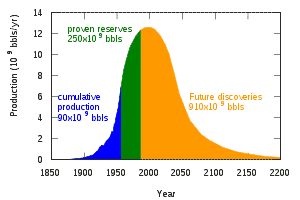
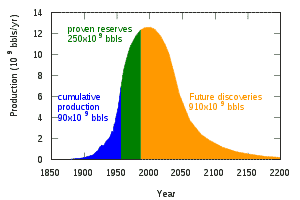
A logistic distribution shaped production curve, as originally suggested by M. King Hubbert in 1956.
See also: the U.S. Department of Energy (DOE), International Energy Outlook 2000, for information on energy trends in 2000.
See also the U.S. Energy Information Administration (EIA), International Energy Outlook 2011, for information on energy trends in 2011.
(Editor’s note. 12 Sep 2023.) See also: US Energy Information Administration (EIA) Annual Energy Outlook for 2023.
The Energy Policy Act of 2005 (Pub.L. 109-58) is a bill passed by the United States Congress on July 29, 2005, and signed into law by President George W. Bush on August 8, 2005, at Sandia National Laboratories in Albuquerque, New Mexico. The act, described by proponents as an attempt to combat growing energy problems, changed US energy policy by providing tax incentives and loan guarantees for energy production of various types.
Criticisms
The Washington Post contended that the spending bill is a broad collection of subsidies for United States energy companies; in particular, the nuclear and oil industries.
…”House Majority Leader Tom DeLay (R-Tex.) also managed to insert at least $500 million in subsidies over a 10-year period — with the option to double the amount — for research into deep-water oil and gas drilling, a grant that many lawmakers expect to go to the Texas Energy Center in DeLay’s home town of Sugar Land. The bill also includes royalty relief for deep-water drilling projects, a strategy that helped jump-start production in the Gulf during the 1990s…”
Senator Hillary Rodham Clinton made the bill an issue in the 2008 Democratic Primary by criticizing Senator Barack Obama’s two votes supporting the bill, calling it the “Dick Cheney lobbyist energy bill.”
This bill exempted fluids used in the natural gas extraction process of Hydraulic fracturing from protections under the Clean Air Act, Safe Drinking Water Act, and CERCLA. The proposed Fracturing Responsibility and Awareness of Chemicals Act would repeal these exemptions.
Please note that information taken from Wikipedia should be verified using other, more reliable sources. It is a good place to start research, but because anyone can edit Wikipedia, we do not recommend using it in research papers or to obtain highly reliable information.
See: Hubbert Clip
See: Marcellus-Shale.us: Our look at the Halliburton Loophole – 2005 Energy Act
See: Energy Policy Act of 2005
See: This Website is a Crash Course In Fracking
See: Affirming Gasland
See: U.S. Environmental Protection Agency (EPA): Weston Wilson Whistle Blower Letter
See: NETL: Secure & Reliable Energy Supplies
See: EPA Findings on Hydraulic Fracturing Deemed “Unsupportable”
See: Coalbed Methane Development: The Costs and Benefits of an Emerging Energy Resource