

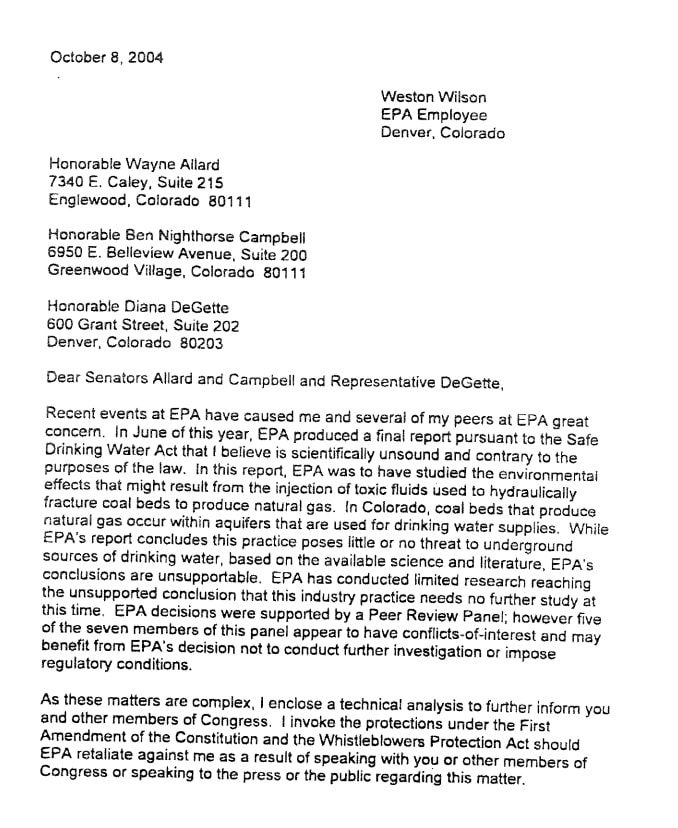
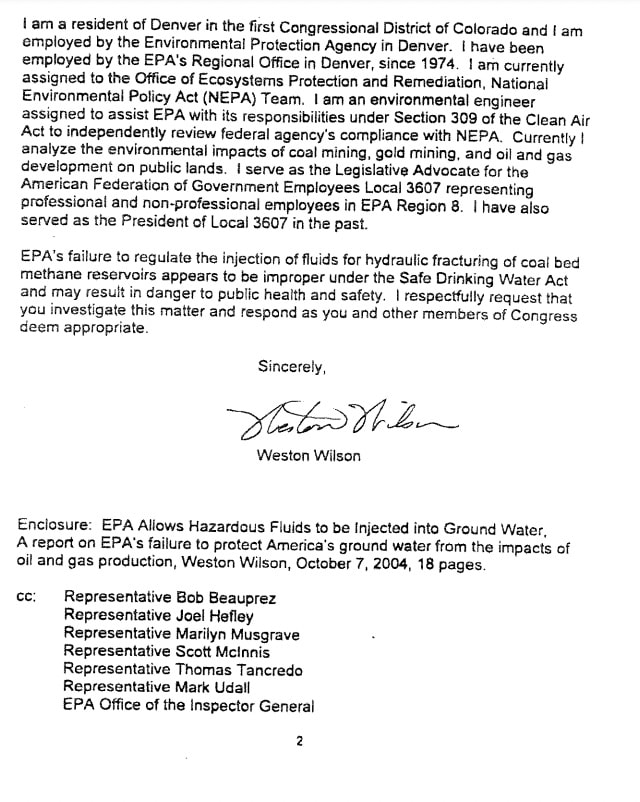
Weston Wilson. Letter written to Senators Allard and Campbell and Representative DeGette ⏳. Denver, Colorado. October 8th, 2004. The U.S. Environmental Protection Agency was criticized by Wilson and others for this Fracking Study which led to the “Halliburton Loophole” of 2005. See New York Times Editorial on Halliburton Loophole . See also the Energy Policy Act of 2005 ⏳.
See also: NYT Editorial. The Halliburton Loophole. 2 Nov 2009. New York Times.
Among the many dubious provisions in the 2005 energy bill was one dubbed the Halliburton loophole, which was inserted at the behest of, you guessed it, then-Vice President Dick Cheney, a former chief executive of Halliburton.
It stripped the Environmental Protection Agency of its authority to regulate a drilling process called hydraulic fracturing. Invented by Halliburton in the 1940s, it involves injecting a mixture of water, sand and chemicals, some of them toxic, into underground rock formations to blast them open and release natural gas.
Hydraulic fracturing has been implicated in a growing number of water pollution cases across the country. It has become especially controversial in New York, where regulators are eager to clear the way for drilling in the New York City watershed, potentially imperiling the city’s water supply. Thankfully, the main company involved has now decided not to go ahead.
The safety of the nation’s water supply should not have to rely on luck or the public relations talents of the oil and gas industry. Thanks in part to two New Yorkers, Representative Maurice Hinchey and Senator Charles Schumer, Congress last week approved a bill that asks the E.P.A. to conduct a new study on the risks of hydraulic fracturing. An agency study in 2004 whitewashed the industry and was dismissed by experts as superficial and politically motivated. This time Congress is demanding “a transparent, peer-reviewed process.”
An even more important bill is waiting in the wings. Cumbersomely named the Fracturing Responsibility and Awareness of Chemicals Act, it would close the loophole and restore the E.P.A.’s rightful authority to regulate hydraulic fracturing. It would also require the oil and gas industry to disclose the chemicals they use.
The industry argues that the chemicals are proprietary secrets and that disclosing them would hurt their competitiveness. It also argues that the process is basically safe and that regulating it would deter domestic production. But if hydraulic fracturing is as safe as the industry says it is, why should it fear regulation?
See also: Debra Anderson. Split Estate. ⏳

In October 2004, Weston Wilson, an environmental engineer and a 32-year veteran of the Environmental Protection Agency, filed a statement seeking whistle-blower protection from Congress. The 18-page statement blew the lid off an EPA study that had concluded that there was no evidence that hydraulic fracturing posed a threat to drinking water.
EPA produced a final report, “… that I believe is scientifically unsound and contrary to the purposes of the law,” Weston Wilson wrote to lawmakers. He went on to argue that the agency review of the safety of the drilling technique did not use established agency standards and relied on a peer review panel dominated by energy industry personnel.
His claims were first reported by the Los Angeles Times and came under review by the EPA’s inspector general until the investigation was dropped and Inspector General Nikki Tinsley, a Clinton appointee, gave her resignation shortly thereafter.
See: Coalbed Methane Development: The Costs and Benefits of an Emerging Energy Resource
See: U.S. Environmental Protection Agency (EPA): Weston Wilson Whistle Blower Letter