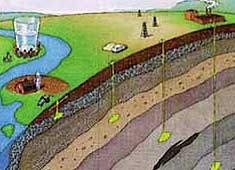
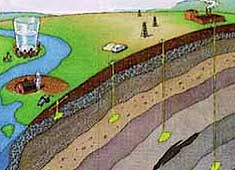
Cynthia Dougherty, U.S. EPA. Hydraulic Fracturing: Applicability of the Safe Drinking Water Act and Clean Water Act. Science Advisory Board Discussion. April 7, 2010. Cynthia Dougherty, Director. Office of Ground Water and Drinking Water, U.S. EPA.
See also: PULS, R. Potential Relationships Between Hydraulic Fracturing and Drinking Water Resources. Presented at The Interstate Oil and Gas Compact Commission Annual Meeting, Lexington, KY, May 23 – 25, 2010.
See also: U.S. EPA Unconventional Oil and Natural Gas Development
Summary Points:
EPA’s central authority to protect drinking water is drawn from the Safe Drinking Water Act (SDWA).
The SDWA requires EPA to set legal limits on the levels of certain contaminants in drinking water.
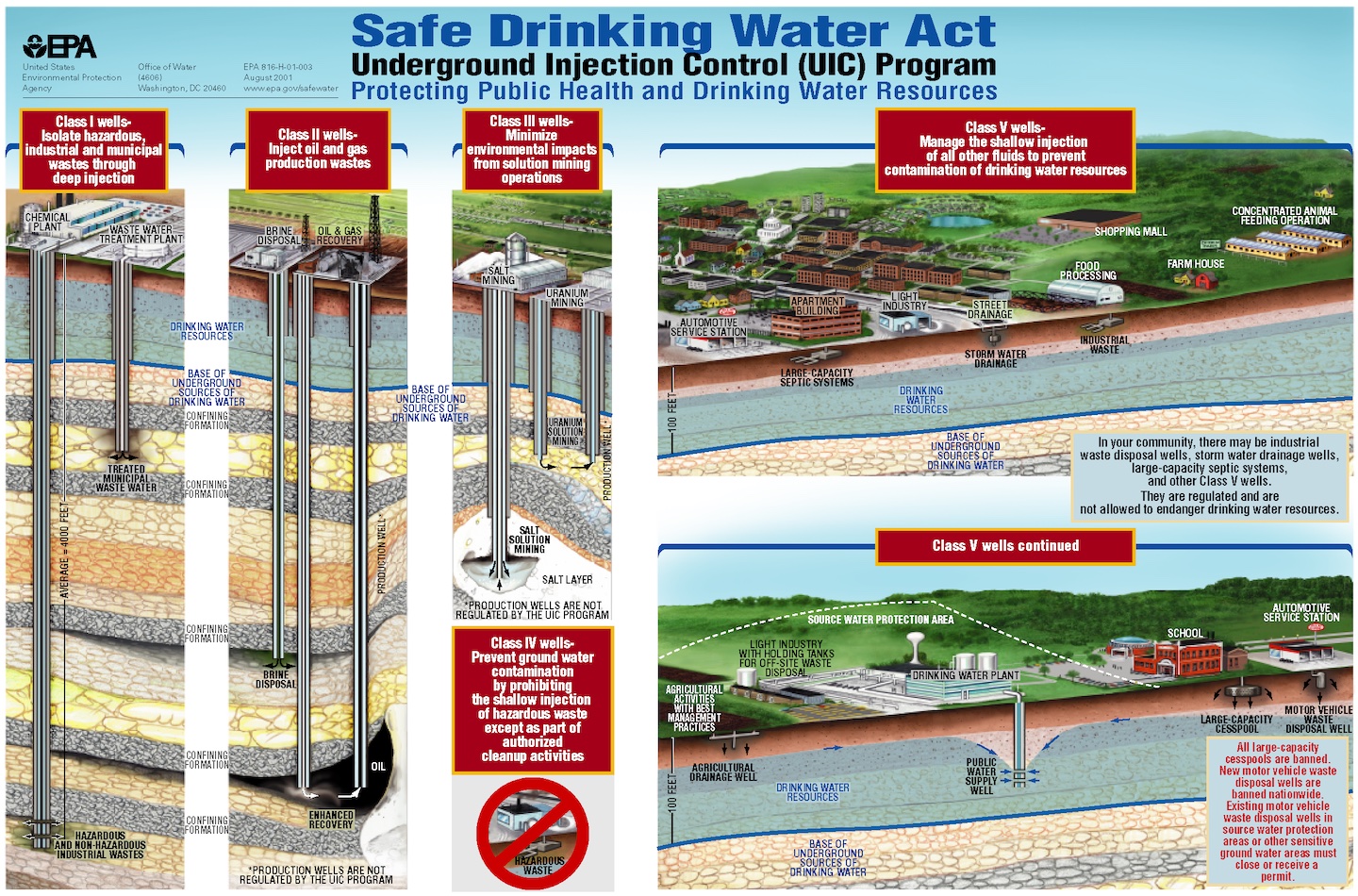
Poster illustrating injection well classes I through V in the U.S. Underground Injection Control program. (Note: Not shown in this poster are Class VI wells, for Geologic Sequestration of CO2, which were authorized by EPA in 2010.)
The Safe Drinking Water Act (SDWA) also requires EPA to protect underground sources of drinking water (USDWs) from contamination caused by underground injection.
- §1421 provides minimum standards for underground injection.
- §1422 provides for state primary enforcement authority.
- §1425 provides for alternative showing of effectiveness of program by state Underground Injection Control (UIC) Programs (Oil and Gas wells only).
- §1431 contains provisions to address imminent and substantial endangerment.
Activities not regulated under Safe Drinking Water Act (SDWA) Provisions for UIC (Sections 1421, 1422, and 1425).
- Oil and gas production activities.
- Hydraulic fracturing (except use of diesel) per 2005 Energy Policy Act.
- Natural gas storage.
States may choose to regulate these activities.
Surface water discharges are regulated under the Clean Water Act (CWA).
.jpg)
See also: Wikipedia. Safe Drinking Water Act
The Safe Drinking Water Act (SDWA) is the principal federal law in the United States intended to ensure safe drinking water for the public.[3] Pursuant to the act, the Environmental Protection Agency (EPA) is required to set standards for drinking water quality and oversee all states, localities, and water suppliers that implement the standards.
The SDWA applies to every public water system (PWS) in the United States.[4] There are currently over 148,000 public water systems providing water to almost all Americans at some time in their lives.[5] The Act does not cover private wells (in 2020, 13% of US households were served by private wells).[6]
…The SDWA can promote environmental justice by increasing the safety of drinking water in the communities most adversely impacted by water contamination.[100] Communities of color and low-income communities are disproportionately impacted by unsafe drinking water and associated health problems in the United States.[101] Specifically, Native American reservations and communities with dense Latino and African American populations are at higher risk of exposure to drinking water contaminants.[102] Contaminants found in the drinking water of such communities include nitrates, coliform, and lead, which have been linked to cancer, reproductive health problems, gastrointestinal illness, and other health problems. One study found that levels of contaminants in the drinking water of two Nebraska Native American reservations were significantly higher than regional contaminant levels.[103] Another study found that Latino residents in Tucson, Arizona, had higher than average levels of contaminants in their drinking water, which were linked to higher rates of cancer and neurological disorders among residents.[104] Also, it is understood that low-income residents in the Appalachian region of West Virginia are disproportionately exposed to contaminants in drinking water from coal mining in the region.[105]
In addressing the updated priorities associated with the act, EPA states that its first priority is to “promote equity… in disadvantaged, small, and environmental justice communities,” specifically addressing that disadvantaged communities face disproportionate risks associated with exposure to contaminated drinking water.[100]
Wikipedia. Safe Drinking Water Act
See also: Safe drinking water is a right. NRCDflix. 9 Dec 2020. YouTube.
See: U.S. EPA Water Enforcement
See: What broke the Safe Drinking Water Act?
See: Buried Secrets: Is Natural Gas Drilling Endangering U.S. Water Supplies?
See: Coalbed Methane Development: The Costs and Benefits of an Emerging Energy Resource
See: Expert Testimony on Hydraulic Fracturing Impacts
See: Under the surface : fracking, fortunes and the fate of the Marcellus Shale
See: Model validation : perspectives in hydrological science
See: Fueling Washington
See: The Next Drilling Disaster?
See: Natural Gas Industry Shills Use the Media to Mislead the Public – Here’s How to Spot Them
See: This Website is a Crash Course In Fracking
See: Affirming Gasland
See: U.S. Environmental Protection Agency (EPA): Weston Wilson Whistle Blower Letter
See: NETL: Secure & Reliable Energy Supplies
See: EPA Findings on Hydraulic Fracturing Deemed “Unsupportable”
See: Coalbed Methane Development: The Costs and Benefits of an Emerging Energy Resource
See: Underground Injection of Gas Industry Brine Taking Off – State Journal – STATEJOURNAL.com