

Bryner, Gary C. “Coalbed methane development: the costs and benefits of an emerging energy resource.” Natural Resources Journal (2003): 519-560.
Coalbed methane has rapidly become an important source of natural gas, particularly in the Inter-mountain West. The rapidity of its development has resulted in significant pressure on communities to deal with its environmental consequences.
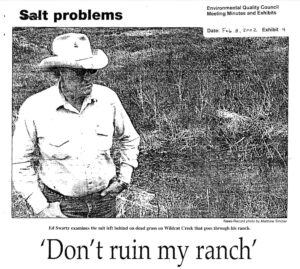
Coalbed methane production often results in large quantities of water that are released as byproducts of production; in some cases, the water may inundate sensitive arid ecosystems, worsen surface water quality, and diminish undergroundwater supplies.
Noise, dust, and increased traffic; impairment of visibility and conflicts with recreation and other land use; impacts on wildlife and ecosystems; and other consequences of development have generated opposition in many communities.
Particularly vexing has been development on split estates, where surface owners do not own the mineral rights underneath their property and are required to cooperate with development that may disrupt the use and control of their land. This article examines the problems associated with coalbed methane development and offers a variety of suggestions for how conflicts could be reduced and how development could proceed in ways that are ecologically sustainable.
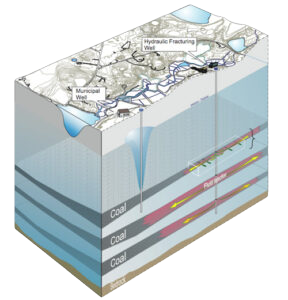
See also: Hydraulic Fracturing Background Information | EPA (2004)
The Energy Policy Act passed by Congress in 2005 amended the Hydraulic Fracturing Applicability of the Safe Drinking Water Act and Clean Water Act Science Advisory Board Discussion to exclude hydraulic fracturing fluids (except diesel fuel) related to energy production from regulation under the UIC program. States may choose to regulate hydraulic fracturing, however.
See also: Black Warrior Riverkeeper | Coalbed Methane
There are over four thousand coalbed methane wells in the Black Warrior River watershed. Tens of thousands of acres are leased to this practice, creating a massive network of roads and well pads. The extraction of coalbed methane involves a process known as hydraulic fracturing.
The Black River Watershed in Alabama provides water to over a million people.
See also: Orion Magazine. Web Special: Coalbed Methane Mining. November/December 2006. Taking On Goliath: Across the West, gas development is devastating land and people. | Now citizens are fighting back.
Taking On Goliath
Across the West, gas development is devastating land and people.
Now citizens are fighting back.
Since the late 1990s, a wave of energy exploitation has accelerated across the American West. Much of it has taken the form of coal bed methane (CBM) development, which entails drilling many shallow, closely spaced gas wells across often vast territories, bringing industrialization to country that formerly was open and quiet, and to the people and creatures who live there.
Please read the Orion articles, delve into the issue with information provided here, and share your comments, ideas, and thoughts on America’s appetite for energy.
See also: Rebecca Clarren. Photographs by Christopher Lamarca. Voices from the Gas Fields. Dec 2006. Orion Magazine.
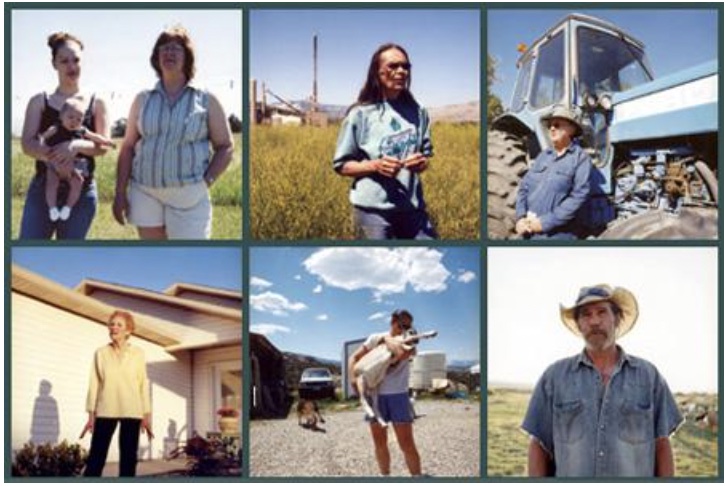
For residents of a western valley, methane gas development has meant uncertainly, doubt, and dragging fear
WHEN THE LIGHT OF EARLY morning shines on the red-ribboned mesas of western Colorado’s Garfield County, and the Colorado River shimmers like a silver snake on the move, it’s easy to see why the rural people who live here say they cling to this place. Then the light catches one of the hundreds of gas wells newly set upon the land, intimating a more complex story.
Deep underneath the county’s dry sagebrush plateaus and irrigated farmland—and 250 miles north of Aztec, New Mexico—lies the Piceance (pronounced pee-awnce) Basin, home to an estimated 40 trillion cubic feet or more of recoverable natural gas, sandwiched between layers of sandstone and coal. Running beneath a quarter of the county’s 1.9 million acres, the basin rolls west off the Rocky Mountains down to the desert country of northwestern Colorado. One of America’s richest sources of natural gas, the Piceance holds enough gas to power the nation at current consumption rates for around two years. As the price of methane—a primary component of natural gas—has quadrupled in recent years, energy companies have sprinted here to drill rock and capture gas.
There are more than 3,200 gas wells in Garfield County, most drilled in the last five years; in the next eight years, gas companies pursuing coal bed methane and other forms of natural gas plan to drill 10,000 more. Drill rigs rising 75 feet into the sky dot the craggy edges of mesas and the wide valleys that ring once quiet towns with names like Rifle and Silt. Miles of new roads crisscross the land. Three-acre dirt pads that hold condensate tanks, sumps, and wells carve brown scars into the green sloping hillsides. Straight, three-hundred-foot-wide swaths cleared of juniper and aspen trees indicate where underground pipelines carry gas as far as California. Garfield County officials don’t even know how many miles of new roads and gas pipeline exist in the area, so quickly have they been laid.
Garfield County is a microcosm of a natural gas boom exploding throughout the country. The Bush administration says that finding energy at home is critical to reducing foreign imports and ensuring national security; last year, state and federal agencies throughout the country issued 36,827 gas well drilling permits, a 78 percent increase from 2002. To date, drilling companies have leased 36 million acres of federal public land, encompassing 88 percent of known natural gas reserves.
Rebecca Clarren. Photographs by Christopher Lamarca. Voices from the Gas Fields. Dec 2006. Orion Magazine.
See: Powder River Basin Resource Council
See: SkyTruth: Upper Green River Valley – A View From Above
See: Fracking and the Environment: Natural Gas Drilling, Hydraulic Fracturing and Water Contamination
See: Western Organization of Resource Councils (WORC)
See: Bushwhacked : Life in George W. Bush’s America
See: PBS | Need to Know
See: Addressing the Environmental Risks from Shale Gas Development
See: Drilling Around the Law: Drinking Water Threatened by Toxic Natural Gas and Oil Drilling Chemicals
See: U.S. Environmental Protection Agency (EPA): Weston Wilson Whistle Blower Letter