
The American Petroleum Institute (API) is the largest U.S. trade association for the oil and natural gas industry. It claims to represent nearly 600 corporations involved in production, refinement, distribution, and many other aspects of the petroleum industry.
It has advanced climate change denial and blocking of climate legislation to defend the interests of its constituent organizations.[4][5]
The association describes its mission as “to promote safety across the industry globally and influence public policy in support of a strong, viable U.S. oil and natural gas industry“.[6] API’s chief functions on behalf of the industry include advocacy, negotiation and lobbying with governmental, legal, and regulatory agencies; research into economic, toxicological, and environmental effects; establishment and certification of industry standards; and education outreach.[7] API both funds and conducts research related to many aspects of the petroleum industry.[7][8]
Public Relations and Lobbying
API spent more than $3 million annually during the period 2005 to 2009 on lobbying; $3.6 million in 2009.[17] As of 2009, according to API’s quarterly “Lobbying Report” submitted to the U.S. Senate, the organization had 16 lobbyists lobbying Congress.[18] According to an investigation conducted by the International Business Times, API lobbied the Department of State for all of 2009 on “legislative efforts concerning oil sands” and “Canadian Oil Sands.”[19]
The American Petroleum Institute also lobbied the State Department every quarter in 2009. In three of four quarters, the group listed “legislative efforts concerning oil sands” as one of the areas it was focusing on in its lobbying, and in the final quarter, it listed “Canadian Oil Sands.” Among API’s members are ExxonMobil, which has invested in Canadian oil sands.
Source: Wikipedia article on American Petroleum Institute
Editor’s Note ( Jul 2022): The American Petroleum Institute (API) lobbies for itself and its itself and over 600 corporations they represent with annual revenues in 2013 of $238,520,840. Here, we look at some of the advertising.
The links originally listed in the American Petroleum Institute article on Fracking Resource guide can no longer be sourced on the internet. These next 2 links have aged out. This happens to all links on the Web over time. The links below, I discovered in review, no longer worked.
Here is the video, Benefits, from the American Petroleum Institute, 2009.
“The American Petroleum Institute (API) is the only national trade association that represents all aspects of America’s oil and natural gas industry. Our nearly 400 corporate members, from the largest major oil company to the smallest of independents, come from all segments of the industry. They are producers, refiners, suppliers, pipeline operators and marine transporters, as well as service and supply companies that support all segments of the industry.”
PR Newswire, 2010
See also: American Petroleum Institute Multimedia Content
See also: Archived version of American Petroleum Institute’s Multimedia Content, 23 Nov 2010.
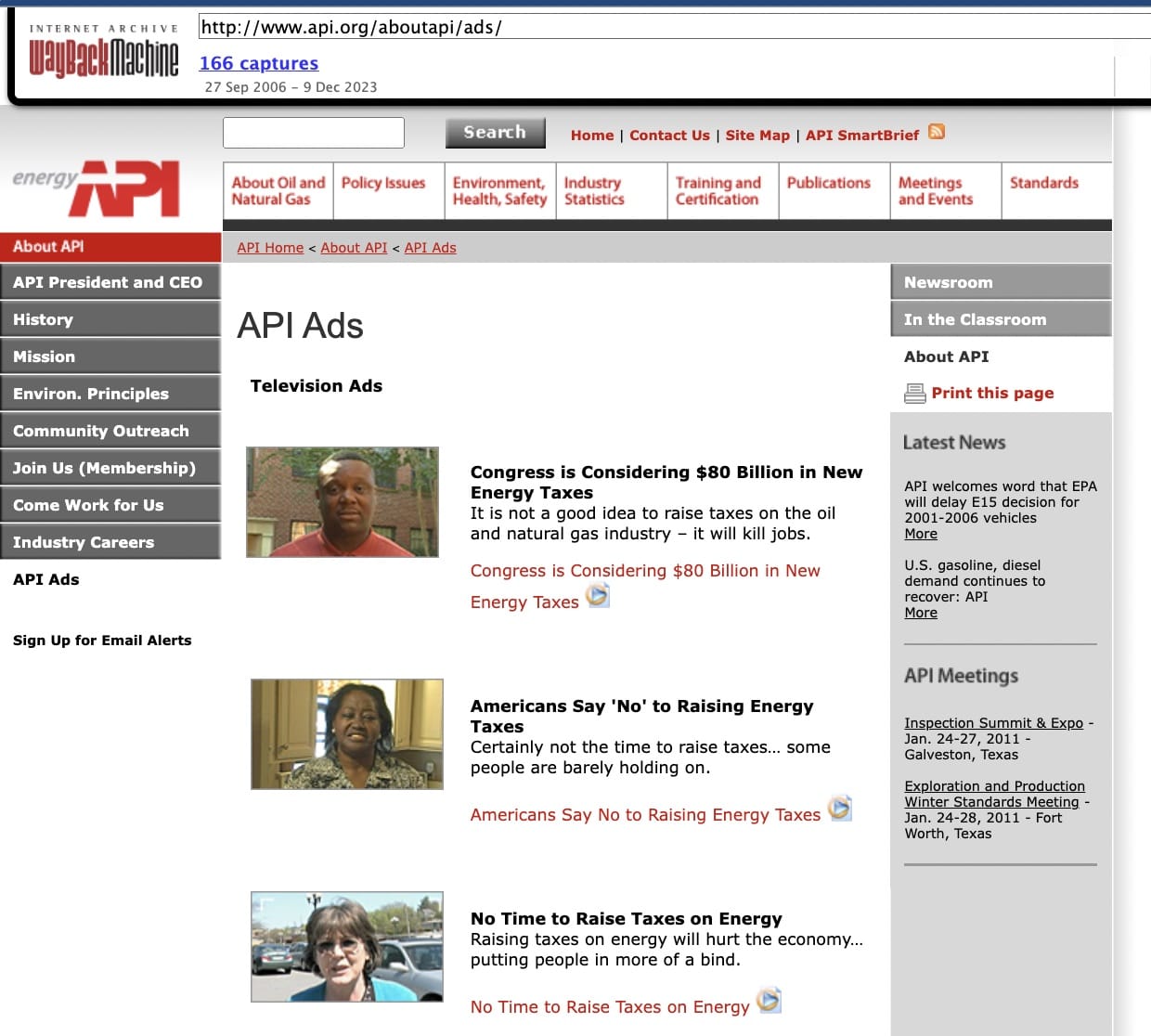
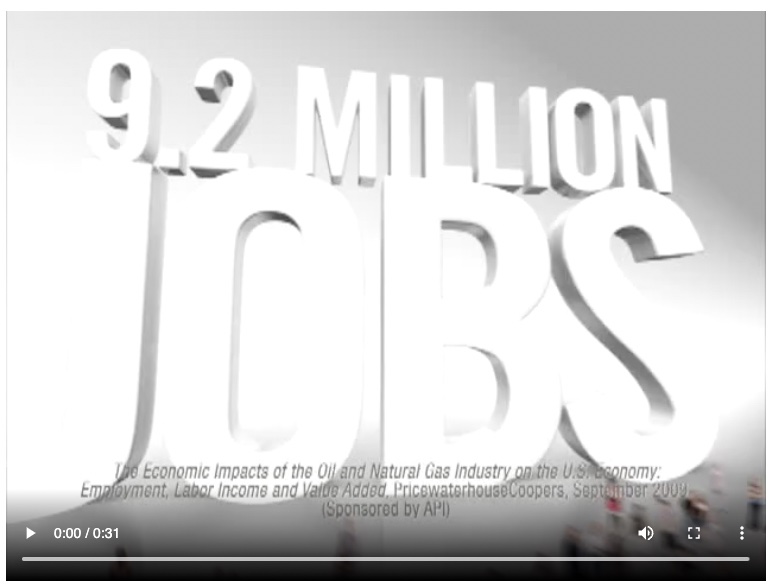
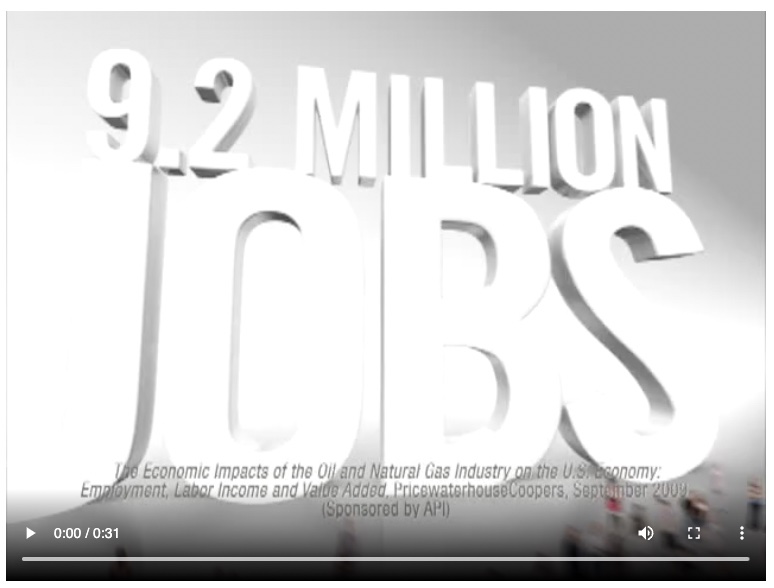
In 2009, API produced a number of TV Ads touting the jobs benefits of the Oil and Gas Industry.
See also: Mark Green. Good News Friday: Energy Jobs, Energy Revenues. 20 May 2011. American Petroleum Institute.
Sometimes it seems like the only news is bad news, but let’s take a moment to focus on the positive. The good news is the oil and natural gas industry is making life better in communities around the country. Here’s a sampling:
The Observer in Dunkirk, N.Y., has an op-ed column by Petro Enterprises CEO David W. Keefe, noting the positive impact of Marcellus shale gas exploration and development. Keefe writes:
(Marcellus) is estimated to contain up to 500 trillion cubic feet of natural gas, making it, potentially, the second-largest gas field in the world. New York’s portion of those reserves could be as much as 50 trillion cubic feet. Drilling the Marcellus in Pennsylvania during a two year period ending in 2010 created 44,000 jobs. Similar performance is expected in New York with the addition of $11.4 billion to the New York economy over the next ten years if development is allowed to take place.
Mark Green. Good News Friday: Energy Jobs, Energy Revenues. 20 May 2011. American Petroleum Institute.
API claims in multiple ad campaigns: “Increased production of oil and natural gas can help rebuild America’s economy by creating new jobs and generating more than $1 trillion for federal, state and local budgets.
America’s Oil and Natural Gas Industry Supports Over 9 Million Jobs
Editor’s Note: Let’s check the facts. The costs of spill clean-up, global warming, and devastated marine ecosystems remain undocumented.
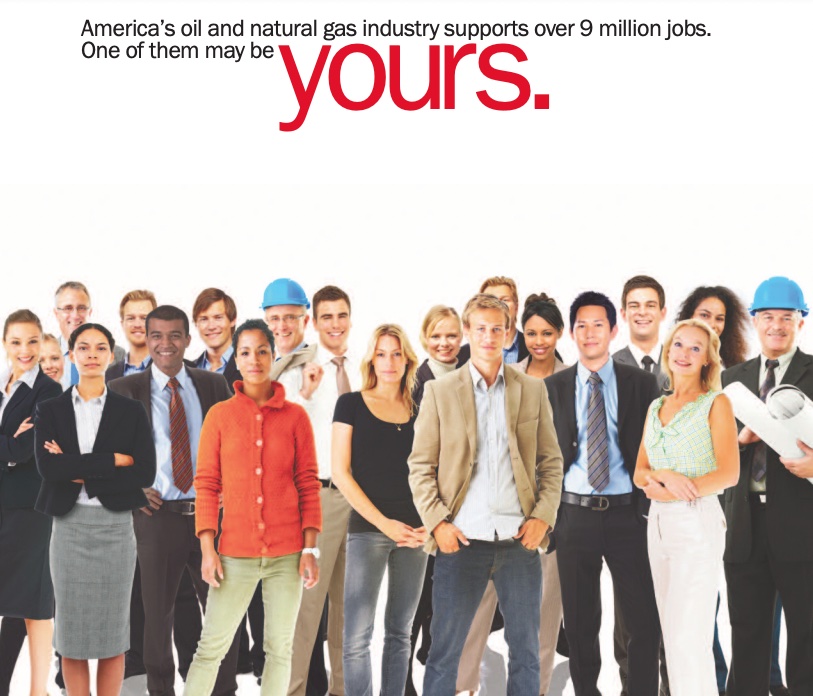
Everyone is touched by America’s oil and natural gas industry. How so? Farmers use fertilizer made from natural gas. Truckers use diesel fuel to ship goods to market. And businesses rely on oil and natural gas to make and sell their products and provide their services. If you buy a loaf of bread, purchase a new electronic gadget, or drive a car, consider yourself a part of the oil and natural gas industry. From airline pilots to welders, and every job in between, we’ve all got a stake in our energy future.”
I got to their old videos list on the WayBack Machine by archive.org:
https://web.archive.org/web/*/http://api.org/aboutapi/ads/upload/*
See also this archved link: Put America to Work. (2009). Scroll down and roll over the interactive U.S. map and click on any state to read the same copy with plug-in paragraphs state by state.
You can see the rise in employment in the energy sector in 2012:
U.S. Energy Information Administration. Oil and gas industry employment growing much faster than total private sector employment. 8 Aug 2013. U.S. Energy Information Administration.
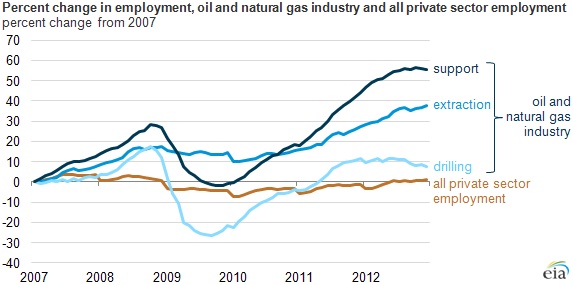
Note: Total private sector employment is non-government employment, as derived from the Quarterly Census of Employment and Wages.
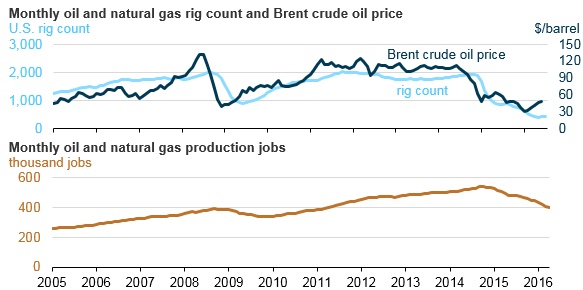
See also to compare: U.S. Energy Information Administration. Oil and natural gas production jobs in May were 26% lower than in October 2014. 5 Aug 2016. U.S. Energy Information Administration.
Now let’s have a look at 2002 statistics. Just fact checking claims about jobs made by API that continue today.
All employees, thousands, oil and gas extraction, seasonally adjusted from the U.S. Bureau of Labor Statistics:
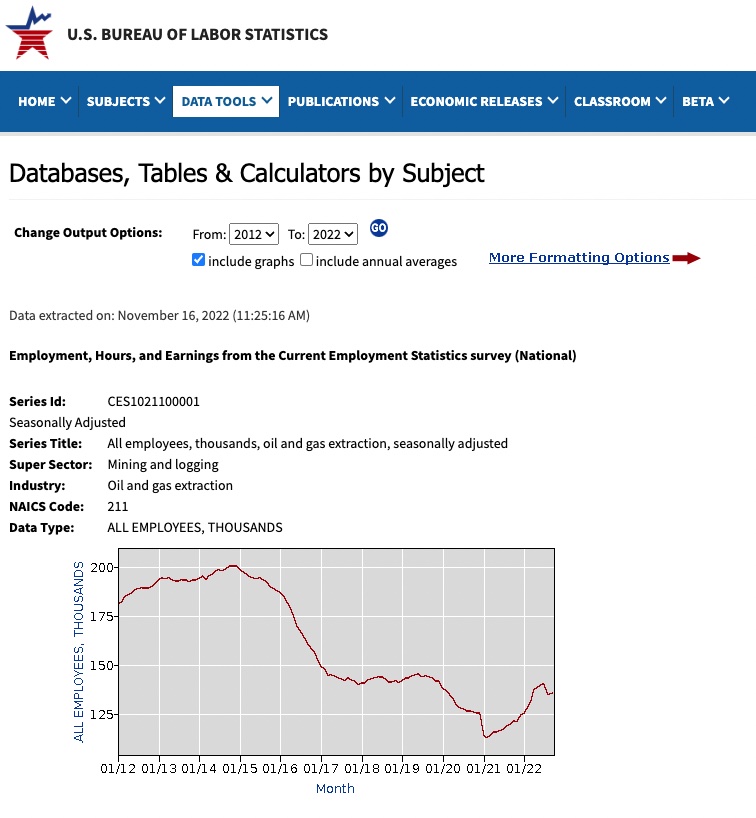
A far cry from the promised 9 million jobs.
James Gerken wrote this satiric take on API at the (archived link) Huffington Post in 2012:
James Gerken. ‘I Vote 4 Energy’ Video Spoofs American Petroleum Institute Ad Campaign (VIDEO). 5 Jan 2012. Huffington Post.
Will you vote 4 energy? A new Greenpeace video spoof suggests citizens should think twice about the latest ad campaign from the American Petroleum Institute (API).
The Greenpeace video, seen below, takes aim at the API’s recently announced “Vote4Energy“ campaign. API President and CEO Jack Gerard announced this week that his group intends to spend “significant” amounts of money to promote discussion and debate over energy and oil policy issues.
While the API claims its campaign will not go so far as to endorse any candidate, the organization maintains a strong stance on issues important to the oil and natural gas industries. In his “State of American Energy” speech this week, Gerard said it would be a “huge mistake” with “huge electoral consequences” for President Obama to reject the Keystone XL pipeline.
Gerard and the API also emphasize the possibility of future American prosperity through increased domestic fossil fuel production. They highlight revenue and job creation potential from lifting restrictions on offshore drilling and oil production on protected government lands, according to AOL Energy.
With its parody ad, Greenpeace hopes to challenge the API’s priorities. Greenpeace Research Director Kert Davies said in a press release, “As Big Oil’s top lobbying group, the American Petroleum Institute has repeatedly spent millions to block clean energy solutions and fake grassroots support for Big Oil. Meanwhile, taxpayers are forced to pay large handouts to the oil industry, the most profitable industry on Earth.”
He added, “The American Petroleum Institute’s Vote4Energy astroturf commercial encourages voters to continue welfare payments to Big Oil for dirty energy projects.”
Last month, a Greenpeace activist infiltrated the API’s “Vote4Energy” commercial shoot and rallied against the oil industry and the API campaign while on camera. Connor Gibson’s audio recordings of the event suggest that the “Energy Citizens“ who were cast for the commercial to give their own views on energy policy were actually put in costume and “fed lines by a director,” reported Yahoo! News.
The American Petroleum Institute’s original “Vote4Energy” television commercial can be seen on the organization’s website. For more information about Greenpeace’s anti-API campaign, visit their parody website vote-4-energy.org.
James Gerken. ‘I Vote 4 Energy’ Video Spoofs American Petroleum Institute Ad Campaign (VIDEO). 5 Jan 2012. Huffington Post.
See also: Andy Rowell. Bad Data and Deception: The American Petroleum Institute Pivots on Methane. 22 Apr 2021. Oil Change International.
A detailed analysis by Oil Change International of the public statements and commitments by the American Petroleum Institute (API) around methane emissions and climate change has uncovered a decade of spurious data, deceptive messaging, and disingenuous public positioning by the big oil spin doctors.
- API Messaging During the Obama Administration (2011-2016)
- API Messaging During the Trump Administration (2017-2020)
- API Messaging During the Biden Administration (2021)
- Major Peer-Reviewed Studies Show Methane from Oil and Gas is Rising
Over the last decade, the API has shifted from being vehemently anti-Obama to passionately pro-Trump, before swiveling 180-degrees to demand a seat at Joe Biden’s climate change policy table.
Andy Rowell. Bad Data and Deception: The American Petroleum Institute Pivots on Methane. 22 Apr 2021. Oil Change International.
Willie Soon
In February 2015, it was revealed that climate skeptic Willie Soon had been paid by several fossil fuel interest groups.[35] Over the course of 14 years, he had received a total of $1.25m from Exxon Mobil, Southern Company, the American Petroleum Institute (API) and a foundation run by the ultra-conservative Koch brothers, the documents obtained by Greenpeace show.[36] The scientist described his studies to fossil fuel executives as “deliverables”, and permitted anonymous pre-publication reviews.[37] Soon advanced the widely discredited theory that changes in solar activity are to blame for climate change, and called into question the severity and extent of climate change in all his studies, never revealing his backers.[37]
From the API website in 2010: “The American Petroleum Institute (API) is the only national trade association that represents all aspects of America’s oil and natural gas industry. Our nearly 400 corporate members, from the largest major oil company to the smallest of independents, come from all segments of the industry. They are producers, refiners, suppliers, pipeline operators and marine transporters, as well as service and supply companies that support all segments of the industry.”
Wikipedia article on American Petroleum Institute
See: EPA Findings on Hydraulic Fracturing Deemed “Unsupportable”
See: Ceres Principles – Corporate Environmental Conduct
See: Coalbed Methane Development: The Costs and Benefits of an Emerging Energy Resource
See: Energy & Commerce Committee Investigates Potential Impacts of Hydraulic Fracturing
See: U.S. Speaker Nancy Pelosi: The Gavel: Draining The Swamp
See: Natural gas: the commodity world’s ugly duckling
See: Natural Gas Industry Shills Use the Media to Mislead the Public – Here’s How to Spot Them
See: Fueling Washington
See: Chevron Human Energy Stories | Addressing Climate Change
See: Halliburton
See: BJ Services
See: Schlumberger
See: BP Deepwater Horizon Committee Hears From Oil Industry Executives
See: Exxon-Xto Deal Forces Congress to Reconsider Natural Gas
See: National Commission on the BP Deepwater Horizon Oil Spill and Offshore Drilling
See: Affirming Gasland
See: This Website is a Crash Course In Fracking
See: Hydraulic Fracturing: History of an Enduring Technology
See: What The Frack? Gas Industry’s Multimillion-Dollar Campaign Demonizes Hydraulic Fracturing Bill