Earthworks. Hydraulic Fracturing 101: An overview of the fracking process and the issues and impacts related to this oil and gas extraction process.
(Editor’s Note: 25 Dec 2023. Updated)
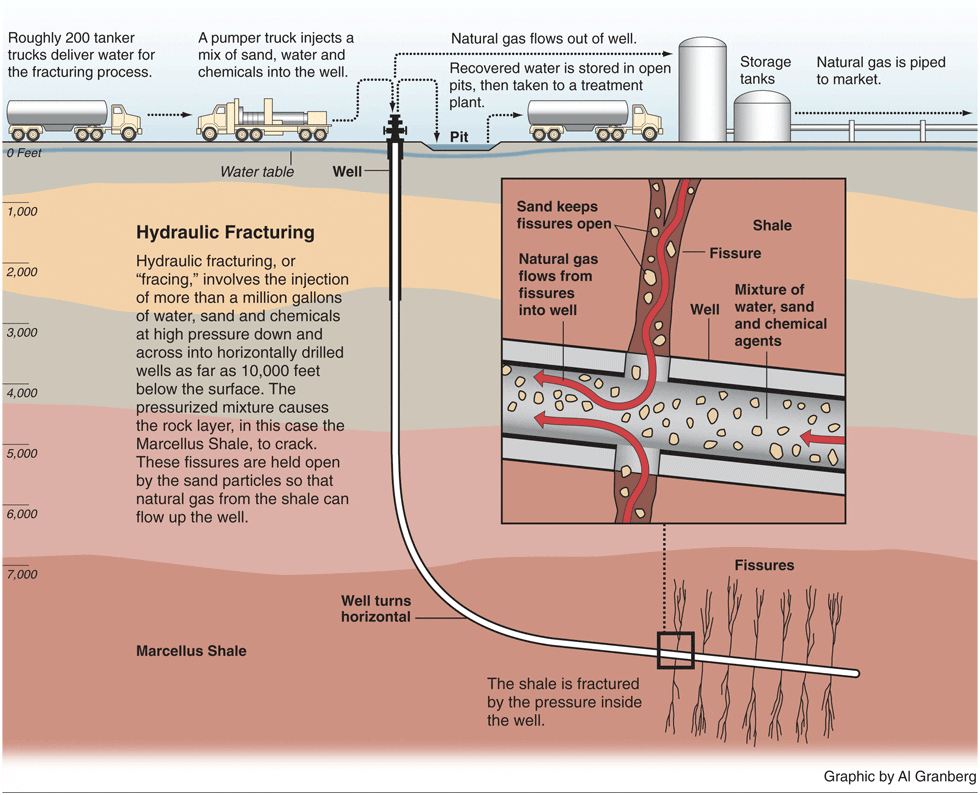
Hydraulic fracturing is a common technique used to stimulate the production of oil and natural gas. Typically, fluids are injected underground at high pressures, the formations fracture, and the oil or gas flows more freely out of the formation. Some of the injected fluids remain trapped underground.
A number of these fluids, such as diesel fuel, qualify as hazardous materials and carcinogens, and are toxic enough to contaminate groundwater resources. Read more details in the Oil and Gas Accontability Project’s (OGAP) basic primer on hydraulic fracturing.
Since 1988, Earthworks has helped communities secure protections of their health, land, water, and air from extractive industries. We are the only national organization in the U.S. to focus exclusively on preventing the destructive impacts of the extraction of oil, gas, and minerals.
Earthworks has won many fights to protect communities, air and water since 1999. Our successes are driven by our commitment to collaboration, putting frontline communities first, using science in new ways and building people power. With our ears to the ground, time and time again, Earthworks has demonstrated the strategic foresight to move us toward a more just and liveable future.
Earthworks Successes
We use innovative science to protect public health. Earthworks was the first organization to deploy optical gas imaging cameras to expose oil and gas methane pollution. Because of our work, methane gas is now exposed as a dangerous fossil fuel that threatens our climate and health.
We have a track record of opposing false corporate solutions and greenwashing. In 2021, we led efforts, along with Global Witness and Greenpeace, in filing the first ever Federal Trade Commission (FTC) complaint against Chevron for misleading consumers through greenwashing.
We help local advocates build their power. Since January, 2020, we’ve helped the Permian Gulf Coast Coalition raise and award over $100,000 for 29 grants to grassroots groups and frontline leaders.
We stand alongside indigenous communities in the U.S. and abroad. We joined Peruvian farmer Máxima Acuña de Chaupe, a Goldman Environmental Prize winner, to protest Newmont Mining’s human rights violations and secure indefinite suspension of plans to construct the Conga mine.
We organize people-powered movements. Our No Dirty Gold campaign enlisted more than 100,000 consumers and 120 jewelry retailers representing nearly 25 percent of the U.S. market to sign on to our Golden Rules for responsible mineral sourcing.
We hold firm to a red line on dangerous hard rock mining. Not one of the hardrock mines we’ve opposed in the past decade has advanced in its permitting process and we’ve always been an unabashed advocate for mining law reform.
Earthworks Successes
See more actions taken by Earthworks:
- Threats to water quality
- Inadequate regulation of hydraulic fracturing (including the Halliburton loophole)
- Hydraulic fracturing 101
- More facts, news, other information
See also: Amy Goodman and Juan Gonzalez. Fracking and the Environment: Natural Gas Drilling, Hydraulic Fracturing and Water Contamination. 3 Sep 2009. Democracy Now!
Video contains an interview with ProPublica’s Abrahm Lustgarten.
JUAN GONZALEZ: We turn now to another story about water. New evidence has emerged possibly linking natural gas drilling to groundwater contamination. ProPublica reports federal officials in Wyoming have found that at least three water wells contain chemicals used in the natural gas drilling process of hydraulic fracturing.
The Wyoming study marks the first time the Environmental Protection Agency has undertaken its own water analysis in response to complaints of contamination in drilling areas. Residents in Pavillion, Wyoming, have complained for years that their water wells turned sour and reeked of fuel vapors shortly after drilling took place nearby.
ProPublica reports precise details about the nature and cause of the contamination have been difficult for scientists to collect, in part because the identity of the chemicals used by the gas industry for drilling and fracturing are protected as trade secrets.
AMY GOODMAN: Gas drilling companies, such as Halliburton, say the gas drilling technique known as hydraulic fracturing, or “fracking,” is safe, but opponents contend it pollutes groundwater with dangerous substances. Here in New York, many politicians and residents have expressed concern that natural gas drilling in upstate and in Pennsylvania could contaminate New York City’s drinking water supplies.
In a moment, we’ll be joined by reporter Abrahm Lustgarten of ProPublica, who has been closely tracking this story. But first we want to play an excerpt from a new documentary called Split Estate by Debra Anderson. The documentary examines the impact the oil and gas drilling boom has had in the Rocky Mountain West. This part deals with Garfield County, Colorado.
AMY GOODMAN: An excerpt from the documentary Split Estate by Debra Anderson. When we come back from break, we’ll be joined by a reporter who has been investigating the issue of fracking around the country and the pollution of the nation’s water supply. Stay with us.
AMY GOODMAN: We’re joined by Abrahm Lustgarten, covers issues around natural gas drilling for ProPublica. Juan?
JUAN GONZALEZ: Well, Abrahm, tell us first, how does this fracking actually work?
ABRAHM LUSTGARTEN: It’s used to extract oil and gas both, very deep underground, in some cases, 10,000 feet or 13,000 feet underground. And in the current exploration plays, we’re looking at tight sands, or shale, that hold the gas in tiny little bubbles, and it can’t really flow freely. So the oil and gas industry will drill a well, and they’ll pump down millions of gallons of liquid, which is sand and water and then these chemicals that I’ve been looking at. And they’ll pump it down under thousands of pounds of pressure to essentially fracture and break up, obliterate, the rock underneath and let the gas flow back out and come back up to the surface.
JUAN GONZALEZ: And the chemicals that are involved that you say you’ve been investigating?
ABRAHM LUSTGARTEN: Yeah, it’s very difficult to know exactly what they are. At this point, the industry has released partial lists. They say that they’re mostly complete, but they won’t go on the record and say that it represents every single chemical that they’ve used. In the past, it’s included diesel fuel. That’s been phased out to rely more on methanol. And then there are a number of soaps and surfactants and lubricants and all sorts of things that they use to essentially engineer the viscosity of the fluid. They want it to go down into the hole as a fairly thick substance and then, you know, on command, they want it to release and get out of the way, so the gas can flow right back up past it. And it’s chemicals that does all of that.
JUAN GONZALEZ: So, in essence, the chemicals then — the residuals then flow into whatever groundwater supply may be in the region, right?
ABRAHM LUSTGARTEN: Well, that’s what’s been very difficult to know. Records are not kept about what amount of fluid and chemicals is taken back out of the well, not in any state where drilling is allowed in the United States. There are geologists who are quite concerned about how far these chemicals and these fluids can travel underground. And then there are these numerous correlative instances of contamination across the country. And until now, it’s been very, very difficult to know whether it’s the actual fracturing process that’s caused this contamination or something else. And it’s partially because there’s so much secrecy around the fracturing process itself.
AMY GOODMAN: Tell us about the main areas affected in the country.
ABRAHM LUSTGARTEN: Well, it’s almost everywhere you look where there’s drilling. There’s drilling in thirty-one states. Drilling has been happening in Wyoming and Colorado for many years. Probably the most intensive development in the country, at least in the early stages, was there. And that’s where you’ve begun to see quite a bit of problems with the water. And these are largely due to spills sometimes or waste streams that are leaked out into the soil and get into water supplies. And sometimes it’s completely mysterious. The documentary clip showed a woman whose well exploded the same day or within a few days of this intensive pressure being pumped into the ground nearby, which implies some kind of geological connection. There have been problems with water in New Mexico, in Wyoming, in Louisiana, in New York, in Pennsylvania.
AMY GOODMAN: The latest Wyoming EPA study?
ABRAHM LUSTGARTEN: In Pavillion, Wyoming, where some of these earliest complaints originated, the EPA has just earlier this year undertaken, for the first time, a real investigation into what’s happening with the water there. They didn’t go in to investigate the gas industry or hydraulic fracturing, but it is the first time that they’ve actually decided that they would test water in response to complaints about water. And they’ve gone in and tested for the broadest array of pollutants with as much objectivity as they could muster. They’ve looked for pesticides and agricultural influences and any other influence on the water supply.
And EPA folks tell me that they’re quite surprised, but what they found in their preliminary reports — and they’re not finished with this study, but they found a couple substances that seem to be linked to gas drilling, and one of them is a substance called 2-butoxyethanol that is used — not exclusively, but is used — in hydraulic fracturing. And it’s also found in some cleaning supplies and some things we use around the house. But it appears to be, at this point, a strong circumstantial link to hydraulic fracturing.
JUAN GONZALEZ: And what are the main companies that are involved in this drilling?
ABRAHM LUSTGARTEN: Well, the industry works in a funny kind of way, depending on multiple tiers of contractors. So it’s all the big oil companies, whether it’s Chesapeake or Shell or Chevron. And then they rely on service companies to do the hydraulic fracturing itself, and that industry is controlled by three large players: Halliburton is one, BJ Services and Schlumberger, the French giant.
AMY GOODMAN: Can you talk about how the energy industry swayed Congress, and the Safe Drinking [Water] Act, how fracking got exempted?
ABRAHM LUSTGARTEN: Yeah, this is politically the most controversial point. In the early days of the George W. Bush administration, Dick Cheney’s energy task force identified hydraulic fracturing as a very important part of the natural gas industry and the ability to develop that industry. And within a year or two after that, there was a proposal put forth to exempt the hydraulic fracturing process from the Safe Drinking Water Act, which is the nation’s premier, you know, water protection law.
It’s not clear that, before that, the EPA was enforcing hydraulic fracturing or was looking at it under this act. And in some cases they weren’t, but they clearly had the authority to do so. And this law took away their opportunity to even decide that this was an issue worthy of EPA investigation.
AMY GOODMAN: I want to play an excerpt again from Split Estate. Filmmaker Debra Anderson interviews Weston Wilson, an environmental engineer in the EPA’s Denver office. In 2004, Wilson openly questioned an EPA study that declared fracking “poses little or no threat” to drinking water.
AMY GOODMAN: EPA’s Weston Wilson. Your response, Abrahm?
ABRAHM LUSTGARTEN: Well, the EPA did undertake that study in 2004, and it’s been highly criticized by Wes Wilson and numerous other scientists who work very directly with these issues. In Colorado, the EPA essentially undertook a survey at that time. They went and heard some of the complaints from residents that their water was bad. They went and asked state regulatory agencies whether they’d seen contamination, and those regulatory agencies said, “Yeah, for the most part, no, we haven’t.” And the EPA, despite its scientific judgment that there was a potential risk to groundwater supplies, which their report clearly says, then went ahead and very surprisingly concluded that there was no risk to groundwater, unless you read deeper into that report.
And part of my reporting found that throughout that process the EPA was closer than seemed comfortable with the industry. I filed FOIA requests for some documents and found conversations between Halliburton employees and the EPA researchers, essentially asking for an agreement from Halliburton in exchange for more lax enforcement. The EPA, in these documents, appeared to offer that and agree to that. And it doesn’t appear, by any means, to have been either a thorough or a very objective study. And that’s why what’s happening in Wyoming now is so significant, because it’s really a change of course for the EPA on this issue.
JUAN GONZALEZ: And the head of the EPA then was Christie Todd Whitman, wasn’t it?
ABRAHM LUSTGARTEN: It was, yeah.
AMY GOODMAN: Well, we’re going to leave it there, but we will continue to follow your reporting, very important for the health of this country. Abrahm Lustgarten, reporter for the investigative news website ProPublica, has been covering the issue very closely around the country, the issue of fracking.
Amy Goodman and Juan Gonzalez. Fracking and the Environment: Natural Gas Drilling, Hydraulic Fracturing and Water Contamination. 3 Sep 2009. Democracy Now!
See: Oil & Gas Accountability Project (OGAP)
See: Schlumberger
See: Halliburton
See: Chevron Human Energy Stories | Addressing Climate Change
See: BJ Services
See: Superior Well Services – Products – Fracturing Systems
See: Universal Well Services, Inc.
See: Sanjel Corporation
See: Ceres Principles – Corporate Environmental Conduct
See: The top five stories of the year [2010] for climate hawks
See: Fueling Washington
See: The Next Drilling Disaster?
See: Natural Gas Industry Shills Use the Media to Mislead the Public – Here’s How to Spot Them
See: Marcellus-Shale.us: Our look at the Halliburton Loophole – 2005 Energy Act
See: Energy Policy Act of 2005
See: This Website is a Crash Course In Fracking
See: Affirming Gasland
See: U.S. Environmental Protection Agency (EPA): Weston Wilson Whistle Blower Letter
See: NETL: Secure & Reliable Energy Supplies
See: Energy Policy Act of 2005-Critique
See: EPA Findings on Hydraulic Fracturing Deemed “Unsupportable”
See: Coalbed Methane Development: The Costs and Benefits of an Emerging Energy Resource
See: Natural gas: the commodity world’s ugly duckling
See: Energy & Commerce Committee Investigates Potential Impacts of Hydraulic Fracturing
See: FracFocus Chemical Disclosure Registry
See: Global Warming
See: Beware The Green Dragon! | Right Wing Watch
See: House committee votes to deny climate change
See: Global Warming Frequently Asked Questions
See: Society of Environmental Journalists (SEJ) Members’ Blogs and Websites
See: Eaarth: Making a Life on a Tough New Planet | 350.org Founder Bill McKibben