

(Editor’s Note 6 Dec 2023)This updated article was first published in 2010.
See also: James Ball and Harry Davies. Where there is oil and gas there is Schlumberger. 18 May 2015. The Guardian.
It’s ubiquitous in fossil fuel operations across the world, has more staff than Google, turns over more than Goldman Sachs, and is worth more than McDonald’s – yet you won’t have heard of it. Meet the oil world’s most secretive operator
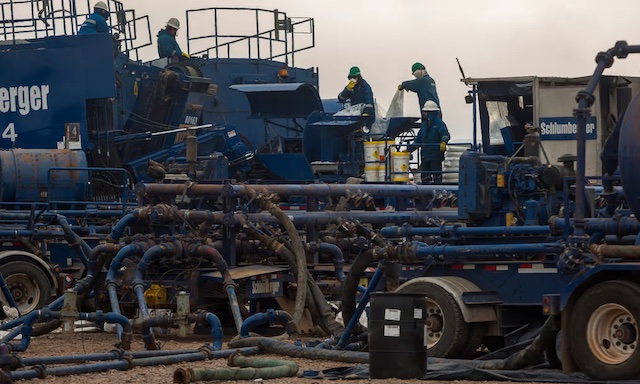
…It works with every major international oil company, and directly for most of the petrostates – including Saudi Arabia, Libya, Russia and Turkmenistan. It operates in the most difficult areas, whether politically, logistically, or technologically, and it is a world leader in the technologies required to get fossil fuels out of the ground – with 36,000 patented ways to help its clients do just that. And it does all of this while staying well out of the limelight.
But with a plea deal with the US authorities finalised at the end of last month, Schlumberger set a corporate record it would probably prefer not to be noticed: receiving the largest corporate criminal fine for sanctions violations in US history.
Its crime, to which it pled guilty, was to involve its US staff in sanctions-busting transactions with both Iran and Sudan, and for its (unsuccessful) attempts to mask such transactions from the authorities.
Schlumberger is now required to pay $155m in criminal fines, forfeit $77.5m in earnings, and undergo three years of corporate probation, the business world’s answer to a yellow card. But for a $48bn-a-year business, which made $208m profit from Iran in 2012 alone, such a fine is just a drop in the oil well. The day the deal was struck, Schlumberger shares actually rose almost 2%, a visible sign investors saw the punishment as little more than a slap on the wrist.
But the deal shines unprecedented light on some of the inner workings of a company central to drilling out fossil fuels right across the planet.
James Ball and Harry Davies. Where there is oil and gas there is Schlumberger. 18 May 2015. The Guardian.
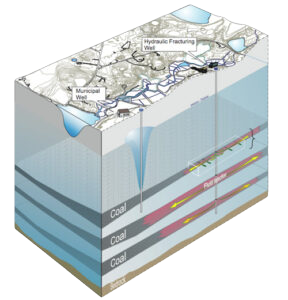
[In 2010] Schlumberger was one of the large companies being investigated by the U.S. House Energy and Commerce Committee to see if the gas extraction method known as hydraulic fracturing, or fracking, is a hazard to groundwater drinking supplies.
Schlumberger then employed over 77,000 people of more than 140 nationalities working in approximately 80 countries.
Reuters reported on May 19, 2010 that personnel from oilfield giant Schlumberger left BP’s Deepwater Horizon only hours before it exploded. Read the article here.
Although “Flaring” was used extensively in the Gulf of Mexico aftermath of the BP Deepwater Horizon explosion in April, 2010, Schlumberger published a 2002 report that recommends zero flaring in the Middle East.
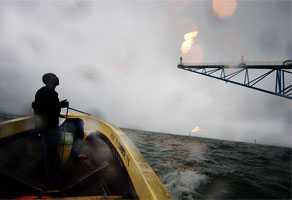
Photo: Ed Kashi
The World Bank estimates that over 150 billion cubic metres of natural gas are flared or vented annually, an amount worth approximately 30.6 billion dollars, equivalent to 25 percent of the United States’ gas consumption or 30 percent of the European Union’s gas consumption per year. See World Bank, December 14, 2009. “World Bank, GGFR Partners Unlock Value of Wasted Gas”.
See also: Renee Schoof and Marisa Talylor. June 11, 2010. McClatchy. “Plan to burn excess oil from BP well raises health questions.“
See also: Energy & Commerce Committee Investigates Deepwater Horizon Rig Oil Spill
See also: CCRM DHSG Report on the Macondo Well Blowout, 01 Mar 2011. United States Coast Guard. “Schlumberger Mississippi Canyon Block 252 Timeline”. CCRM DHSG Report on the Macondo Well Blowout, 01 Mar 2011. United States Coast Guard. (PDF)
The Deepwater Horizon Study Group (DHSG) was formed by members of the Center for Catastrophic Risk Management (CCRM) in May 2010 in response to the blowout of the Macondo well on April 20, 2010.
A fundamental premise in the DHSG work is: we look back to understand the why‘s and how‘s of this disaster so we can better understand how best to go forward. The goal of the DHSG work is defining how to best move forward – assessing what major steps are needed to develop our national oil and gas resources in a reliable, responsible, and accountable manner.
On April 18, 2010, a Schlumberger wireline cased hole crew arrives on Transocean Deepwater Horizon. Specifically, BP contracted with Schlumberger to be available to perform a cement bond log and set a bridge plug and/or cement retainer, should BP request those services. At approximately 7:00 a.m., BP informs Schlumberger crew that no wireline cased hole services will be requested and BP sends Schlumberger crew home.
At approximately 11 :15 a .m., on April 20, 2010, the day of the BP well explosion, the Schlumberger crew departed Transocean Deepwater Horizon on regularly scheduled BP helicopter flight. At 10:56 EDT, the fire on Deepwater Horizon started. It burned for more than a day and sank April 22, leading to 11 deaths and the largest oil spill in U.S. history. Schlumberger failed to advise public officials on how BP’s actions, declining a wireline cased hole service might have prevented this disaster.
How can government regulators require that private contractors in the oil and gas industry blow the whistle on potentially global disasters? (Neil Zusman, 2010-08-13.)
See also: Publication: Middle East & Asia Reservoir Review
Volume: No. 3, 2002
Publication Date: 01/01/2002
Download:Towards Zero Flaring (1.41 MB PDF)
An important issue in protecting the environment of the Gulf, which is no less fragile than elsewhere in the world, is the effect of hydrocarbon flaring from oil production operations. This causes many forms of pollution – noise, toxic gases, soot, acid rain and the production of carbon dioxide, the latter is one of the primary causes of global warming. In this article, Alp Tengirsek and Nashat Mohamed explain the progress of a project in Abu Dhabi that has already eliminated oil flaring during testing and production, with the ultimate aim of eliminating all hydrocarbon flaring within a year.
See also: Stanley Reed. “The Stealth Oil Giant: Why Schlumberger, long a hired gun in oil-field services, is becoming a major force and scaring Big Oil“. Business Week. 2008-01-03
…When a board member recently floated the idea of rebranding the Russian operations as Schlumberger, the local team rejected the proposal. “I don’t see what we would gain,” says Maurice Dijols, president of Schlumberger Russia. “We need to keep the Russian identity.”
Schlumberger has gone native in Russia. It has a global reputation as a leader in oil-field services, but its thriving Russian business has been built on three local outfits it has bought since 2004. In each case, Schlumberger revamped operations but kept enough of the old company intact to preserve its earthy Russian character. Schlumberger “doesn’t make the assumption that the West is best,” says Rob Whalley, a sturdy Briton who serves as the company’s drilling czar in the country.
It helps to keep a low profile. Schlumberger has prospered by offering its services through local subsidiaries, even as Moscow has strong-armed Royal Dutch Shell (RDS) and BP (BP) out of premier assets, forcing them to hand over control of big fields in Siberia and on Sakhalin Island to state-owned Gazprom, now a Schlumberger client. Schlumberger has 14,000 employees in Russia, and its revenues there topped $1.5 billion last year, triple the level in 2004. “Russia could one day be as big for us as the U.S.,” where Schlumberger gets nearly 30% of its revenues, says Chief Executive Andrew F. Gould, a British native who has lived in Paris for decades.
You could call Schlumberger the stealth oil major. Sure, giants such as ExxonMobil (XOM), Chevron (CVX), and BP dominate headlines in the global quest for crude. But they couldn’t do it without Schlumberger. The company helps them scope out pockets of oil thousands of feet below the earth’s surface, conjuring up their layer-cake images on a computer screen, and then threading drill bits through the richest bands.
…These days, the business-class lounge at Moscow’s Domodedovo airport has become the unofficial headquarters for Schlumberger executives and engineers boarding Soviet-era Antonov and Tupolev jets for the long flight out to West Siberia, which accounts for about four-fifths of Russian oil production. The region requires thousands of new wells, such as those being drilled at Pad 1b Lempyskoye, just to keep output at current levels. And there’s still lots of oil to be found. In the 1960s and ’70s, Soviet drillers moved rapidly across the forest and tundra, hitting big pockets of oil but bypassing the smaller pools. These can now be tapped by the tricky horizontal wells Schlumberger has taught its Russian employees to drill, and production at old wells can be bumped up by a process called hydraulic fracturing, another Schlumberger specialty.
Stanley Reed. “The Stealth Oil Giant: Why Schlumberger, long a hired gun in oil-field services, is becoming a major force and scaring Big Oil“. Business Week. 2008-01-03
See also: Ryan Hogg. Texas-based oil giant accused of failing to help its Russian workers avoid being conscripted by Putin, report says.15 Oct 2022. Business Insider.
See also: Schlumberger on Wikipedia: Russia (Dec 2023)
In October 2022, it was reported that some of Schlumberger’s more than 9,000 Russian employees based in Russia received military draft notices through the company. Human rights groups such as Business & Human Rights Resource Centre are watching how the company responds to the concerns.[67] About a week later, the company said it was evaluating unspecified options for its thousands of Russian employees.[68] According to a list maintained by the Chief Executive Leadership Institute at Yale University which tracks company responses about operating in Russia, Schlumberger is noted as “buying time” while it continues to carry out the bulk of its business in the country.[69]
On July 14, 2023 the company announced the termination of deliveries to Russia.[70]
See: Gasland – The Debate
See: Energy & Commerce Committee Investigates Potential Impacts of Hydraulic Fracturing
See: BP Deepwater Horizon Committee Hears From Oil Industry Executives
See: Exxon-Xto Deal Forces Congress to Reconsider Natural Gas
See: National Commission on the BP Deepwater Horizon Oil Spill and Offshore Drilling
See: Hydraulic Fracturing: History of an Enduring Technology
See: Natural gas: the commodity world’s ugly duckling
See: Chevron Human Energy Stories | Addressing Climate Change
See: Halliburton
See: BJ Services
See: Superior Well Services – Products – Fracturing Systems
See: Universal Well Services, Inc.
See: Sanjel Corporation
See: EPA Findings on Hydraulic Fracturing Deemed “Unsupportable”
See: Coalbed Methane Development: The Costs and Benefits of an Emerging Energy Resource
See: Natural gas: the commodity world’s ugly duckling
See: This Website is a Crash Course In Fracking
See: Affirming Gasland
See: Poison Fire