
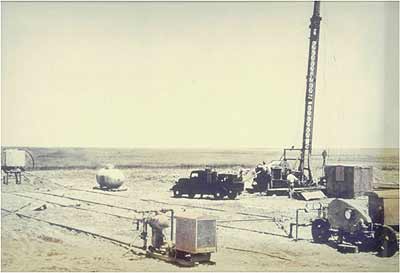
Fig. 1—In 1947, Stanolind Oil conducted the first experimental fracturing in the Hugoton field located in southwestern Kansas. The treatment utilized napalm (gelled gasoline) and sand from the Arkansas River.
Since Stanolind Oil introduced hydraulic fracturing in 1949, close to 2.5 million fracture treatments have been performed worldwide. Some believe that approximately 60% of all wells drilled today are fractured. Fracture stimulation not only increases the production rate, but it is credited with adding to reserves—9 billion bbl of oil and more than 700 Tscf of gas added since 1949 to US reserves alone—which otherwise would have been uneconomical to develop.
In addition, through accelerating production, net present value of reserves has increased. Fracturing can be traced to the 1860s, when liquid (and later, solidified) nitroglycerin (NG) was used to stimulate shallow, hard rock wells in Pennsylvania, New York, Kentucky, and West Virginia. Although extremely hazardous, and often used illegally, NG was spectacularly successful for oil well “shooting.” The object of shooting a well was to break up, or rubblize, the oil-bearing formation to increase both initial flow and ultimate recovery of oil. This same fracturing principle was soon applied with equal effectiveness to water and gas wells.
In the 1930s, the idea of injecting a nonexplosive fluid (acid) into the ground to stimulate a well began to be tried. The “pressure parting” phenomenon was recognized in well-acidizing operations as a means of creating a fracture that would not close completely because of acid etching. This would leave a flow channel to the well and enhance productivity. The phenomenon was confirmed in the field, not only with acid treatments, but also during water injection and squeeze-cementing operations.
But it was not until Floyd Farris of Stanolind Oil and Gas Corporation (Amoco) performed an in-depth study to establish a relationship between observed well performance and treatment pressures that “formation breakdown” during acidizing, water injection, and squeeze cementing became better understood. From this work, Farris conceived the idea of hydraulically fracturing a formation to enhance production from oil and gas wells.
Montgomery, Carl T., and Michael B. Smith. “Hydraulic fracturing: History of an enduring technology.” Journal of Petroleum Technology 62.12 (2010): 26-40.
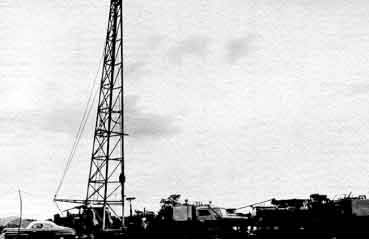
Fig. 2—On 17 March, 1949, Halliburton conducted the first two commercial fracturing treatments in Stephens County, Oklahoma, and Archer County, Texas.

See also: Carl T. Montgomery and Michael B. Smith. “Hydraulic Fracturing: History of an Enduring Technology.” Journal of Petroleum Technology (JPT). 2010.(PDF 2.1 MB)

At the 2006 SPE Annual Technical Conference and Exhibition (ATCE), SPE honored nine pioneers of the hydraulic fracturing industry as Legends of Hydraulic Fracturing. Claude E. Cooke Jr., Francis E. Dollarhide, Jacques L. Elbel, C. Robert Fast, Robert R. Hannah, Larry J. Harrington, Thomas K. Perkins, Mike Prats, and H.K. van Poollen were recognized as instrumental in developing new technologies and contributing to the advancement of the field through their roles as researchers, consultants, instructors, and authors of groundbreaking journal articles.
This CD includes more than 150 papers published by these industry legends; it also includes an overview of the history of hydraulic fracturing, along with personal reflections from a number of the Legends and their colleagues.
Hydrafrac (1946)
See: Search for hydrafrac on Google Patents by oldest first.
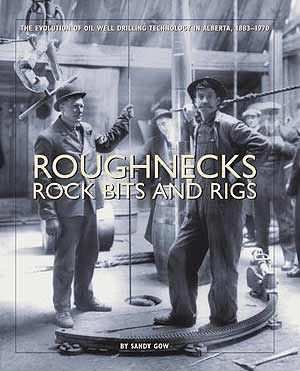
See: Gow, Sandy, and Bonar Alexander Gow. Roughnecks, rock bits and rigs: the evolution of oil well drilling technology in Alberta, 1883-1970. University of Calgary Press, 2005. Web.
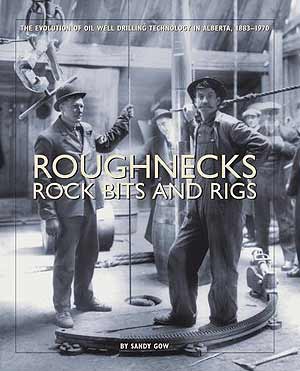
This book is a comprehensive study of the evolution of the component aspects of drilling technology in Alberta, from the evolution of power sources and drill bit designs to the composition of drilling muds and the use of fishing tools. Included are explanations of the costs and risks of oil well drilling and of the larger issue of industrial technology — how it evolves and under what conditions. The author draws extensively from original source material such as interviews, photographs, and appendices from both the Glenbow Archives and the Devon-Leduc Petroleum Hall of Fame and Interpretive Centre.

The Stanolind patent (1946), p. 268, was the first patent issued for hydraulic fracturing. You may preview this page by clicking on the snippet in the link I’ve provided.
See also : George C. Howard. “Well Completion Process.” Stanolind Oil and Gas Company. Tulsa, OK. June 29, 1949. U.S. Patent number: 2667224, Filing date: Jun 29, 1949, Issue date: Jan 1954.
See also: Erle P. Halliburton. “Method and Apparatus for Drilling Wells, Such As Oil Wells.” New Wilson, OK. U.S. Patent number: 1703234, Filing date: Nov 4, 1920, Issue date: Feb 1929.
See also: Google Labs Books Ngram Viewer of the historical usage of the term “hydraulic fracturing”. Try the word frack or fracking.
(Editor’s Note: 4 Aug 2023. Searching for the patents on the core inventions of resource extraction led me to discover Kirk Teska and the discipline and writing of water historians. )
See also: Kirk Teska. Patent Watch. Iandiorio Teska & Coleman LLP. 2017.
Kirk Teska is the author of Patent Project Management (ASME Press) and Patent Savvy for Managers (Nolo), is an adjunct law professor at Suffolk University Law School, and is the managing partner of Iandiorio Teska & Coleman, an intellectual property law firm in Waltham, Mass.
Fracking is a timely topic. The idea is to fracture the rock adjacent to a well to increase the extraction of oil and natural gas. Advocates see it as a means for the U.S. to produce more of its own energy. Critics fear it threatens local water supplies.
It’s timely, but not new. Fracking has been with us at least since the 1860s. Patent No. 59,936 dated Nov. 20, 1866, names Edward Roberts as an inventor. The patent states: “In my improved method of increasing the capacity of oil-wells, I fracture the rock containing the oil to some distance around the wells, thus creating artificial seams, and enabling me to connect the well thereby with seams containing the oil that would not have been otherwise reached.…” The key to the method was to “sink a flask containing gunpowder, or other powerful explosive material or gas, down the well.” A column of water above the charge directed the explosion downward. Explosive fracking later used nitroglycerin.
Roberts obtained a royalty not only on the procedure but also on the increased flow of oil—a move that made him wealthy. Infringers worked at night to escape detection and came to be called “moonlighters.” The validity of Roberts’s patent was litigated at least twice and was upheld.
Today, hydraulic fracturing is the common practice. By some accounts, the Stanolind Oil and Gas Co. introduced hydrofracking early in the 20th century.
I’m not sure that’s true. Patent No. 199,488, dated Jan. 22, 1878, is the first I could find for using pressurized water to fracture the rock. Packing (a bag filled with seed) is disposed partway down a well. Water above the packing is pumped out and a ram is placed in the well: “The ram is allowed to fall, striking the seed bag first, thus preventing the water from escaping upward on account of the great pressure of the ram and causing the water, under the heavy pressure applied to it, to be forced out through the openings in the well-tubing and thus opening the crevices in the well.”
Stanolind’s earliest fracking patent—No. 2,667,224, dated June 29, 1949—is for a fluid used in hydraulic fracturing. The ‘224 patent itself admits that various hydraulic fracturing techniques and fluids precede Stanolind’s invention.
Modern fracking techniques include a “proppant,” which must be strong enough to keep the fissures open and also allow the gas or oil to flow. Sand was the proppant of choice through the 1950s. Union Oil Co.’s patent of that era, No. 7,274,431, describes solids that are carried by the penetrating fluid and left behind to keep the fissures open. “Ottawa silica sand of about 20-30 mesh particle size is most widely used,” the patent reads.
Patents for proppant materials include Nos. 3,399,727 (ceramics), 4,068,718 (sintered bauxite), and 3,245,866 (vitreous spheres of slag). But how do you know the process worked? In general, once a crack forms, the pressure of the “frack pump” drops. But there are more sophisticated techniques for mapping the fractures to predict yield: ultrasonic systems, seeding the proppant with radioactive tracers and using gamma ray technology, and using seismic hydrophone arrays. Columbia University has a patent, No. 4,832,121, which provides a good overview of the different mapping and monitoring techniques.
Kirk Teska. Patent Watch. Iandiorio Teska & Coleman LLP. 2017.
See also: Daniel Macfarlane. A Big Fracking Deal. 13 Nov 2013. Active History.
As a water historian, the part of fracking that first caught my attention a few years ago was the massive amounts of water that are used. This causes numerous problems. First off, the millions of gallons of water that is used by each “frac-job” has to come from somewhere – such as nearby lakes, rivers, and aquifers – and displacing massive amounts of water in this fashion is always ecologically dubious. Furthermore, these water withdrawals are rarely regulated. And where does the water go after it has been used? This is perhaps the biggest concern for the water, particularly since it is rarely subject to regulation and oversight. The water is often contaminated, either by the chemicals used as part of fracking or by exposure to other contaminants in the well or underground.
Daniel Macfarlane. A Big Fracking Deal. 13 Nov 2013. Active History.
See: States taking a closer look at controversial natural gas drilling method
See: Under the surface : fracking, fortunes and the fate of the Marcellus Shale
See: This Website is a Crash Course In Fracking
See: U.S. Geological Survey (USGS): Water Resources and Natural Gas Production from the Marcellus Shale
See: Superior Well Services – Products – Fracturing Systems