

(Editor’s Note. 19 Dec 2023. The article originally posted here was about the Clean Water Act using information from Wikipedia. It has been updated critically. nz)
Annie Snider. What broke the Safe Drinking Water Act? 10 May 2017. Politico.
…Toxins are supposed to be managed under the Safe Drinking Water Act, the 1974 law that Congress passed after scientists discovered widespread contamination in American tap water. Under the law, the EPA has set national limits for 89 dangerous chemicals, bacteria and viruses. But nearly all of those limits were set between 1986 and 1996, when Congress required the EPA to analyze and regulate chemicals at a steady clip. Water utilities complained they couldn’t keep pace, and in 1996, Congress updated the law to leave it up to the EPA to decide when to set new regulations. It also required a new and extensive review process for any new standards.
In the 20 years since that update went into effect, not a single new contaminant has been regulated under the law. Meanwhile, tens of thousands of new chemicalshave come into use, with more than 85,000 now on the market. Advances in technology and science have shown that long-used chemicals can spread more than previously though, and can present dangers at even low levels. But little has been done at the federal level to set safer limits for older chemicals, assess the health impact of new substances making their way into the water supply, or even monitor regularly for potential contaminants in the drinking water that millions of Americans ingest every day.
Annie Snider. What broke the Safe Drinking Water Act? 10 May 2017. Politico.
See also: Erik D. Olson. The Broken Safe Drinking Water Act Won’t Fix the PFAS Crisis. 12 Sep 2019. Natural Resources Defense Council (NRDC).
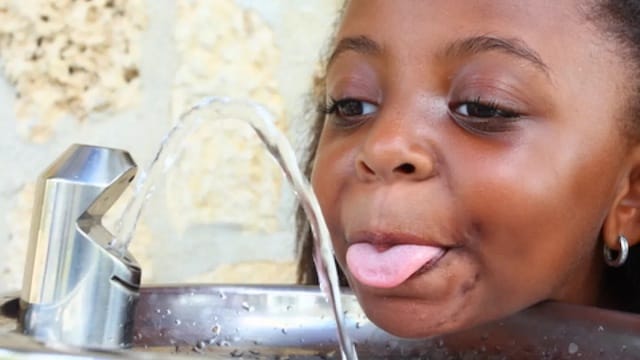
Since the PFAS crisis first came to light, some have been calling on the EPA to set drinking water standards to clean up our drinking water. Indeed, we have suggested that a PFAS standard is ultimately needed and clearly those calling for a standard are well-intentioned and want to protect the public from this scourge. But it is important to explain why badly-needed repairs to the underlying statute should support such an effort. Unless EPA is expressly required to protect vulnerable populations such as pregnant and nursing moms, infants and children, and to establish the most stringent standard feasible, the agency can at most be expected to establish weak standards that will likely undercut state efforts to set strict, health-based protections.
Can’t We Count on the Safe Drinking Water Act to Set Health-Protective Standards?
The short answer is no. You might ask, for example, if the PFAS (or any other) problem is so widespread and serious, why hasn’t the EPA addressed the problem under the Safe Drinking Water Act? This is because: (1) the Safe Drinking Water Act was seriously weakened by 1996 Amendments that have made establishment of protective standards very unlikely; and (2) despite repeated promises to act, the Trump Administration has not even formally made the finding that drinking water standards are needed, much less proposed a standard for any PFAS compound. And even if EPA were to move forward with new tap water rules—or were ordered by Congress to do so—it is unlikely that the agency would set strict, health-protective standards because of the serious flaws in the Act enacted in 1996.
Erik D. Olson. The Broken Safe Drinking Water Act Won’t Fix the PFAS Crisis. 12 Sep 2019. Natural Resources Defense Council (NRDC).
See also: Natural Resources Defense Council (NRDC). Watered Down Justice. 27 Mar 2020. Natural Resources Defense Council (NRDC).
Coauthored with Steve Taylor, Coming Clean and Michele Roberts, EJHA
While the Safe Drinking Water Act guarantees all Americans access to clean, drinkable water, it hasn’t worked out that way in practice. NRDC partnered with the Environmental Justice Health Alliance for Chemical Policy Reform (EJHA) and Coming Clean to analyze nationwide violations of the law from 2016 to 2019. We found a disturbing relationship between sociodemographic characteristics—especially race—and drinking water violations. We found that the rate of drinking water violations increased in:
- Communities of color
- Low-income communities
- Areas with more non-native English speakers
- Areas with more people living under crowded housing conditions
- Areas with more people with sparse access to transportation
Our analysis revealed that race, ethnicity, and language had the strongest relationship to slow and inadequate enforcement of the Safe Drinking Water Act. That means that water systems that serve the communities that are the most marginalized are more likely to be in violation of the law—and to stay in violation for longer periods of time.
Natural Resources Defense Council (NRDC). Watered Down Justice. 27 Mar 2020. Natural Resources Defense Council (NRDC).
See also: Natural Resources Defense Council (NRDC). Watered Down Justice Report. 2019. Natural Resources Defense Council (NRDC). (PDF).
See also: American Chemistry Council. Organizations Around the Country Oppose EPA’s Flawed Drinking Water Proposal. 18 Jul 2023. American Chemistry Council.
The American Chemistry Council has provided a detailed critique of the Environmental Protection Agency’s proposed Per- and Polyfluoroalkyl Substances (PFAS) National Primary Drinking Water Regulation (NPDWR).
Broadly, ACC argues that the NPDWR must be based in sound science and realistic economic data, which the proposal currently fails to do. Among additional points raised, ACC argues: EPA has relied on an assessment of potential health effects that is fundamentally flawed; overstates the non-cancer risks associated with PFOA and PFOS exposure; fails to demonstrate that the benefits of the proposal justify the costs as required by the Safe Drinking Water Act; and significantly underestimated the costs of complying with the proposed standard and the number of systems that will be impacted;
American Chemistry Council. Organizations Around the Country Oppose EPA’s Flawed Drinking Water Proposal. 18 Jul 2023. American Chemistry Council.
See also: James McBride and Noah Berman. How U.S. Water Infrastructure Works. 31 Mar 2023. Council on Foreign Relations. (CFR).
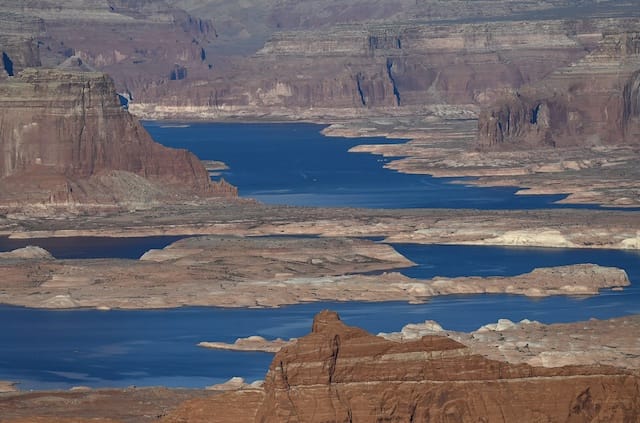
The sprawling U.S. water system is central to the nation’s economy, but chronic underinvestment, increasing demand, and the consequences of climate change have revealed the system’s weaknesses.
Summary
James McBride and Noah Berman. How U.S. Water Infrastructure Works. 31 Mar 2023. Council on Foreign Relations. (CFR).
- U.S. drinking water is among the safest and most reliable in the world, but high-profile infrastructure failures have revealed that many Americans still lack access to clean and affordable water.
- Aging infrastructure, growing demand, and severe droughts threaten to destabilize industries that rely on water, including agriculture and power generation.
- The Joe Biden administration has made the largest federal investment in U.S. water infrastructure in decades, but critics contend that more money is needed to fix the beleaguered system.
See also: The Associated Press. The EPA finalizes a water-protection rule that repeals Trump-era changes. 30 Dec 2022. NPR.
ST. LOUIS — President Joe Biden’s administration on Friday finalized regulations that protect hundreds of thousands of small streams, wetlands and other waterways, repealing a Trump-era rule that federal courts had thrown out and that environmentalists said left waterways vulnerable to pollution.
The rule defines which “waters of the United States” are protected by the Clean Water Act. For decades, the term has been a flashpoint between environmental groups that want to broaden limits on pollution entering the nation’s waters and farmers, builders and industry groups that say extending regulations too far is onerous for business.
The Associated Press. The EPA finalizes a water-protection rule that repeals Trump-era changes. 30 Dec 2022. NPR.
See also: Julie Depenbrock. In ‘Fen, Bog & Swamp,’ Annie Proulx pens a history of wetland destruction. 11 Oct 2022. NPR.
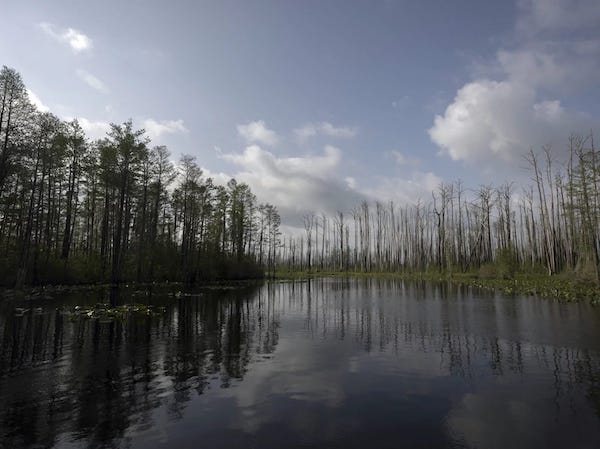
Stephen B. Morton/AP
The Pulitzer Prize-winning author Annie Proulx may be best known for her works of fiction, titles like The Shipping News and Brokeback Mountain.
But the 87-year-old author’s newest book, Fen, Bog & Swamp: A Short History of Peatland Destruction and Its Role in the Climate Crisis, is a love letter to ecosystems that are rapidly disappearing — America’s wetlands.
“Before the last wetlands disappear I wanted to know about this world we are losing,” Proulx writes. “What was a world of fens, bogs and swamps and what meaning did these peatlands have, not only for humans but for all other life on Earth?”
Julie Depenbrock. In ‘Fen, Bog & Swamp,’ Annie Proulx pens a history of wetland destruction. 11 Oct 2022. NPR.
See: Buried Secrets: Is Natural Gas Drilling Endangering U.S. Water Supplies?
See: U.S. EPA Water Enforcement
See: Fracked: Barnett Shale drilling chemicals found in blood and organs
See: Coalbed Methane Development: The Costs and Benefits of an Emerging Energy Resource
See: Expert Testimony on Hydraulic Fracturing Impacts
See: Under the surface : fracking, fortunes and the fate of the Marcellus Shale
See: Model validation : perspectives in hydrological science
See: Fueling Washington
See: The Next Drilling Disaster?
See: Natural Gas Industry Shills Use the Media to Mislead the Public – Here’s How to Spot Them
See: This Website is a Crash Course In Fracking
See: Affirming Gasland
See: U.S. Environmental Protection Agency (EPA): Weston Wilson Whistle Blower Letter
See: NETL: Secure & Reliable Energy Supplies
See: EPA Findings on Hydraulic Fracturing Deemed “Unsupportable”
See: Coalbed Methane Development: The Costs and Benefits of an Emerging Energy Resource
See: Underground Injection of Gas Industry Brine Taking Off – State Journal – STATEJOURNAL.com