ExxonMobil. The Lamp. No. 4, 2009. p. 7-8.
Andrew Swiger, Exxon Senior V.P. has said,
“A key question about shale and other unconventional plays will be whether a company has the technology to turn them into profitable opportunities.
Swiger notes that technology advances ExxonMobil has perfected in producing unconventional natural gas from tight-sands formations in Colorado’s Piceance Basin should prove advantageous.
Editor’s Note. 11 Dec 2023. I am adding additional information on what Exxon knew about the effect of greenhouse gases on global warming.
See also: Steve Horn. Tillerson Present as Exxon Signed Major Deal with Saudi Arabia During Trump Visit. 30 May 2017. DeSmog.

During his recent trip to Saudi Arabia, President Donald Trump announced an array of economic agreements between the U.S. and the Middle Eastern kingdom, saying it would usher in “jobs, jobs, jobs” for both oil-producing powerhouses.
While the $350 billion, 10-year arms deal garnered most headlines, a lesser-noticed agreement was also signed between ExxonMobil and the state-owned Saudi Basic Industries Corporation (SABIC) to study a proposed co-owned natural gas refinery in the Gulf of Mexico. Under the deal, signed at the Saudi-U.S. CEO Forum, the two companies would “conduct a detailed study of the proposed Gulf Coast Growth Ventures project in Texas and begin planning for front-end engineering and design work” for the 1,300-acre, $10 billion plant set to be located near Corpus Christi, Texas, according to an ExxonMobil press release.
Steve Horn. Tillerson Present as Exxon Signed Major Deal with Saudi Arabia During Trump Visit. 30 May 2017. DeSmog.
Exxon Knew
See also: Union of Concerned Scientists. The Climate Deception Dossiers: Internal Fossil Fuel Industry Memos Reveal Decades of Corporate Disinformation. 29 Jun 2015. UCUSA.
The climate deception dossiers
Containing 85 internal memos totaling more than 330 pages, the seven dossiers reveal a range of deceptive tactics deployed by the fossil fuel industry. These include forged letters to Congress, secret funding of a supposedly independent scientist, the creation of fake grassroots organizations, multiple efforts to deliberately manufacture uncertainty about climate science, and more.
The documents clearly show that:
- Fossil fuel companies have intentionally spread climate disinformation for decades.
- Fossil fuel company leaders knew that their products were harmful to people and the planet but still chose to actively deceive the public and deny this harm.
- The campaign of deception continues today.
What fossil fuel companies knew and when they knew it
The fundamentals of global warming have been well established for generations. Fossil fuel companies have almost certainly been aware of the underlying climate science for decades.
As early as 1977, representatives from major fossil fuel companies attended dozens of congressional hearings in which the contribution of carbon emissions to the greenhouse effect was discussed. By 1981 at least one company (Exxon) was already considering the climate implications of a large fossil fuel extraction project.
In 1988, the issue moved beyond the scientific community and onto the national stage. James Hansen, a leading NASA climate scientist, testified before Congress that scientific data had confirmed that industrial activities were causing climate change. It was also in 1988 that the United Nations formed the Intergovernmental Panel on Climate Change and the U.S. Congress introduced the National Energy Policy Act in an effort to reduce emissions of heat-trapping gases. It is difficult to imagine that executives, lobbyists, and scientists at major fossil companies were by this time unaware of the robust scientific evidence of the risks associated with the continued burning of their products.
Indeed, one of the key documents highlighted in the deception dossiers is a 1995 internal memo written by a team headed by a Mobil Corporation scientist and distributed to many major fossil fuel companies. The internal report warned unequivocally that burning the companies’ products was causing climate change and that the relevant science “is well established and cannot be denied.”
How did fossil fuel companies respond? They embarked on a series of campaigns to deliberately deceive the public about the reality of climate change and block any actions that might curb carbon emissions.
The result? More than half of all industrial carbon emissions have been released since 1988 and there is still no comprehensive U.S. federal policy to address the problem.
Holding fossil fuel companies accountable
As the picture of fossil fuel companies’ efforts to deceive the public comes into clear view, the time is ripe to hold these companies accountable for their actions and responsible for the harm they have caused.
So how should the US public expect fossil fuel companies to behave? At a minimum, society should expect them to:
- Stop disseminating misinformation about climate change. It is unacceptable for fossil fuel companies to deny established climate science. It is also unacceptable for companies to publicly accept the science while funding climate contrarian scientists or front groups that distort or deny the science.
- Support fair and cost-effective policies to reduce global warming emissions. It is time for the industry to identify and publicly support policies that will lead to the reduction of emissions at a scale needed to reduce the worst effects of global warming.
- Reduce emissions from current operations and update their business models to prepare for future global limits on emissions. Companies should take immediate action to cut emissions from their current operations, update their business models to reflect the risks of unabated burning of fossil fuels, and map out the pathway they plan to take in the next 20 years to ensure we achieve a low-carbon energy future.
- Pay for their share of the costs of climate damages and preparedness. Communities around the world are already facing and paying for damages from rising seas, extreme heat, more frequent droughts, and other climate-related impacts. Today and in the future, fossil fuel companies should pay a fair share of the costs.
- Fully disclose the financial and physical risks of climate change to their business operations. As is required by law, fossil fuel companies are required to discuss risks—including climate change—that might materially affect their business in their annual SEC filings. Today, compliance with this requirement is not consistent.
Source documents (PDFs)
- Email from Former Exxon Employee Lenny Bernstein
- Deception Dossier #1: Dr. Wei-Hock Soon’s Smithsonian Contracts
- Deception Dossier #2: American Petroleum Institute’s “Roadmap” Memo
- Deception Dossier #3: Western States Petroleum Association’s Deception Campaign
- Deception Dossier #4: Forged Letters from the Coal Industry to Members of Congress
- Deception Dossier #5: Coal’s “Information Council on the Environment” Sham
- Deception Dossier #6: Deception by the American Legislative Exchange Council
- Deception Dossier #7: The Global Climate Coalition’s 1995 Primer on Climate Change Science
- Deception Dossiers: All Documents
High-Resolution Graphics (JPGs)
- Deception Dossier #1: Dr. Wei-Hock Soon’s Smithsonian Contracts
- Deception Dossier #2: American Petroleum Institute’s “Roadmap” Memo
- Deception Dossier #3: Western States Petroleum Association’s Deception Campaign
- Deception Dossier #4: Forged Letters from the Coal Industry to Members of Congress
- Deception Dossier #5: Coal’s “Information Council on the Environment” Sham
- Deception Dossier #6: Deception by the American Legislative Exchange Council
- Deception Dossier #7: The Global Climate Coalition’s 1995 Primer on Climate Change Science
See also: Suzanne Goldenberg. Exxon knew of climate change in 1981, email says – but it funded deniers for 27 more years. 8 Jul 2015. The Guardian.
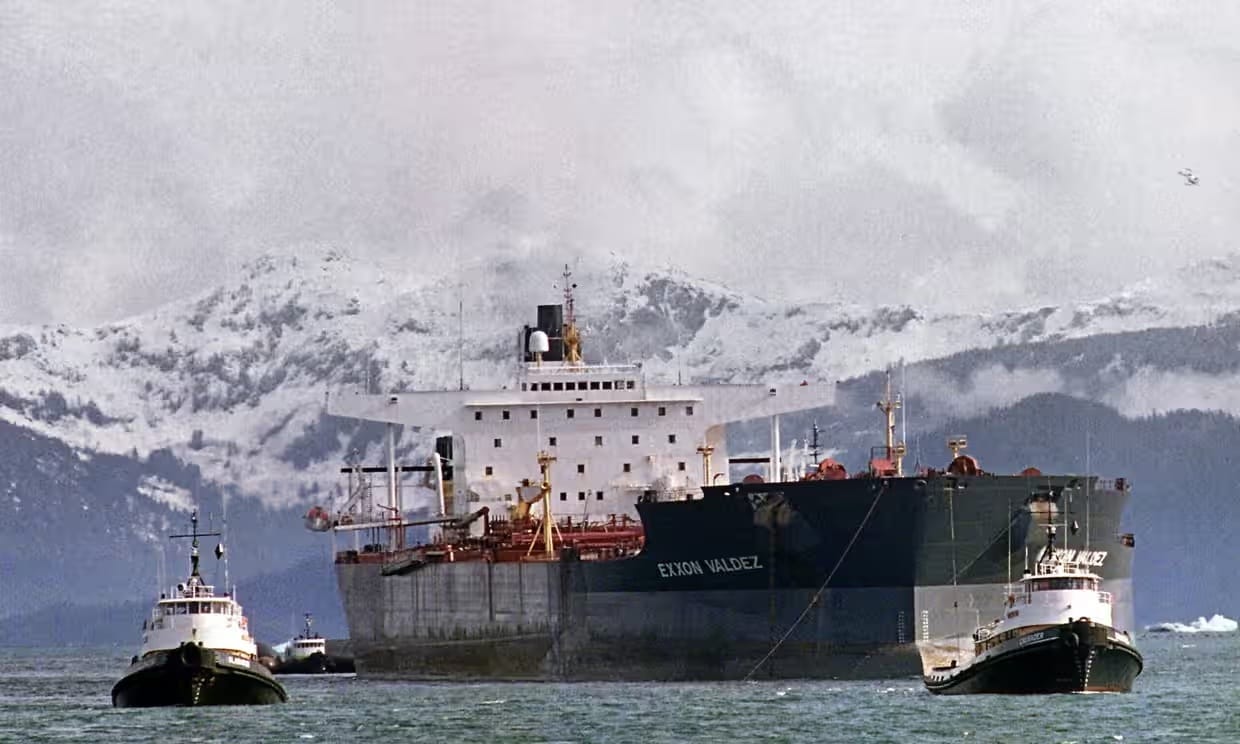
A newly unearthed missive from Lenny Bernstein, a climate expert with the oil firm for 30 years, shows concerns over high presence of carbon dioxide in enormous gas field in south-east Asia factored into decision not to tap it.
…However, Exxon’s public position was marked by continued refusal to acknowledge the dangers of climate change, even in response to appeals from the Rockefellers, its founding family, and its continued financial support for climate denial. Over the years, Exxon spent more than $30m on thinktanks and researchers that promoted climate denial, according to Greenpeace.
Exxon said on Wednesday that it now acknowledges the risk of climate change and does not fund climate change denial groups.
Some climate campaigners have likened the industry to the conduct of the tobacco industry which for decades resisted the evidence that smoking causes cancer.
In the email Bernstein, a chemical engineer and climate expert who spent 30 years at Exxon and Mobil and was a lead author on two of the United Nations’ blockbuster IPCC climate science reports, said climate change first emerged on the company’s radar in 1981, when the company was considering the development of south-east Asia’s biggest gas field, off Indonesia.
That was seven years ahead of other oil companies and the public, according to Bernstein’s account.
Suzanne Goldenberg. Exxon knew of climate change in 1981, email says – but it funded deniers for 27 more years. 8 Jul 2015. The Guardian.
See also: Alice McCarthy. Exxon disputed climate findings for years. Its scientists knew better. 12 Jan 2023. The Harvard Gazette.
“What we found is that between 1977 and 2003, excellent scientists within Exxon modeled and predicted global warming with, frankly, shocking skill and accuracy only for the company to then spend the next couple of decades denying that very climate science.”
Alice McCarthy. Exxon disputed climate findings for years. Its scientists knew better. 12 Jan 2023. The Harvard Gazette.“I think this new study is the smoking gun, the proof, because it shows the degree of understanding … this really deep, really sophisticated, really skillful understanding that was obscured by what came next,” said Harvard Professor Naomi Oreskes.
Naomi Oreskes
See also: Naomi Oreskes on Wikipedia.
In 2015, news outlets reported that ExxonMobil scientists had found evidence for climate change, but had nonetheless continued to raise doubts about it, a charge that Oreskes also reported.[38][39] The company criticized Oreskes and invited her and the public to read approximately 187 documents written between 1977 and 2014.[38] She and Geoffrey Supran did so, and reported their findings, which supported the original accounts, in the peer-reviewed journal Environmental Research Letters in 2017.[38][40]
Naomi Oreskes on Wikipedia.
Exxon Secrets (animated, archived)
Editor’s Note: I am especially proud to include a 2017 web site commissioned by GreenPeace that can now only be viewed on The Internet Archive. It loads a bit slowly.
Alternative Narratives Visualization Archive. Josh On and Amy Balkin for GreenPeace 2017.
Exxon Secrets Project in Internet Archive.
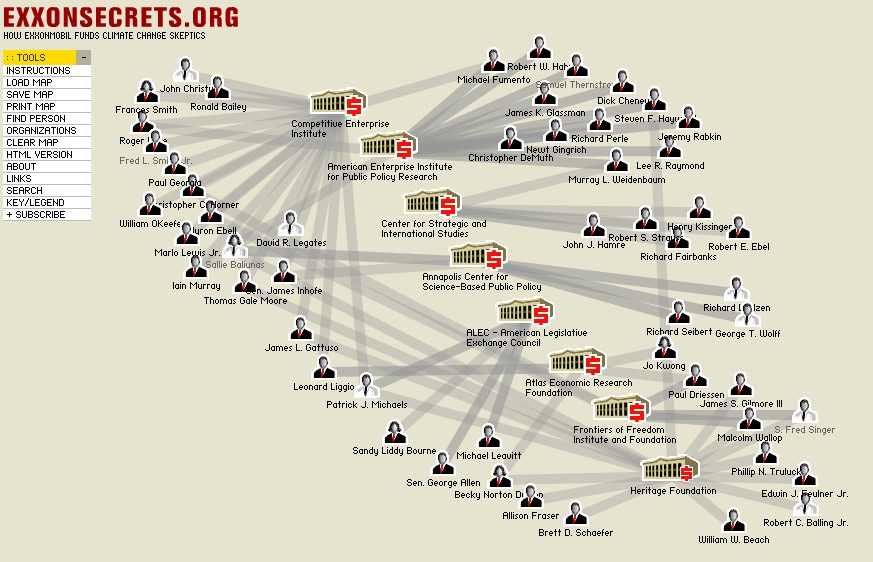
The website visualize the invisible connections between Exxon Mobil and and not-so independent organizations and think-tanks that have worked against solutions to global warming and climate change.
This project pretends to show how ExxonMobil is quietly funding these organizations by exposing the perfidious network of connections between ExxonMobil and the organizations and people that benefit from their funding.
Developed by Josh On (http://www.futurefarmers.com/josh/index.html) and Amy Balkin (http://www.tomorrowmorning.net/) for Greenpeace, as a research tool for journalists and the interested public, Exxon Secrets is Documenting Exxon-Mobil’s funding of climate change skeptics and provides a research database of information on the corporate funded anti-environmental movement.
The tool is based on Josh On’s previous project “They Rule”, but in contrast to this, Exxon Secrets is specifically designed to be a research database of information on the corporate funded anti-environmental movement.
Josh On is one of New Zealand’s most acclaimed artists and designers working with new media. He was born in 1972 in Christchurch He studied at the Royal College of Art in London. Josh On joined the acclaimed San Francisco art and design studio, Futurefarmers in 1998. Futurefarmers are well known as innovators within the new media art and design contexts. They have exhibited internationally at numerous galleries and museums, including the New Museum of Contemporary Art, the ZKM in Germany and at America’s most prestigious art exhibition, The Whitney Biennale. They have received numerous awards including the Webby Award and the Transmediale award among others. In 2001 Josh On completed They Rule, an online artistic project which aims to make some of the relationships of the elite of the US ruling class visible. They Rule has been exhibited widely since 2001, and in 2002 received electronic art’s most coveted award, the Prix Ars Electronica. (Honor Harger)
Alternative Narratives Visualization Archive. Josh On and Amy Balkin for GreenPeace 2017.
ExxonMobil‐XTO Merger:

Read preliminary transcripts of Rex Tillerson, CEO, giving testimony to the House Energy Committee. ExxonMobil‐XTO Merger: Impact on U.S. Energy Markets Preliminary Transcript of Testimony, House of Representatives, Subcommittee on Energy and Environment, Committee on Energy and Commerce. Wednesday, January 20, 2010. 122 pages.
This merger heralds a fundamental long‐term shift in U.S. energy markets and one that deserves our close attention. Over the last decade, a small group of companies that most Americans have never heard of has been developing huge deposits of natural gas in deep shale formations across America.”
-Edward J. Markey (D-MA), Chair of Subcommittee on Energy and the Environment.Tillerson testimony on p. 52.
See: Exxon-Xto Deal Forces Congress to Reconsider Natural Gas
See: Exxon Confronts Nuns, Calpers Over Global Warming Plans, Boskin
See: U.S. Speaker Nancy Pelosi: The Gavel: Draining The Swamp
See: Chevron Human Energy Stories | Addressing Climate Change
See: Ceres Principles – Corporate Environmental Conduct
See: Fueling Washington
See: The Next Drilling Disaster?
See: Natural Gas Industry Shills Use the Media to Mislead the Public – Here’s How to Spot Them
See: This Website is a Crash Course In Fracking
See: Affirming Gasland
See: EPA Findings on Hydraulic Fracturing Deemed “Unsupportable”
See: Coalbed Methane Development: The Costs and Benefits of an Emerging Energy Resource