
Sen. Murkowski Press Release. Sen. Murkowski Offers Disapproval Resolution to Block EPA Endangerment of Economy. 21 Jan 2010. U.S. Senate.
Legislative Veto of Agency Rule will Take Worst Option for Reducing Emissions off Table
WASHINGTON, D.C. – U.S. Sen. Lisa Murkowski, R-Alaska, today introduced a bipartisan disapproval resolution to stop the Environmental Protection Agency (EPA) from regulating greenhouse gas emissions under the Clean Air Act.
Murkowski’s resolution – co-sponsored by 35 Republicans and three Democrats – comes in the wake of the EPA’s recent endangerment finding, which will result in damaging new regulations that endanger America’s economy.
“As the EPA moves closer and closer to issuing these regulations, I continue to believe that this command-and-control approach is our worst option for reducing the emissions blamed for climate change,” Murkowski said.
Murkowski, the ranking Republican on the Senate Energy and Natural Resources Committee and a strong proponent of moving the nation toward a cleaner energy future, said the disapproval resolution is necessary to avoid the “economic train wreck” that would result from the EPA regulating greenhouse gases under the Clean Air Act.
“Our bipartisan resolution deals with an incredibly important question: whether or not members of this body are comfortable with the actions EPA will take under its current interpretation of the Clean Air Act. I’m not comfortable with those actions, and neither are the senators who have already agreed to add their names to this effort,” Murkowski said. “The Clean Air Act was written by Congress to regulate criteria pollutants, not greenhouse gases, and its implementation remains subject to oversight and guidance from elected representatives. We should continue our work to pass meaningful energy and climate legislation, but in the meantime, we cannot turn a blind eye to the EPA’s efforts to impose back-door climate regulations with no input from Congress.”
Murkowski said EPA regulation could force businesses being to cut jobs or close their doors for good; severely restrict domestic energy production, increasing our dependence on foreign suppliers and threatening our national security; make Housing less affordable; and consumer goods more expensive.
“If you truly believe that EPA climate regulations are good for the country, then vote to oppose our resolution,” Murkowski said. “But if you share our concerns, and believe that climate policy should be debated in Congress, then vote with us to support it.”
Murkowski filed her disapproval resolution pursuant to the provisions of the Congressional Review Act (CRA). Sen. Don Nickles, R-Okla., and Sen. Harry Reid, D-NV, were the principal sponsors of the CRA, incorporated into the Contract with America Advancement Act of 1996, and signed into law by President Bill Clinton.
Upon introduction, a disapproval resolution is referred to the committee of jurisdiction, which in this case will be the Senate Committee on Environment and Public Works. If the committee does not favorably report the resolution, it may be discharged upon petition by 30 Senators. Once a disapproval resolution is placed on the Senate calendar, it is then subject to expedited consideration on the Senate floor, and not subject to filibuster.

By JOHN M. BRODER, New York Times, January 21, 2010.
WASHINGTON: In a direct challenge to the Environmental Protection Agency’s authority, Senator Lisa Murkowski, Republican of Alaska, introduced a resolution on Thursday to prevent the agency from taking any action to regulate carbon dioxide and other climate-altering gases.
Ms. Murkowski, joined by 35 Republicans and three conservative Democrats, proposed to use the Congressional Review Act to strip the agency of the power to limit emissions of greenhouse gases under the Clean Air Act. The Supreme Court gave the agency legal authority to regulate such emissions in a landmark 2007 ruling.
The agency has declared carbon dioxide and other greenhouse gases to be a threat to human health and the environment and is moving to write regulations to restrict emissions from vehicles, power plants and other major sources. The action could impose significant costs on the economy but would also rein in production of the heat-trapping gases that most scientists link to worrisome changes in the global climate.
“Make no mistake,” Ms. Murkowski said in a floor statement, “if Congress allows this to happen there will be severe consequences.” She said businesses would be forced to close or move overseas, domestic energy production would be curtailed, housing would become more expensive and agricultural costs would rise.
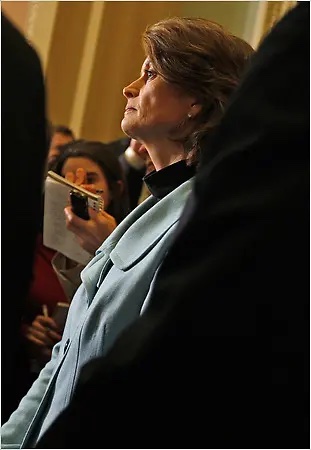
Senator Lisa Murkowski is challenging the authority of the Environmental Protection Agency.
Her resolution requires a majority vote in the Senate, a remote possibility because of the strong opposition of the Democratic leader, Senator Harry Reid of Nevada, and most other Democrats. It faces even longer odds in the House. And then it would require the signature of President Obama, who is all but certain to veto it because it would rob him of a critical regulatory tool.
Ms. Murkowski said that the Obama administration was using the threat of E.P.A. regulation to force Congress to move quickly on broad energy and climate-change legislation, including a complex cap-and-trade program to limit carbon-dioxide pollution.
Ms. Murkowski, the senior Republican on the (Jan 2010) Senate Committee on Energy and Natural Resources, has nearly unanimous Republican support in addition to the backing of the three Democrats: Senators Blanche Lincoln of Arkansas, Mary Landrieu of Louisiana and Ben Nelson of Nebraska.
Her effort was applauded by a broad swath of industry, agriculture and energy lobbies, which fear the prospect of what they consider capricious and heavy-handed regulation by the E.P.A.
An aide to Mr. Reid said that the measure was unlikely to come to a vote before March because of a crowded legislative calendar. He also said that while Mr. Reid believes that legislation to address climate change is preferable to E.P.A. regulation, the agency must retain the authority to act if Congress does not.
“There is no disagreement that it would be better than E.P.A. regulation for Congress to pass bipartisan comprehensive clean energy and climate legislation that creates jobs, improves our energy security and invests in making our economy and businesses more efficient and globally competitive,” the aide, Jim Manley, said. “But, thus far, very few Republicans have shown any willingness to work with us to get that done.”
See: Don’t Give Up
See: U.S. Speaker Nancy Pelosi: The Gavel: Draining The Swamp