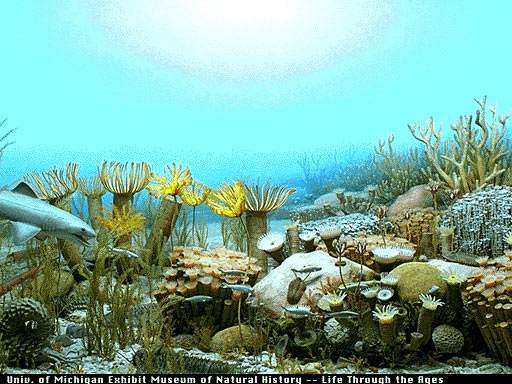

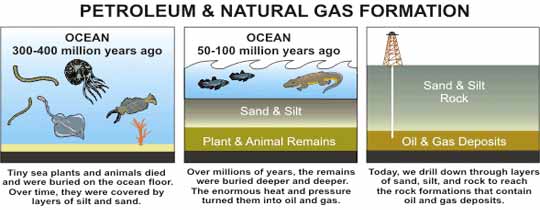
The main ingredient in natural gas is methane, a gas (or compound) composed of one carbon atom and four hydrogen atoms. Millions of years ago, the remains of plants and animals (diatoms) decayed and built up in thick layers. This decayed matter from plants and animals is called organic material — it was once alive. Over time, the sand and silt changed to rock, covered the organic material, and trapped it beneath the rock. Pressure and heat changed some of this organic material into coal, some into oil (petroleum), and some into natural gas — tiny bubbles of odorless gas.
U.S. Energy Information Administration. Natural Gas Basics-How Was Natural Gas Formed? 19 Oct 2010. USEIA.
Natural Gas Informational Site by the U.S. Department of Energy (U.S. DOE).
U. S. Department of Energy. Energy Kids. 2010 (Editor’s Note. 23 Dec 2023 – archived top level section.) Includes articles on How Do We Get Natural Gas?, How Was Natural Gas Formed? Also article on Energy Explained, Use of Natural Gas, Delivery and Storage of Natural Gas, How Much Natural Gas Is Left.
Current Page: U. S. Department of Energy. Energy Explained: Your guide to understanding energy. (Accessed 23 Dec 2023.) U.S. Department of Energy.
See also: Energy Kids, Nonrenewable Natural Gas
Archived:
- Getting Natural Gas to Users »
- What is Liquefied Natural Gas? »
- Uses of Natural Gas »
- Natural Gas & the Environment »
Natural Gas Basics
How Was Natural Gas Formed?
The main ingredient in natural gas is methane, a gas (or compound) composed of one carbon atom and four hydrogen atoms. Millions of years ago, the remains of plants and animals (diatoms) decayed and built up in thick layers. This decayed matter from plants and animals is called organic material — it was once alive. Over time, the sand and silt changed to rock, covered the organic material, and trapped it beneath the rock. Pressure and heat changed some of this organic material into coal, some into oil (petroleum), and some into natural gas — tiny bubbles of odorless gas.
Source: U.S. Energy Information Administration (Public Domain)
In some places, gas escapes from small gaps in the rocks into the air; then, if there is enough activation energy from lightning or a fire, it burns. When people first saw the flames, they experimented with them and learned they could use them for heat and light.
How Do We Get Natural Gas?
Operators Preparing a Hole for the Explosive Charges Used in Seismic Exploration

The search for natural gas begins with geologists, who study the structure and processes of the Earth. They locate the types of rock that are likely to contain gas and oil deposits.
Today, geologists’ tools include seismic surveys that are used to find the right places to drill wells. Seismic surveys use echoes from a vibration source at the Earth’s surface (usually a vibrating pad under a truck built for this purpose) to collect information about the rocks beneath. Sometimes it is necessary to use small amounts of dynamite to provide the vibration that is needed.
Scientists and engineers explore a chosen area by studying rock samples from the earth and taking measurements. If the site seems promising, drilling begins. Some of these areas are on land but many are offshore, deep in the ocean. Once the gas is found, it flows up through the well to the surface of the ground and into large pipelines.
Some of the gases that are produced along with methane, such as butane and propane (also known as “by-products”), are separated and cleaned at a gas processing plant. The by-products, once removed, are used in a number of ways. For example, propane can be used for cooking on gas grills.
Dry natural gas is also known as consumer-grade natural gas. In addition to natural gas production, the U.S. gas supply is augmented by imports, withdrawals from storage, and by supplemental gaseous fuels.
Most of the natural gas consumed in the United States is produced in the United States. Some is imported from Canada and shipped to the United States in pipelines. Increasingly, natural gas is also being shipped to the United States as liquefied natural gas (LNG).
We can also use machines called “digesters” that turn today’s organic material (plants, animal wastes, etc.) into natural gas. This process replaces waiting for millions of years for the gas to form naturally.
Getting Natural Gas to Users
Natural Gas Is Often Stored Before It Is Delivered
Natural gas is moved by pipelines from the producing fields to consumers. Because natural gas demand is greater in the winter, it is stored along the way in large underground storage systems, such as old oil and gas wells or caverns formed in old salt beds. The gas remains there until it is added back into the pipeline when people begin to use more gas, such as in the winter to heat homes.

When the gas gets to the communities where it will be used (usually through large pipelines), it flows into smaller pipelines called “mains.” Very small lines, called “services,” connect to the mains and go directly to homes or buildings where it will be used.
Natural Gas Can Also Be Stored and Transported as a Liquid
LNG Transport Barge Unloading

When chilled to very cold temperatures, approximately -260°F, natural gas changes into a liquid and can be stored in this form. Because it takes up only 1/600th of the space that it would in its gaseous state, liquefied natural gas (LNG) can be loaded onto tankers (large ships with several domed tanks) and moved across the ocean to other countries. When this LNG is received in the United States, it can be shipped by truck to be held in large chilled tanks close to users or turned back into gas when it’s ready to put in the pipelines.
What is Liquefied Natural Gas?
Liquefied natural gas (LNG) is natural gas that has been cooled to about -260°F for shipment and/or storage as a liquid. The volume of the liquid is about 600 times smaller than in its gaseous form. In this compact form, natural gas can be shipped in special tankers to receiving terminals in the United States and other importing countries. At these terminals, the LNG is returned to a gaseous form and transported by pipeline to distribution companies, industrial consumers, and power plants.
Liquefying natural gas provides a means of moving it long distances where pipeline transport is not feasible, allowing access to natural gas from regions with vast production potential that are too distant from end-use markets to be connected by pipeline.
Uses of Natural Gas
Natural Gas Is a Major Energy Source for the United States
About 25% of energy used in the United States came from natural gas in 2009. The United States used 22.84 trillion cubic feet (Tcf) of natural gas in 2009.
How Natural Gas Is Used
Natural gas is used to produce steel, glass, paper, clothing, brick, electricity and as an essential raw material for many common products. Some products that use natural gas as a raw material are: paints, fertilizer, plastics, antifreeze, dyes, photographic film, medicines, and explosives.
Slightly more than half of the homes in the United States use natural gas as their main heating fuel. Natural gas is also used in homes to fuel stoves, water heaters, clothes dryers, and other household appliances.
The major consumers of natural gas in the United States in 2009 included:
- Electric power sector — 6.9 trillion cubic feet (Tcf)
- Industrial sector — 6.1 Tcf
- Residential sector — 4.8 Tcf
- Commercial sector — 3.1 Tcf
Where Natural Gas Is Used
Natural gas is used throughout the United States, but the top natural gas consuming States in 2008 were:
- Texas
- California
- Louisiana
- New York
- Illinois
- Florida
Natural Gas & the Environment
Pipeline Across Alaskan Lands

Natural Gas Use Contributes to Air Pollution
Natural gas burns more cleanly than other fossil fuels. It has fewer emissions of sulfur, carbon, and nitrogen than coal or oil, and when it is burned, it leaves almost no ash particles. Being a cleaner fuel is one reason that the use of natural gas, especially for electricity generation, has grown so much.
However, as with other fossil fuels, burning natural gas produces carbon dioxide which is a greenhouse gas. Greenhouse gases contribute to the “greenhouse effect.”1
As with other fuels, natural gas also affects the environment when it is produced, stored, and transported. Because natural gas is made up mostly of methane (another greenhouse gas), small amounts of methane can sometimes leak into the atmosphere from wells, storage tanks, and pipelines. The natural gas industry is working to prevent any methane from escaping.
Technology Helps Reduce Drilling’s “Footprint”
Exploring and drilling for natural gas will always have some impact on land and marine habitats. But new technologies have greatly reduced the number and size of areas disturbed by drilling, sometimes called “footprints.” Plus, the use of horizontal and directional drilling make it possible for a single well to produce gas from much bigger areas than in the past.
Natural gas pipelines and storage facilities have a good safety record. This is important because when natural gas leaks it can cause explosions. Since raw natural gas has no odor, natural gas companies add a smelly substance to it so that people will know if there is a leak. If you have a natural gas stove, you may have smelled this “rotten egg” smell of natural gas when the pilot light has gone out.
1. Scientists know with virtual certainty that increasing greenhouse gas concentrations tend to warm the planet, according to the U.S. Environmental Protection Agency, Climate Change State of Knowledge.
See: The Marcellus Shale Formation Information Site
See: Natural gas: Fueling the Future
See: Encana Fracking Cake for Kids – A Look Underground
See: It’s Getting Hot In Here: Keeping (and Calculating) Tabs on Gas Drilling
See: The Yes Men | Climate Pledge of Resistance
See: U.S. Energy Information Administration. EIA Energy Kids – Natural Gas
See: Natural Gas – Energy Explained, Your Guide To Understanding Energy
See: Peabody coal company threatens to sue over getting punked
See: Society of Environmental Journalists (SEJ) Members’ Blogs and Websites
See: WATER: Rulings Restrict Clean Water Act, Foiling E.P.A.
See: Hydraulic Fracturing: History of an Enduring Technology
See: Natural Gas Industry Shills Use the Media to Mislead the Public – Here’s How to Spot Them
See: Chevron Human Energy Stories | Addressing Climate Change
See: NETL: Secure & Reliable Energy Supplies
See: The Deep Hot Biosphere : The Myth of Fossil Fuels
See: Tales from the Ice: Explaining Rapid Climate Change