FAS envisions a world where cutting-edge science, technology, ideas and talent are deployed to solve the biggest challenges of our time. We embed science, technology, innovation, and experience into government and public discourse in order to build a healthy, safe, prosperous and equitable society.

We include the Sourcewatch article on FAS because we rely on Sourcewatch for their valuable and unfettered insight into how power works in government and industry
The Center for Media and Democracy publishes SourceWatch to track corporations.
We provide well-documented information about corporate public relations (PR) campaigns, including corporate front groups, people who “front” corporate campaigns, and PR operations.
Please visit SourceWatch’s sister websites EXPOSEDbyCMD, to find our investigations and original documents we release, PRWatch, to read our original reporting, and ALECexposed, to see our award-winning investigation of a corporate front group where corporate lobbyists actually vote as equals with elected legislators on “model” legislation to change our rights.
Also, please check out the in-depth research from around the world by our partner projects within SourceWatch: Coal Swarm, and FrackSwarm.
The Sourcewatch page on FAS provides overview including links to directors, funders, and board members.

See FAS page (PDF) on Earth Systems:
“Over the next century the earth’s resilience and adaptive capabilities will be stressed by the demands of global climate change, environmental degradation, a population increase of two billion people, and the accompanying increased resource and energy demand.
These stresses will place an additional burden upon the earth’s natural systems and the processes and resources that drive these systems. Future system scarcities and imbalances represent a security concern with the potential to destabilize and weaken existing political, social, and economic structures. And as these natural systems are inherently highly interdependent, it is necessary for them to be analyzed and considered systemically.
The Earth Systems Program seeks to address these issues by developing and promoting sustainable, scientifically sound, and inclusive solutions, policies, and technological developments.”
“The Federation of American Scientists (FAS) was founded in 1945 by scientists who had worked on the Manhattan Project to develop the first atomic bombs. These scientists recognized that science had become central to many key public policy questions. They believed that scientists had a unique responsibility to both warn the public and policy leaders of potential dangers from scientific and technical advances and to show how good policy could increase the benefits of new scientific knowledge.”
FAS works to challenge excessive government secrecy and promote public oversight with their FAS Project on Government Secrecy. Part of the project includes the distribution of the free electronic newsletter Secrecy News, which provides informal coverage of new developments in secrecy, security and intelligence policies.
Sourcewatch
Includes video interview with Hans Bethe on Atomic weapons.
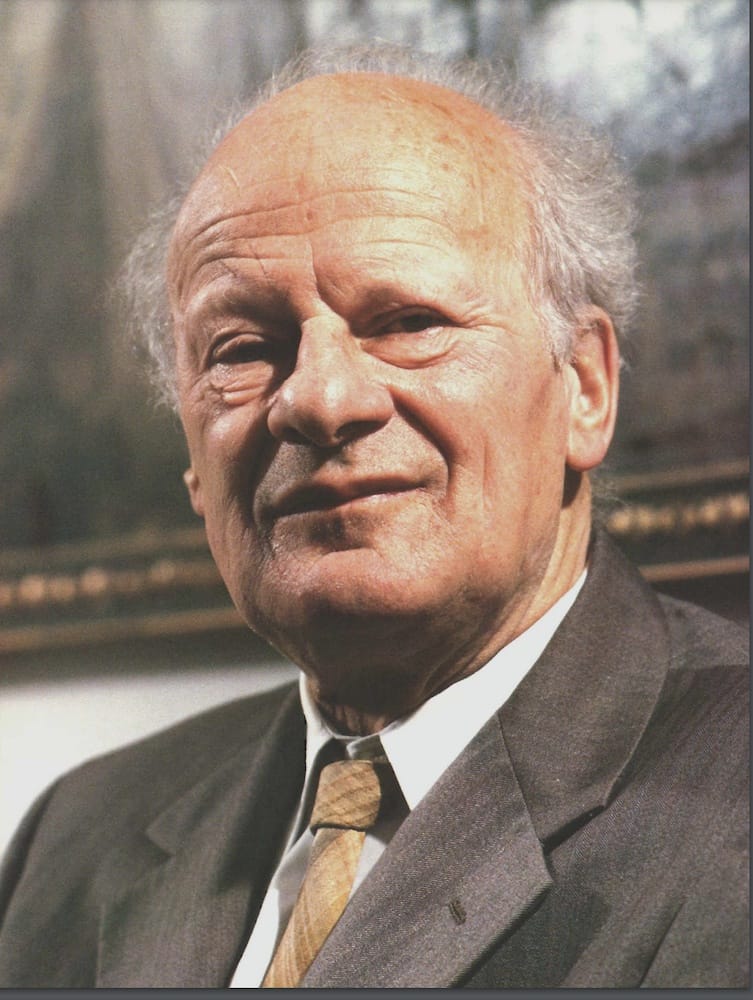
See also: Videos featuring Hans Bethe on Web of Stories
See also: Open Vault on WGBH:
Part of War and Peace in the Nuclear Age.
A Nobel Laureate in physics, Hans Bethe served as Director of Theoretical Physics for the Manhattan Project from 1943-1946, and later worked on the hydrogen bomb, among other activities. Before and since, he was a Professor of Physics at Cornell University. In this interview, he asserts his belief that development of the atomic bomb was inevitable, a conclusion tied to the concept of “technological imperative.”
He also believes that there have been several missed opportunities to impose meaningful controls over nuclear weapons. He then recounts his arrival in the United States in 1935, the state of the field at that time, and the implicit competition with German scientists on nuclear matters. Discussing his time at Los Alamos, he relates the conflicts that arose between scientists and military representatives, and recalls the experience of witnessing the Trinity test. He then discusses general attitudes among the Los Alamos community toward the Soviets and the question of whether an arms race was likely after the war.
His first reaction to Hiroshima was pride and elation at the end of the war, he recalls, later tempered by the evidence of devastation that occurred. After the war, in his recounting, he and a number of colleagues felt obliged to educate the public about the dangers of nuclear war. He comments briefly on the unnecessary Bikini test and on the Baruch Plan. And he closes with a commentary on the scope of the danger involved in a conflict with hydrogen bombs, which he calls “a multiplication of evil.”
Amid the violence, fear and desperation of World War II, nuclear weapons are created and used for the first time.
“Dawn” traces the development of the first atomic bomb, from 1932 with the ominous rumblings that led to World War II and the ground-breaking scientific experiments that led to the bomb. Atomic physicist Victor Weisskopf explains, “we did not think at all that this business would have any direct connection with politics, or with humanity.” The frantic rush by American scientists who feared the Nazis were ahead of them and the first nuclear explosion in the New Mexico desert on July 16, 1945 are described by eyewitnesses. Physicist Philip Morrison was ten miles away from the blast and will never forget the heat on his face. “Dawn” concludes with the failure of the first attempts to reach agreement on international control of atomic weapons after the war.
Please note that information taken from Wikis should be verified using other, more reliable sources. It is a good place to start research, but because anyone can edit a Wiki, we do not recommend using it in research papers or to obtain highly reliable information.
See also: Matt Novak. We’ve Been Failing to Predict Peak Oil For Over a Century. 11 Oct 2014. Paleofuture.
See also: Victor K. McElheny. Hans Bethe Urges U.S. Drive for Atom Power and Coal. 14 Dec 1974. New York Times.
…Because a nation’s level of prosperity depends directly on the amount of energy used, Dr. Bethe said, “it is an illusion to think that we can solve our problem by energy conservation alone. For the next few years, conservation must play a very important role, but at the same time, we must use and develop all our alternative energy sources.
“…With the demand for energy increasing constantly, there seems to me no prospect that oil will be plentiful,” Dr. Bethe said. “The hope for a lower oil price is paralyzing long‐range action on energy in Washington and elsewhere.
“Only if we achieve virtual energy independence can there be any hope for a drop in the oil price.”
Most expectations are that oil and natural gas will continue to be in short supply at least until 1985, Dr. Bethe said, and demands on coal will be heavy, not only for industry and electric power generation but also for artificial gas. Hence, “we urgently need, another, non‐fossil source of power,” he said. “The only such source which is available and which has been developed for use is nuclear power from fission,” or splitting a heavy atom such as uranium virtually in half.
Work on harnessing thermonuclear fusion, which brings together atoms of the lightest element, hydrogen, to form helium, in order to generate electric power, is being “stepped up” about five‐fold, Dr. Bethe said.
“But it would be irresponsible,” he said, “to expect quick results, or to base our energy policy on the expectation that fusion will solve our problem in the next 10 or 20 or 30 years.””
Victor K. McElheny. Hans Bethe Urges U.S. Drive for Atom Power and Coal. 14 Dec 1974. New York Times.
See: House committee votes to deny climate change
See: All Things Nuclear
See: EPA Findings on Hydraulic Fracturing Deemed “Unsupportable”
See: Leaked EPA Documents Expose Decades-Old Effort to Hide Dangers of Natural Gas Extraction
See: Smackdown: climate science vs. climate economics
See: Global Warming
See: Probe Earth’s Interior with Advanced Radiation Sources
See: The Deep Hot Biosphere : The Myth of Fossil Fuels
See: Center for Dark Energy Biosphere Investigations (C-DEBI)