Our mission is to explore life beneath the seafloor and make transformative discoveries that advance science, benefit society, and inspire people of all ages and origins.
In a provocative 1992 essay, Thomas Gold postulated the existence of a “deep, hot biosphere”, supported by geological energy sources. The potential for the oceanic deep biosphere to influence global biogeochemical processes scales with the size of the subseafloor as a habitat.
Center for Dark Energy Biosphere Investigations (C-DEBI)
The ramifications of a massive buried biosphere of “intraterrestrial microbes” are significant, leading to paradigm shifts in our thinking in the biosciences and geosciences.
“Water is life!”
McGenity, Terry, Jan Roelof Van Der Meer, and Victor de Lorenzo. Handbook of hydrocarbon and lipid microbiology. Ed. Kenneth N. Timmis. Vol. 552. Berlin: Springer, 2010. (3 Dec 2009)
“Despite an intense focus on discovering abiotic hydrocarbon sources in natural settings, only a handful of sites convincingly suggest that abiotic organic synthesis occurs within the geosphere…
…The crux of this topic is that currently there is no foolproof approach to distinguishing abiotic versus biotic organic synthesis. Thus, it is especially important to be cognizant of the possibilities and limitations of abiotic hydrocarbon production when considering a deep subsurface biosphere where the organic matter may be synthesized by both abiotic and biotic processes.” (Proskurowski, 2010)
Proskurowski, G. “Abiogenic Hydrocarbon Production at the Geosphere-Biosphere Interface via Serpentinization Reactions” in Timmis, Kenneth N., ed. Handbook of Hydrocarbon and Lipid Microbiology. Berlin, Heidelberg: Springer, 2010
See also: Life in the Oceans | The Why Files.

See also: The Sloan – Deep Carbon Observatory (DCO)
The Deep Carbon Observatory is a program of the Carnegie Institution for Science, Alfred P. Sloan Foundation, and the Carnegie Institution of Washington.
The Sloan – DCO mission includes the fostering of international cooperation in addressing global-scale questions, including the nature and extent of deep microbial life, the fluxes of carbon dioxide from the world’s volcanoes, and the distribution and characteristics of deep hydrocarbon reservoirs.
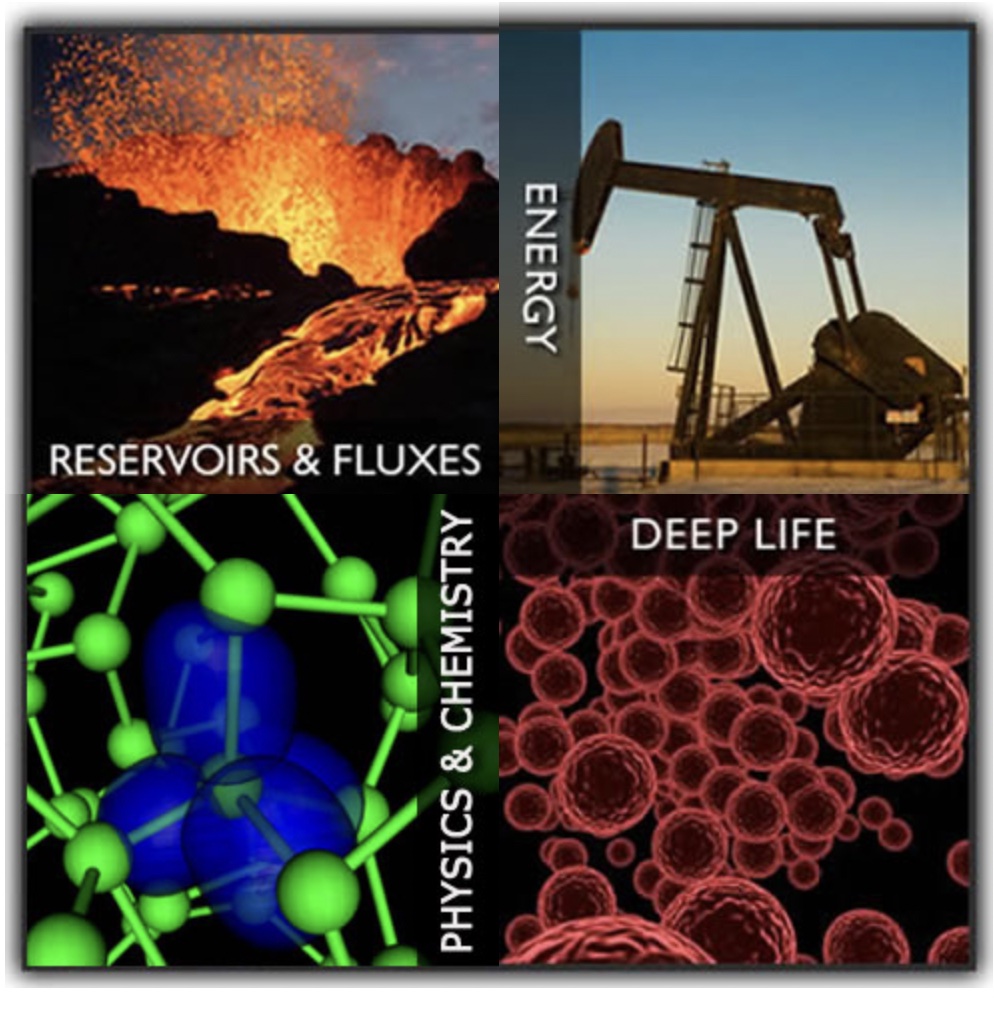
The DCO is currently composed of four science directorates: Deep Life; Reservoirs and Fluxes; Energy, Environment, and Climate; and Physics and Chemistry of Carbon.
The deep carbon cycle has unknown and potentially profound connections to societal concerns related to energy, environment and climate. Carbon-based fuels supply most of our energy, while small carbon-containing molecules in Earth’s atmosphere play a major role in our variable and uncertain climate. Anecdotal, and often contradictory, evidence points to possible abiotic organic synthesis in some deep crustal and mantle environments. Deep organic synthesis might contribute to some petroleum deposits and it may have played a role in life’s origins as well. The principal research tasks of the Deep Carbon Observatory will likely focus on deep abiotic organic synthesis and stability.
Guiding questions for the Deep Carbon Observatory include:
What is the nature and extent of deep organic synthesis?
What physical and chemical evidence constitutes an unambiguous abiotic signature?
Is there a deep source of abiotic methane?
Does methane migrate to shallow crustal zones, for example into methane hydrates or petroleum reservoirs?
What is the role of deep methane in sustaining the subsurface biosphere?
What are the thermochemical and physical properties of water-CO2 fluids at mantle conditions?
Might the study of deep carbon reservoirs inform efforts to sequester CO2 in deep reservoirs?
References:
Gold, Thomas. The Deep Hot Biosphere : The Myth of Fossil Fuels. New York: Springer | Copernicus, 1998.
Goncharov, Alexander. “Unanswered Questions in Deep Carbon Research” presented at the 2009 Annual Meeting keynote | Sloan Deep Carbon Cycle Workshop, Carnegie Institution, Geophysical Laboratory | Washington, D.C., May 15, 2008. (PDF 4.4 MB)
Proskurowski, G. “Abiogenic Hydrocarbon Production at the Geosphere-Biosphere Interface via Serpentinization Reactions” in Timmis, Kenneth N., ed. Handbook of Hydrocarbon and Lipid Microbiology. Berlin, Heidelberg: Springer, 2010.
See: Probe Earth’s Interior with Advanced Radiation Sources
See: The Deep Hot Biosphere : The Myth of Fossil Fuels
See: Tales from the Ice: Explaining Rapid Climate Change
See: Smoke Signals
See: BP – For BP, a History of Spills and Safety Lapses
See: Drinking Water: Understanding the Science and Policy behind a Critical Resource
See: Art of the common-place: the agrarian essays of Wendell Berry