For best viewing, click ⛶ for fullscreen.
These Two Circles: Out Walking | Sep 2025
12 minutes read time.
We begin by looking down.
Cracks in the sidewalk spread beneath us as if we were looking at them from space. They dissolve into small white flowers, then grasses stand in front of a concrete wall as though they have been placed in an art gallery.
A flower pushes toward us for attention. Sunlight glistens on a shadowy creek. The chirping of creatures we cannot see has already demanded our attention.
We listen.
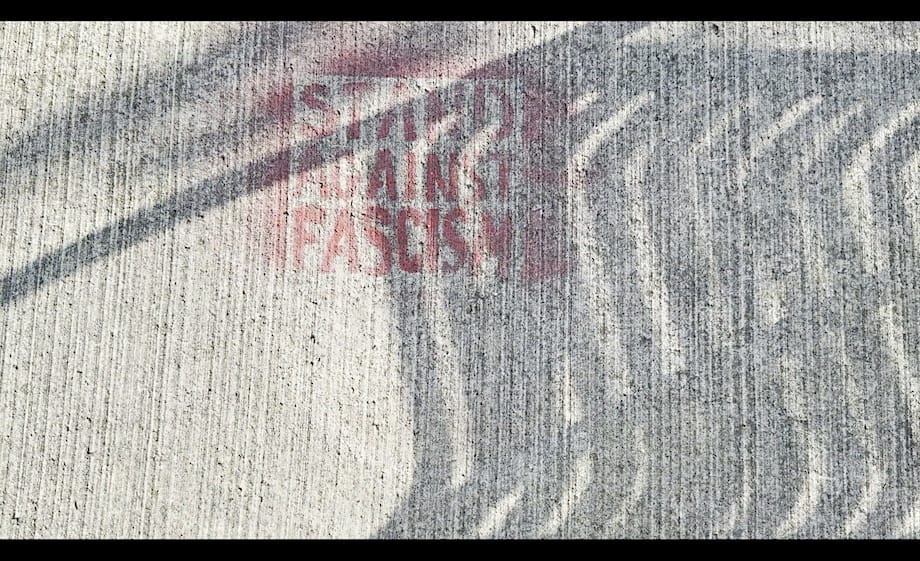
Painted fencework becomes another pattern around the words Stand Against Fascism. A rope circles a dockside piling, bound tight, revolving in front of us.
Wisps of dandelion drift. Gulls call out and one finds a fish. The metal of a guardrail falls beneath the pages of a mechanical flipbook.
On the Commons, I stop at Autumn Leaves and spend time with Wendy Marvel and Mark Rosen’s Mechanical Flipbook. A little girl opens a green-and-yellow heart:
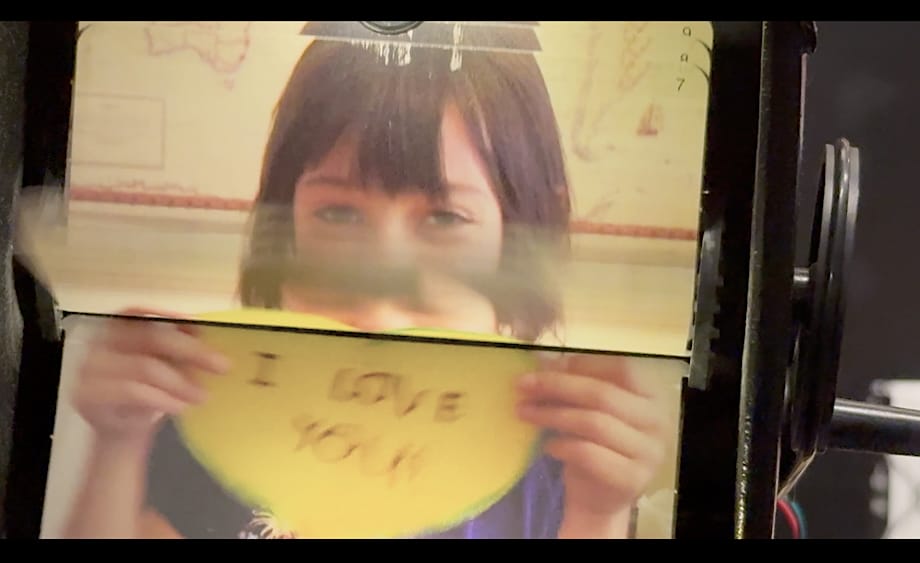
I love you.
Nearby, an optical illusion in the Alphabet Soup toy-store window asks us to:
Look at these two circles.
The instruction is simple enough. Look.
At the Brain Shoppe, a silver atomic model spins. Its circles become flashing lights, then rain washes toward a sewer.
The circles do not stay in the window.
Around the corner from my house, the surface of the street is being peeled away. A Roadtec RX-700 grinds the asphalt and vacuums it into a truck. Underneath, rows of brick appear, a street hidden beneath the street we have been walking on.
Perhaps those bricks were laid before motorized vehicles traveled here.
For the moment, they are visible again.
On the machine is a heraldic shield with three lions and the slogan Making America Great Again. The machine moves across a much older road while removing the one laid over it.
A sewer cover spins as though it has entered orbit. My walking shadow passes beside it, seeming to propel the circle into an unnatural motion.
Later, heading south on Corn Street and turning onto Cleveland Avenue, I pass St. James AME Zion Church, founded in 1836. Frederick Douglass and Harriet Tubman came here to speak. The church became an Underground Railroad station and later an enlistment site for Black soldiers during the Civil War.
Nearby, a monument remembers the men of the 26th Regiment United States Colored Infantry.
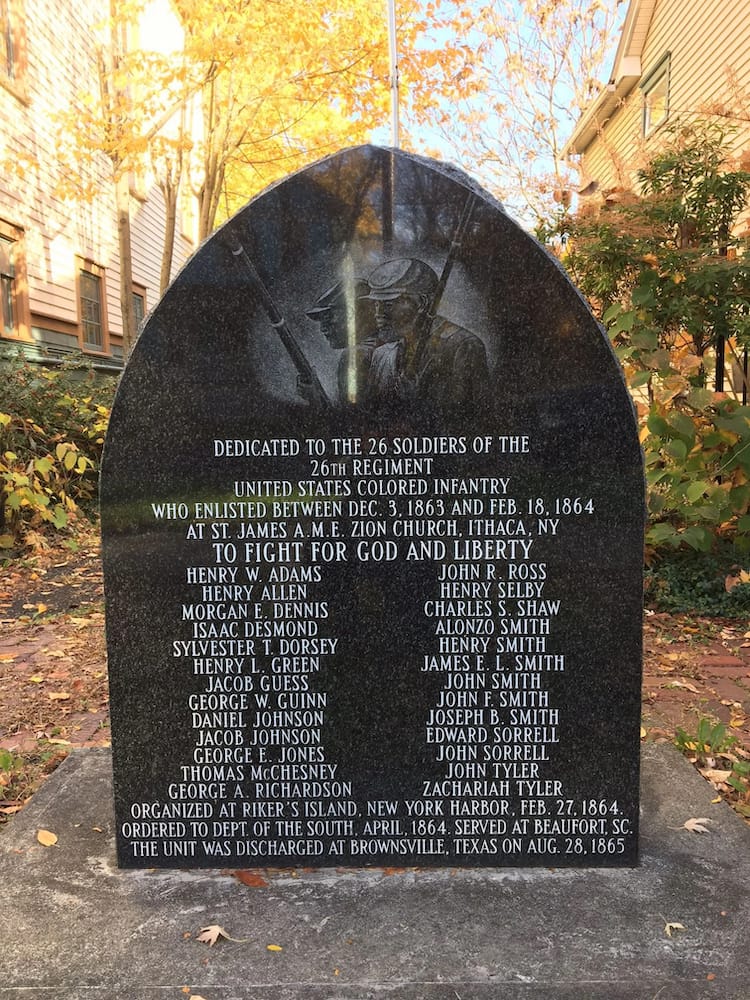
The street has layers. So does the walk.
The monument dissolves back into the road machine.
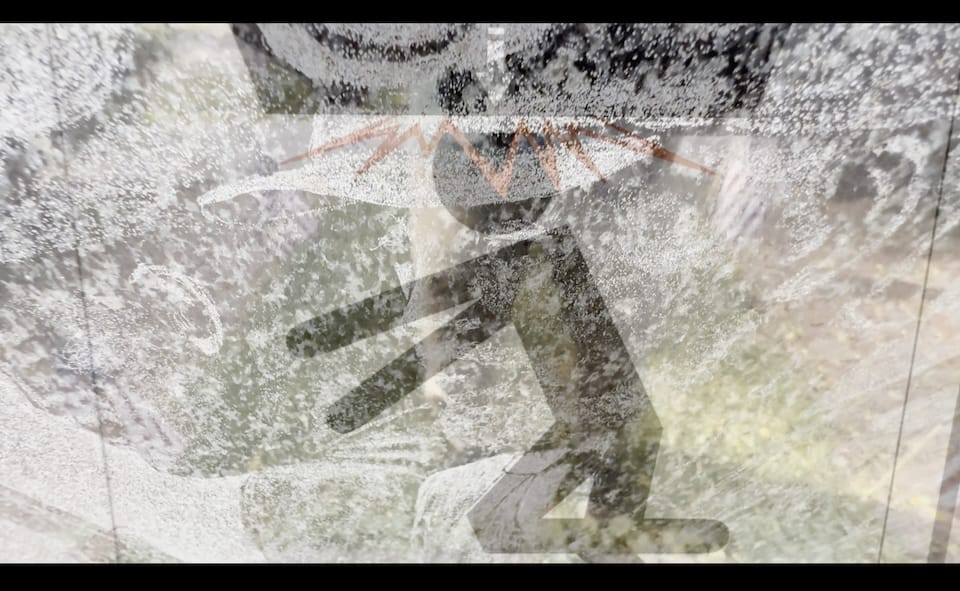
On its side, a safety graphic shows a black figure beneath a descending weight. A cartoon-red explosion of pain rises from the figure’s head like a crown:
Set Safety Bars Before Working.
Then a control panel, with a large red button.
Emergency stop?
Out to the lake and its yellow flowers and grasses. A cacophony of yellow, a pattern on the water, oscillating on the wave, floating into watery cloud reflections. The arches of the bridge reveal the shoreline, and one wonders how much time has elapsed between the town and my walking out to the lake.
Through the arches of the bridge we see the shoreline.
How much time has passed between the town and my walking out to the lake?
Another control panel floats into our gaze. Its red switches appear to have melted in the heat.
By coincidence, I pass a Dungeons & Dragons shrine.
Lost or found?
Another warning. A black arrow strikes the black figure in the chest. Another comes down on its head.
In a panoramic mirror I appear too, walking past, recording with my phone.
A bee works a flower. Rowers pass on the inlet, disappear, then appear again.
Oscillation becomes vibration and dissolves into smoke. From the smoke rises a sign:
No Smoking.
Six ducks seen from overhead move across a stony creek and merge into oscillating water.
Large flowers parade past. More rowers. Autumn leaves. A snake darts into the bushes. Sunlight moves through leaves and a sunflower fills our view.
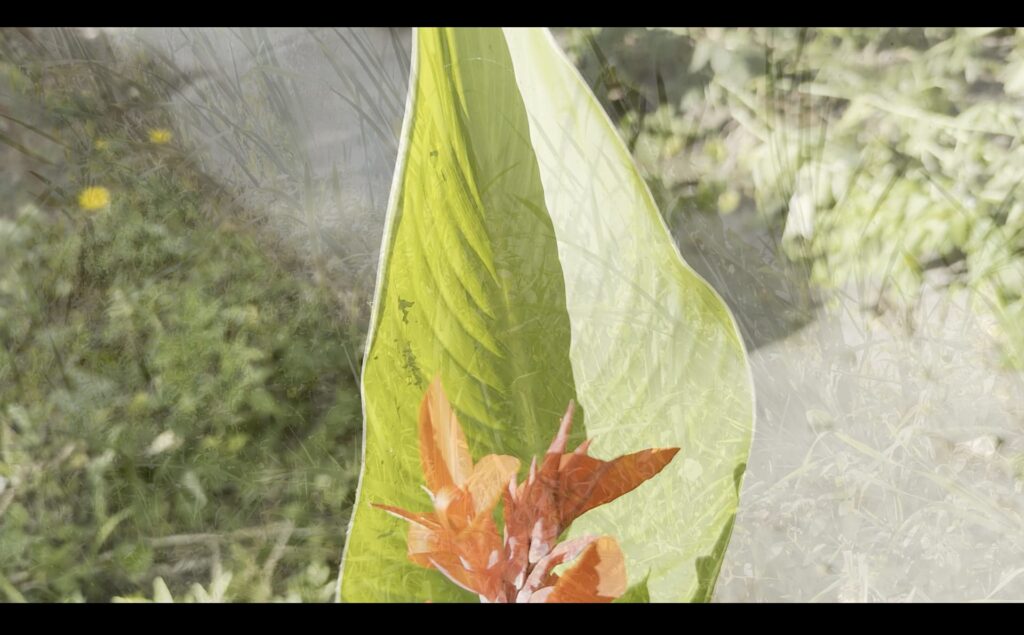
Yellow circles become rusty circles of seasonal change.
A wooden houseboat. A chair. A silver wheel.
Heading west is the best way forward.
My long shadow walks east.
Stones on a bridge. A bee riding the wind.
My footsteps return us to spinning metal sewer grates. We look up through a web of leaves that becomes a spider’s web, then the glassy sheen of wet black asphalt, then a black glass ornament in a garden.
Each catches the light.
Our box elder is being pruned. An arborist suspended from a crane carefully brings down a large branch.
The streets are worked on. The trees are cared for.
Back at the lake, rowers pass below us. Their oars enter the water and leave it again. Reflections form, disappear, return.
I keep walking.
Looking down, the toe of my boot flies past in a cacophony of pebbles in motion.
A bell rings.
A historic blue Ford F-250 Twin I-Beam beckons us to remember. A pair of Harley-Davidsons, orange and silver. A horn sounds like a ship at sea.
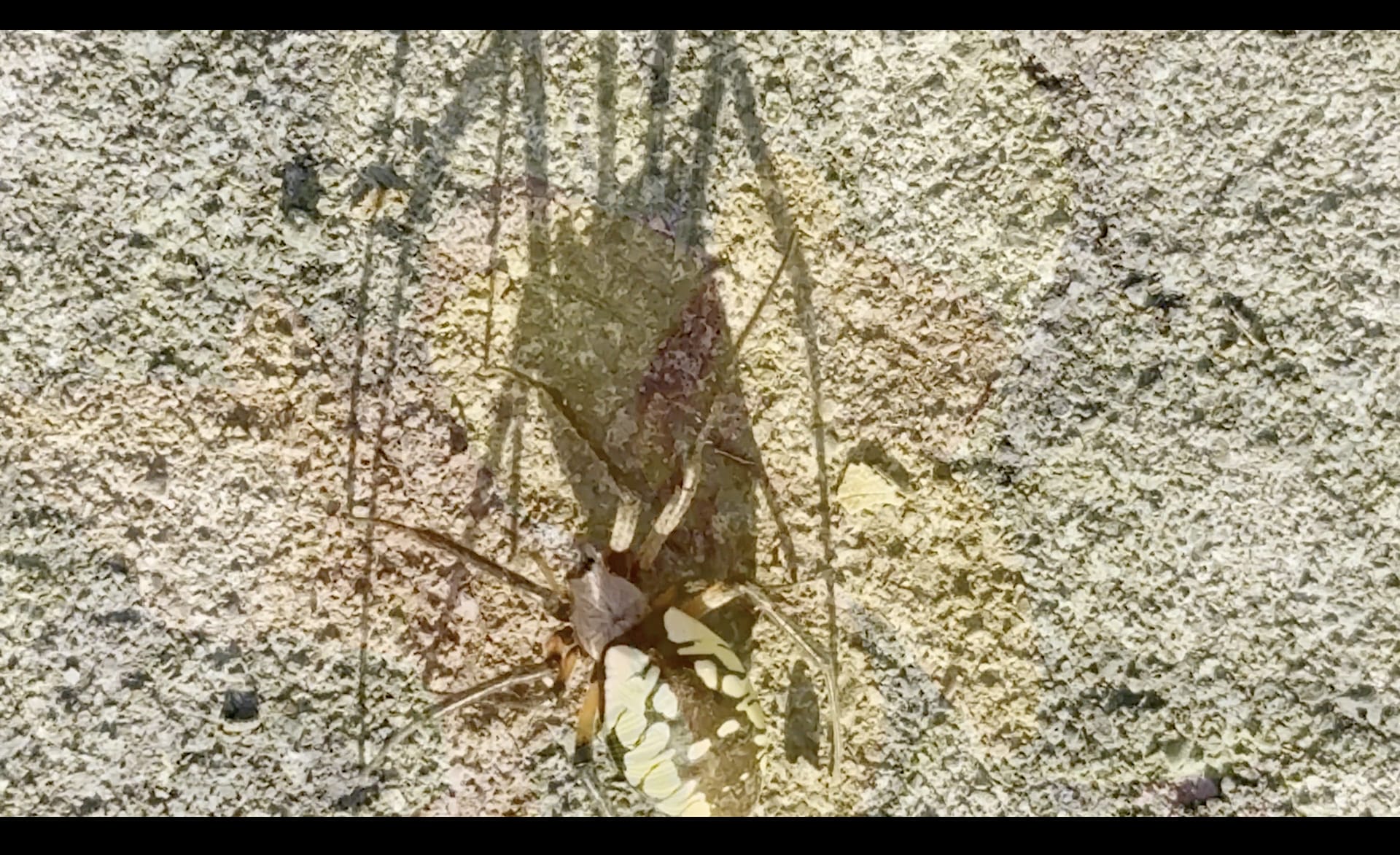
A spider and its shadow become larger than life.
Here I am!
Orange flowers dance in the wind. If we could find the saddle, perhaps we would ride them.
Richard wears a T-shirt with a hammer on it:
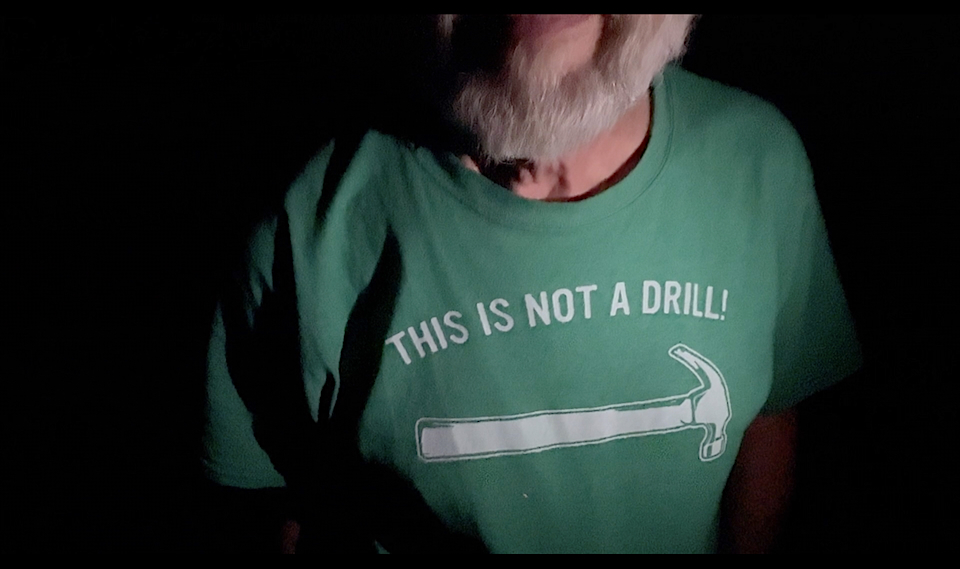
This is not a drill.
A mushroom. A fall leaf losing its color in the gray rain. A grasshopper repositions itself.
A sign says:
Free Air.
Another says Fastest in Pit Town, except the S has fallen onto its side. It has been that way long enough that perhaps no one notices anymore.
We pass through the clouds toward the stars and somehow wind up again at the water’s edge.
More rowers.
More oscillations.
Reflections emerge and disappear.
Inside a house, a shiny faucet has been replaced. Cat bottles sit on a windowsill. The trigger of a gun. Lost shoes. A wrench.
Then outside again: a crosswalk, railroad tracks, lake reeds in the midst of cicada songs.
Old friends all.
The walk keeps circling without returning to exactly the same place.
Flowers, wheels, atoms, sewer covers, buttons, ripples and oars repeat their forms. A buried street comes into view and will be covered again. A monument keeps an earlier Ithaca visible. Warning signs describe what might happen to a body. An arborist lowers a branch carefully to the street.
Some things are uncovered. Some things are protected. Some are forgotten until we happen to notice them again.
The optical illusion asked us to look at two circles. It did not tell us what to think about them.
Perhaps that is enough.
The eye follows one circle while the mind travels another. The route of the walk repeats while thought wanders elsewhere and returns. What appears to be one thing becomes something else because another image has come beside it.
The old street exists beneath the new one.
History exists beside the roadwork.
Clouds appear in asphalt.
A spider becomes a signal.
A flower becomes a circle.
The water moves and returns without becoming the same water.
The two circles are never only two circles.
We keep looking.
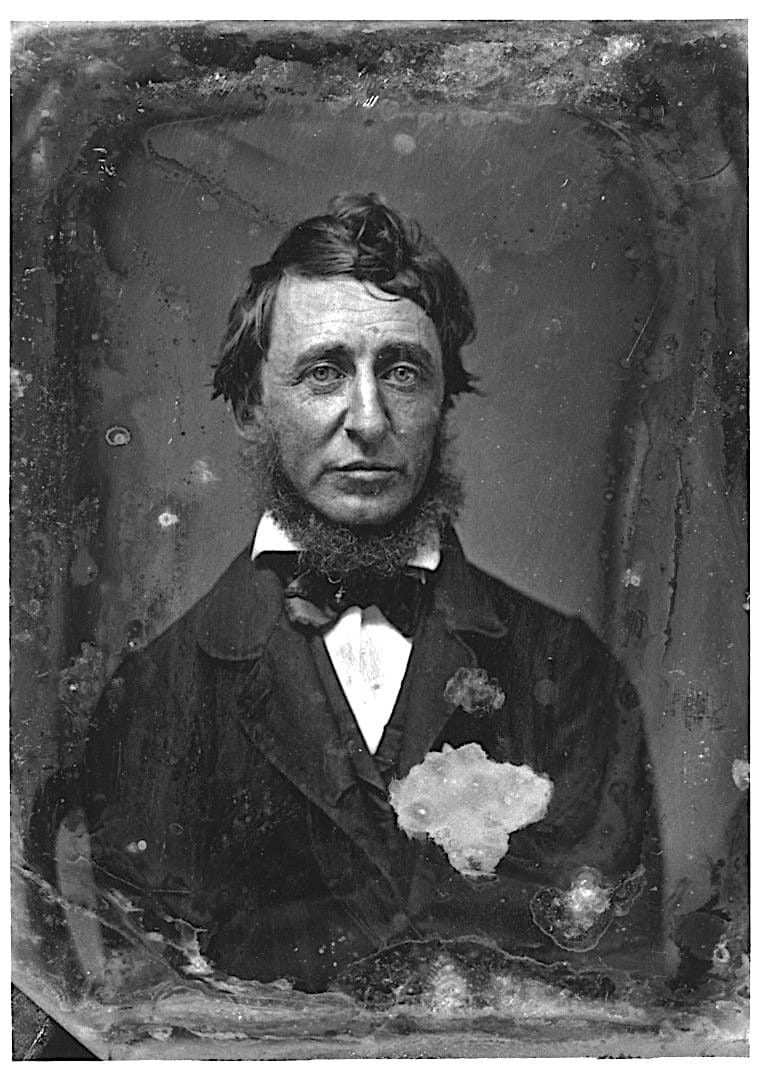
At present, in this vicinity, the best part of the land is not private property; the landscape is not owned, and the walker enjoys comparative freedom. But possibly the day will come when fences shall be multiplied, and man-traps and other engines invented to confine men to the PUBLIC road. … Let us improve our opportunities, then, before the evil days come.
Henry David Thoreau. Walking. As published in Atlantic Monthly, 1862.
What is it that makes it so hard sometimes to determine whither we will walk? I believe that there is a subtle magnetism in Nature, which, if we unconsciously yield to it, will direct us aright. It is not indifferent to us which way we walk. … We would fain take that walk, never yet taken by us through this actual world, which is perfectly symbolical of the path which we love to travel in the interior and ideal world.
Smackdown
Official Story / Public Reckoning / Deeper Contrast
September 2025
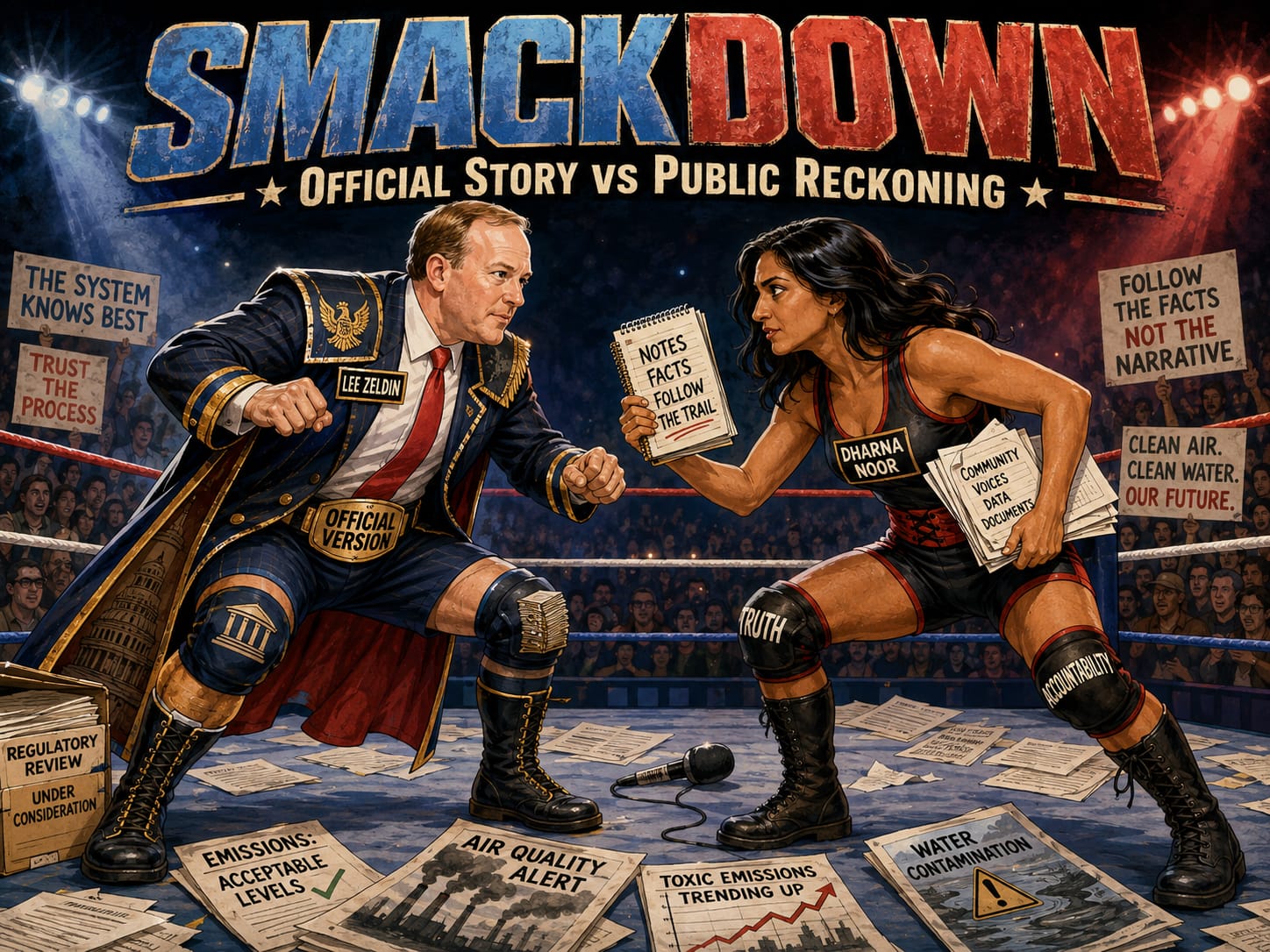
Federal / EPA, Energy
Federal agencies describe September through deregulation, energy abundance, affordability, reliability, and growth. Greenhouse-gas reporting becomes a regulatory burden. Rising electricity demand becomes a reason to expand generation. Coal, natural gas, nuclear power, and domestic production are presented as tools for energy security and technological leadership.
Emphasis
- EPA proposes removing Greenhouse Gas Reporting Program obligations for 46 source categories, covering most of the more than 8,000 facilities and suppliers then required to calculate and report their greenhouse-gas emissions.
- EPA describes the reporting program as “bureaucratic red tape” and estimates that ending most requirements could save businesses as much as $2.4 billion in compliance costs.
- Energy Secretary Chris Wright describes rising demand for affordable, reliable, and secure energy, emphasizing the electricity required for rapid development of artificial intelligence and the need for dependable baseload power.
- Energy promotes expanded U.S. gas exports and an “energy dominance” agenda in Europe, presenting American production as a source of lower prices, security, and geopolitical stability.
- Energy announces a $625 million investment to expand and reinvigorate the coal industry, linking coal generation to grid reliability, lower electricity prices, reindustrialization, and the race to power AI.
Key rhetoric
- “Bureaucratic red tape”
- “Energy dominance”
- “Affordable, reliable, and secure”
- “Energy addition, not subtraction”
- “Reinvigorate”
- “Powering the AI race”
Foregrounded
Compliance costs, energy supply, electricity demand, AI, national security, industrial growth, grid reliability, and domestic production. The emphasis is on what government can remove, save, expand, reinvigorate, and keep operating.
Minimized or absent
What disappears when emissions are no longer routinely reported: the ability of governments, researchers, communities, and the public to see where greenhouse gases are coming from, compare sources, follow changes, and preserve a record of what was emitted.
The New York Times, The Guardian / National Academies
The public record follows September from policy to what can still be known. Emissions are measured rather than made smaller by changing their description. Scientific evidence returns the discussion to health and physical harm. By the end of the month, even the language used to describe climate change has become part of the story.
Emphasis
- Maxine Joselow reports that thousands of major industrial facilities would no longer have to disclose their greenhouse-gas emissions. The data had provided one of the country’s principal ways to track carbon dioxide, methane, and other heat-trapping gases by source.
- Oliver Milman reports that U.S. greenhouse-gas emissions rose 1.4 percent during the first half of 2025. Analysis by the Rhodium Group also projects a substantially slower pace of emissions reduction following the reversal of federal climate and clean-energy policies.
- The National Academies reviews scientific evidence accumulated since EPA’s 2009 Endangerment Finding and concludes that human-caused greenhouse-gas emissions continue to harm public health and welfare. The evidence has grown stronger, not weaker.
- A planetary health assessment finds ocean acidification has crossed a critical threshold. Carbon dioxide from burning coal, oil, and gas enters seawater and changes its chemistry, with consequences for corals, shell-forming organisms, food webs, and the ocean’s ability to absorb carbon.
- Dharna Noor reports that employees in an Energy Department office were told to avoid terms including “climate change,” “emissions,” and “decarbonization” in internal and public-facing work. The Department of Energy denied that such a directive existed.
Key rhetoric
- Data
- Measurement
- Emissions
- Evidence
- Harm
- Health
- Language
Foregrounded
Measurements, trends, public data, scientific evidence, human health, atmospheric pollution, ocean chemistry, and the language available to describe them. The reporting keeps returning to what can be observed, counted, compared, and named.
Minimized or absent
Deregulation, affordability, reliability, and energy abundance are not accepted as complete descriptions. The public reckoning asks what becomes harder to see when measurements disappear, what the measurements continue to show, and whether changing the language changes the physical consequence.
Key verbs
Federal verbs: remove, save, unleash, secure, expand, reinvigorate, power
Public verbs: measure, report, track, compare, rise, harm, name
Sources
- U.S. Environmental Protection Agency. EPA Releases Proposal to End the Burdensome, Costly Greenhouse Gas Reporting Program, Saving Up to $2.4 Billion. 12 Sep 2025. U.S. Environmental Protection Agency.
- U.S. Department of Energy. U.S. Secretary of Energy Chris Wright Delivers U.S. National Statement at the General Conference of the International Atomic Energy Agency in Vienna, Austria. 16 Sep 2025. U.S. Department of Energy.
- U.S. Department of Energy. ICYMI: Secretary Wright Advances President Trump’s Energy Dominance Agenda in Europe. 18 Sep 2025. U.S. Department of Energy.
- U.S. Department of Energy. Energy Department Announces $625 Million Investment to Reinvigorate and Expand America’s Coal Industry. 29 Sep 2025. U.S. Department of Energy.
- Maxine Joselow. E.P.A. to Stop Collecting Emissions Data From Polluters. 12 Sep 2025. The New York Times.
- Oliver Milman. Jump in US greenhouse gas pollution pushed global emissions higher – report. 10 Sep 2025. The Guardian.
- National Academies of Sciences, Engineering, and Medicine. National Academies Publish New Report Reviewing Evidence for Greenhouse Gas Emissions and U.S. Climate, Health, and Welfare. 17 Sep 2025. National Academies.
- The Guardian. World’s oceans fail key health check as acidity crosses critical threshold for marine life. 24 Sep 2025. The Guardian.
- Dharna Noor. US energy department cracks down on workers’ use of climate crisis language. 30 Sep 2025. The Guardian.
The Deeper Contrast
The optical illusion asks us to look at two circles. The road machine removes one surface and reveals another. A memorial keeps people and events from disappearing entirely into the past.
Again and again, September returns to what can be seen, and what becomes visible only when we look longer.
Thoreau imagined the actual walk and the interior walk occupying the same world. I experience something similar here. I walk through streets, flowers, machinery, warnings, water and smoke while another route forms through history, politics, memory and thought. The two paths cross without becoming the same path.
The public argument over climate moves through the same world. Measurements do not create emissions. Scientific language does not create heat, smoke or changing ocean chemistry. These are attempts to describe what is already happening.
Stopping a measurement can make something harder to see. Changing the language can make something harder to name. Neither changes the material condition.
The smoke is there for the believer and atheist.
We may disagree about why the world exists, what gives it meaning, or what obligations follow from being here. The street remains beneath our feet. The atmosphere surrounds us. The body breathes what is in the air.
What binds is not necessarily belief.
What binds is what is real.
Perhaps that is another way to look at these two circles: the world as we describe it and the world that continues whether or not our descriptions are adequate.
Walking moves through both.
See also: Minho Kim. 5 Takeaways From Trump’s Address to Generals and Admirals. 30 Sep 2025. New York Times.
The president suggested troops use cities as military ‘training grounds.’
Mr. Trump again labeled large coastal cities run by Democratic mayors as “unsafe” and “dangerous” places where law enforcement officers faced brutal attacks by protesters and “career criminals” roamed for victims. That, he said, was his rationale for deploying the National Guard troops to Washington, Chicago and Portland, Ore., adding he would “straighten them out one by one.”
But then he went a step further. The president recounted telling Mr. Hegseth that the U.S. military should use those cities as “training grounds” for future wars.
See also: The Editorial Board. The Trump Administration’s Chilling Efforts to Punish Free Speech. 19 Sep 2025. New York Times.
“The ability to disagree with other people on raw, difficult issues, without fear of repression, is the essence of American freedom.”
See also: Moira Donegan. Jimmy Kimmel, Stephen Colbert … who is the next to be silenced? 18 Sep 2025. The Guardian.
“When a regime can use the power of the law to punish speech because it does not like that speech, then speech is not free.”
See also: Maxine Joselow and Brad Plumer. Trump Administration Taps Climate Science Critic to Oversee Flagship Report. 10 Jul 2026. New York Times.
“Matthew M. Wielicki has criticized the scientific consensus on global warming as alarmist. Now he’ll oversee a major federal report on the topic.”
See: Civil Disobedience
See: Criminalising Civil Disobedience
See: Drinking Water: Understanding the Science and Policy behind a Critical Resource
See: Climate Zombies Now Run The House
See: Scalise: EPA Declares CO2 a Dangerous Pollutant Based on “Climate Gate’s” Corrupt Science
See: Louisiana tells EPA that it should let Congress handle greenhouse gas regulation