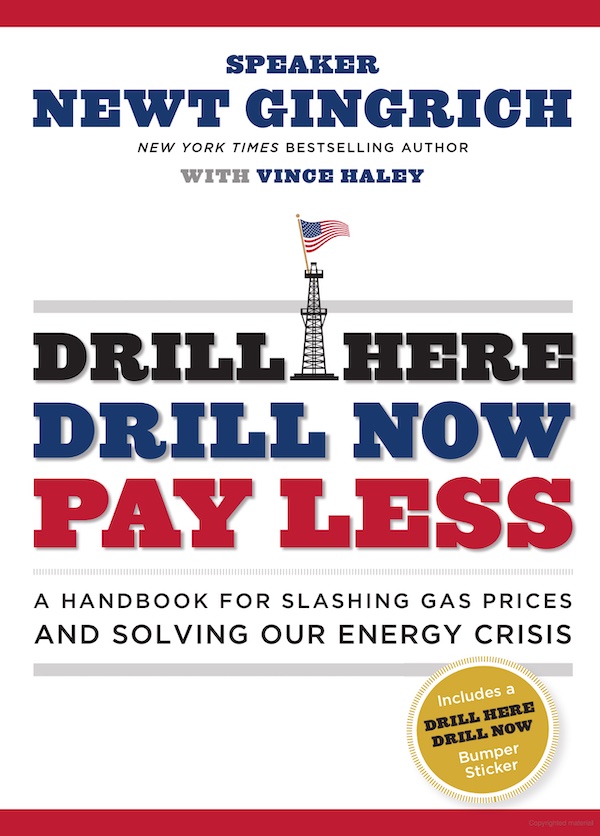
Gingrich, Newt, and Vince Haley. 2008. Drill here, drill now, pay less: a handbook for slashing gas prices and solving our energy crisis. Washington, DC: Regnery Pub. (download ebook)
“Drill, baby, drill” is a slogan that supports increased drilling for oil and gas. It’s been used to promote domestic energy sources, but it has also raised concerns about the impact on fisheries and coastal communities.
Concerns about fisheries
- Pollution and oil spills Offshore drilling can pollute the ocean and cause oil spills, which can harm wildlife and fishing industries.
- Economic stability Coastal economies that rely on tourism and fishing can be endangered by offshore drilling.
Other concerns
- Climate change Offshore drilling can divert investment from renewable energy, which can exacerbate climate change.
- Local opposition Some coastal towns fear negative side effects to their tourism and fishing industries.
Supporters
- Oil and gas industry The oil and gas industry supports the slogan because it promotes increased drilling.
- Republican vice presidential nominee Sarah Palin Palin used the slogan during the vice-presidential debate, which helped it gain further prominence.
Opponents
- Environmentalists and activists Environmentalists and activists oppose the slogan because it threatens ocean health and coastal communities.
- Marine conservation groups Marine conservation groups like Oceana oppose the slogan because it ignores local and state opposition.
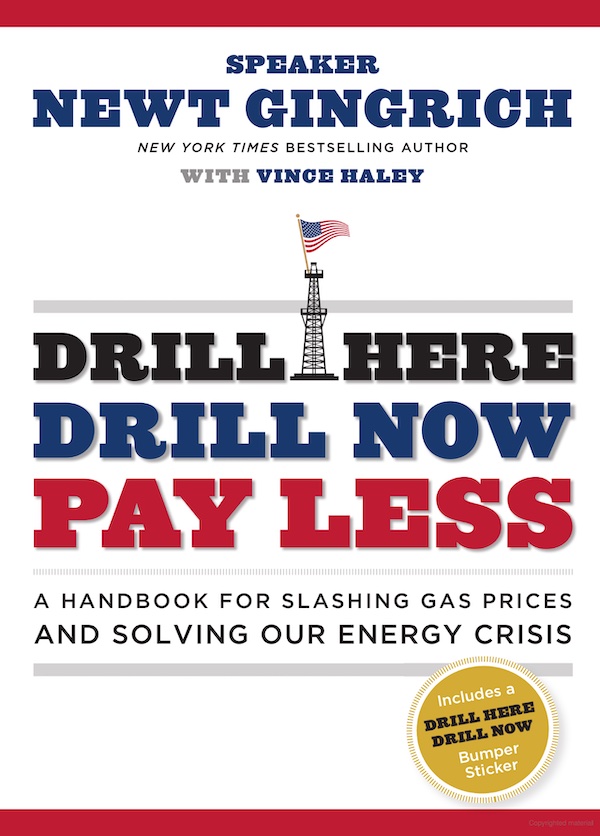
From Amazon website: New York Times bestselling author, former Speaker of the House, and Fox News political analyst Newt Gingrich has a plan for slashing gas prices and reducing our long-term dependence on foreign oil.
Gingrich is famous for taking big, visionary ideas and boiling them down into practical solutions as demonstrated in this year’s earlier release, Real Change, which was on the New York Times bestseller list for eleven weeks. His new book Drill Here, Drill Now, Pay Less does just that. Dealing not only with spiraling gas prices, but with the energy crisis as a whole, Gingrich shows how we can safely reap the benefits of America’s own natural resources and technology in gas, oil, coal, wind, solar, biofuels and nuclear energy.
Gingrich argues that the pinch Americans are feeling at the pump is not a blip in the economy but a looming crisis–affecting not only the price of gas, but the price of food, the strength of our economy, and our national security.
To meet this crisis, Gingrich lays out a national strategy that will tap America’s scientists, engineers, and entrepreneurs, and require Congress to unlock our oil reserves and remove all the impediments and disincentives that unnecessary government regulation has put in the way of American energy independence. The energy crisis is solvable, as Newt Gingrich’s plan makes clear. His handbook, Drill Here, Drill Now, Pay Less is sure to become the talk of the presidential campaign season.
Fishing for pleasure or business? Drinking beer? These are only 2 of the human endeavors threatened by unregulated offshore and land based drilling.
Editor’s note, 4 Feb 2025: Zeke Grader of The Pacific Coast Federation of Fishermen’s Associations (PCFFA) published a review of the Gingrich book but it can no longer be located online. I will be reaching out to them to obtaion a copy of that review to publish here.
See also: Pacific Coast Federation of Fishermen’s Associations. Testimony of W.F. “Zeke” Grader, Jr. Executive Director Pacific Coast Federation of Fishermen’s Associations To the Assembly Water, Parks & Wildlife Committee on California Salmon Crisis: Understanding the Severity of the Crisis and the State’s Role in Recovery. State Capitol, Sacramento 10 March 2009. State of California.
…In my 33 years with PCFFA I have witnessed our salmon fishery decline from nearly 6,000 active vessels in California – employing at-sea and onshore thousands of people – to a fleet of roughly 600 boats in the state. We witnessed record ocean landings of more than 14 million pounds of chinook in the commercial fishery in 1988, along with a healthy recreational fishery and good returns to the rivers that same year, to a total closure, for the first time in history…
…You will undoubtedly hear of the myriad of problems facing salmon, from impediments to passage, to unscreened diversions, to lack of shallow water habitat, to predation by invasive species, to hatchery practices, to, most recently, poor ocean conditions and climate change. The number and scope of the problems appears daunting and there has been no shortage of handwringing over it. But if we are to be serious about rebuilding our salmon populations and I believe we can – to numbers approximating 20 to 30 millions pounds of production of chinook annually (which would make California the leading producer of that species of Pacific salmon) – than we must get out of panic mode and take a clear view and develop a step-by-step plan for restoring these fish.
…As you know, when you build a house, you follow a plan. You don’t fret about the brand of appliances, the color of the interior walls or the carpet without first doing the basics – laying down a foundation, framing and putting on a roof. It’s really no different in rebuilding salmon populations. The first thing that’s needed is the foundation. Without that nothing else matters. The foundation for rebuilding our salmon stocks in California is making sure there are adequate flows of good quality water so the fish can safely travel from the redds from where they were spawned, downriver – in the case of Central Valley stocks, through the Delta – and to the ocean to return 3 or 4 or even 7 years later to their natal streams to spawn and die and begin the cycle anew.
…Finally, let me add that we also need federal cooperation. The Bureau of Reclamation has to be a party and willing to participate in rebuilding and the U.S. EPA has to be vigilant about water quality. It is also time we had someone at the federal level who is capable of salmon rebuilding all along the Pacific happen. Yesterday a coalition of 78 organizations sent a letter to President Obama requesting his appointment of a White House level “Salmon Director.” I have brought you copies of that letter and hope it can be something you will support.
Pacific Coast Federation of Fishermen’s Associations. Testimony of W.F. “Zeke” Grader, Jr. Executive Director Pacific Coast Federation of Fishermen’s Associations To the Assembly Water, Parks & Wildlife Committee on California Salmon Crisis: Understanding the Severity of the Crisis and the State’s Role in Recovery. State Capitol, Sacramento 10 March 2009. State of California.
Zeke Grader and Glen Spain. Offshore Drilling — It’s Back “Drill, Baby Drill,” Really Burn, Baby Burn for Fisheries. Nov 2008. The Pacific Coast Federation of Fishermen’s Associations (PCFFA).
“America is suffering from an artificial energy crisis that is also a dangerous national security crisis—artificial, because America is gifted with enormous reserves of energy; dangerous, because it makes us vulnerable to unreliable and potentially hostile countries.
With oil prices skyrocketing, electricity costs rising, and the American people rightly outraged at soaring gas prices and our dependence on foreign oil, how did our government respond?
The U.S. Senate was so out of touch with the people who elected it that it considered a bill to make energy more expensive.
The Senate debated this past June—and at one point seemed ready to pass—not a pro-energy bill but an anti-energy bill. Called the Boxer-Warner-Lieberman bill, it would have restricted the domestic supply of energy even more and effectively increased the federal tax on gasoline, diesel, and other fuels and energy supplies.
The Boxer amendment alone would have raised the price of gas by $1 per gallon at a time when family budgets were already being wrecked by high gas prices.
To state the obvious, current American energy policy is a disaster—and our government isn’t doing anything about it. It’s time for we the people to act.”
I wanted to learn more about Zeke Grader, so I did that for you in 2025.
See also: Zeke Grader and Glen Spain. The Fisherman’s Manifesto. Pacific Coast Federation of Fishermen’s Associations and Institute for Fisheries Resources. 1 May 1996.
Human beings now can — and indeed now are — changing the planet far faster than any geological force, but without any guidance whatsoever and with almost no forethought as to the ultimate consequences. Like the demigods and heros of ancient Greek mythology, we are afflicted with our own hubris — the belief that we can do Nature’s job better than she can. This is pure arrogance of the sort which usually leads to tragedy.
Zeke Grader and Glen Spain. The Fisherman’s Manifesto. Pacific Coast Federation of Fishermen’s Associations and Institute for Fisheries Resources. 1 May 1996.
See also: Trent Orr. In Memoriam of Zeke Grader. 11 Sep 2015. Earthjustice.
See also: Zeke Grader. Time to Say Goodbye. 13 May 2015. Fishermen’s News.
…So, yeah, there’s been all of that and a lot more that PCFFA and I am proud of. And while I have been given a lot of credit for accomplishments over the course of my career, I, we, did not do it alone. Key friends in the Congress and state Legislatures and their staff have been critical to making these things happen, as have been the allies among other fishing associations, among recreational fishing groups, among the Tribes and conservation organizations, foundation funders, and among scientists in the bowels of the fishery agencies who really do care about the fish and fisheries despite their agency policies.
But at the end of 40 years, I am not here to look back. The challenges ahead are daunting; more challenging, I believe, than what we faced the past two score of years…
…Preventing Investor Takeover of our Food Supplies. We are already witnessing Wall Street investors getting control over large commodity crops (e.g., almonds, grapes) in the US and abroad. Unless we are careful, our fisheries could be next, making sharecroppers out of fishermen. Catch share programs and individual fishing quotas may make fishing better for some, but unless these programs are carefully crafted and tightly enforced, they will be the pathway for third party take-overs of our fish stocks.
Zeke Grader. Time to Say Goodbye. 13 May 2015. Fishermen’s News.
See also: Suzanne Goldenberg. Barack Obama reverses campaign promise and approves offshore drilling. 31 Mar 2010. The Guardian.
President allows oil and gas exploration off several coastal areas to horsetrade with Republicans over climate change bills.
…But as the summer of 2008 wore on with prices spiking at the pump, Obama along with other Democrats began moderating their opposition to offshore drilling.
Democrats in Congress did not renew an annual ban on offshore drilling, and Obama began reversing his opposition.
See: Before the Big Spill
See: National Commission on the BP Deepwater Horizon Oil Spill and Offshore Drilling
See: BP Deepwater Horizon Committee Hears From Oil Industry Executives
See: National Commission on the BP Deepwater Horizon Oil Spill and Offshore Drilling
See: BP chief hails American breakthrough in gas supplies from shale rocks
See: Clean Water Not Dirty Drilling
See: U.S. Speaker Nancy Pelosi: The Gavel: Draining The Swamp
See: Chevron Human Energy Stories | Addressing Climate Change
See: Graham Pulls Support for Major Senate Climate Bill
See: West Virginia Blue: Dunkard Creek fish kill
See: Wildlife Mortality Risk in Oil Field Waste Pits. U.S. Fish and Wildlife Service
See: Frack Fluid Spill in Dimock Contaminates Stream, Killing Fish – ProPublica
See: Ecological integrity of streams related to human cancer mortality rates
See: Natural Gas Industry Shills Use the Media to Mislead the Public – Here’s How to Spot Them