

The Gates of Hell | The Great Pacific Garbage Patch
Jared Wade. The Seven Strangest Man-Made Disasters. 16 Jun 2010. Risk Management Monitor.
This pit of fire that has been burning for 40 years looks more like something out or Mordor than Turkmenistan. But the burning crater of natural gas began shortly after a Russian drilling rig collapsed into the Underworld and no one knew what to do.
Having opened this huge poisonous gas cavern up, the atmosphere and the nearby residents in the village of Derweze decided the next logical move would be to set this huge crater on fire, and it has been burning ever since.
Here’s video of some tourists enjoying the incredible, football-field-wide hole to hell (not literally).
“Yikes. One of the craziest things I have ever seen…and I got within a metre of it! I am kinda freaking out, maybe it was due to spending all that time in the desert.”
The Centralia Underground Coal Fire
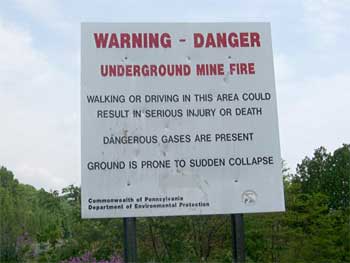
Our former publisher and Pennsylvanian Bill Coffin used to talk about this one all the time, so I have been familiar with its existence for some time. Nevertheless, it’s completely nuts. Like the Gates of Hell, it has been burning for decades — since 1962 in fact. But unlike the Turkmenistan fire, its genesis is not so clear.
It is suspected to be a blunder by the local fire department in 1962 which had been tasked with cleaning up the local landfill, which itself sat on top of an abandoned strip mine. To accomplish this, they set the landfill on fire, apparently not an unheard of method at the time. However, the theory goes that the fire was not put out properly, and heated up veins of coal underneath the landfill, which began to smolder over time.
Eventually the reaction lit an underground fire which continued to burn, which caused little concern from local authorities until almost two decades later when in 1981, a 12-year-old boy fell into a 150-foot sinkhole which suddenly opened up in the backyard underneath his feet.
See also: The Great Pacific Garbage Patch
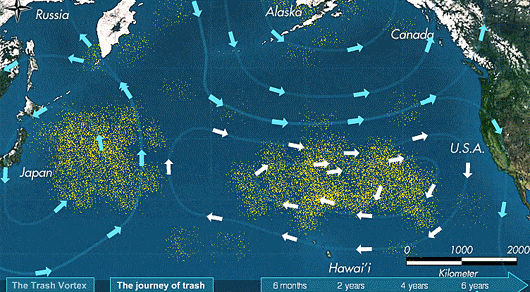
This is one of the neatest, worst things I have ever found out about. Discovered by chance by Captain Charles Moore some 12 years ago, the Great Pacific Garbage Patch is an unfathomably immense, floating, amorphous collection of trash in the middle of the planet’s largest ocean. It is located between Hawaii and California due to the fact that that is where multiple sea currents meet — and there the (mostly) plastic mass churns in the water at twice the size of Texas.
Pretty cool, huh? But sorry, folks, it’s not all beautiful pollution.
There is also a downside.
Since the area is so massive in scale (both in terms of width and depth underwater), many scientists believe it is nearly impossible to cleanup the contamination at sea, and that it would likely do even more damage to the surrounding sea life in the process. When people talk about our need to recycle plastics, this is why.
Over the decades the garbage patch has been developing, much of the debris has been broken down into smaller and smaller particles, comprised largely of various kinds of plastics, which is then mistaken for food by the marine life, which in turn contaminates the ecosystem all way up the food chain.
Jared Wade. The Seven Strangest Man-Made Disasters. 16 Jun 2010. Risk Management Monitor.
See also: Lillit Marcus. Gates of Hell: Turkmenistan’s President wants to close Darvaza gas crater. 9 Jan 2022. CNN.
See also: Darvaza Gas Crater on Wikipedia.
See also: Captain Charles Moore on the seas of plastic.
See also: Stephen Colbert Versus Captain Charles Moore
Colbert’s guest was Captain Charles Moore. He’s the person who stumbled onto the Great Pacific Garbage Patch, which is believed to be the world’s largest dump. Plastic debris from the world over makes its way into waterways, where it’s carried out to sea and trapped in swirling ocean currents, thereby forming a trash dump in the North Pacific that’s twice the size of Texas.
See: Birth of a mud volcano: East Java, 29 May 2006
See: WATER: Rulings Restrict Clean Water Act, Foiling E.P.A.
See: Scientific Study Links Flammable Drinking Water to Fracking