


FracTracker Alliance. Do the Natural Gas Industry’s surface water withdrawals pose a health risk? 22 Sep 2010. FracTracker.
Water withdrawals for the natural gas industry are permitted through the Pennsylvania Department of Environmental Protection (PA DEP) with the approval of the Department of Conservation and Natural Resources (DCNR). As water is withdrawn, the volumes of stream flow decrease. Water withdrawals must be conducted responsibly, so that the volumes of stream flow are not impacted.
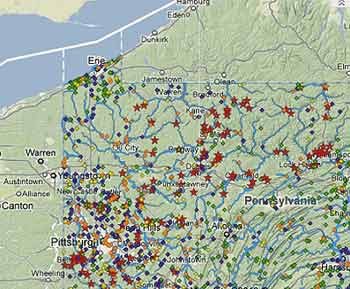
This map shows the multitude of surface water withdrawals in Pennsylvania that are permitted by the PA DEP. The many points exemplify the magnitude that the PA community and economy relies on the quality of our surface water resources. The red stars show the oil and natural gas industry withdrawal locations.
See also: FracTracker Petrochemicals Guide: Breathe at Your Own Risk.

Petrochemicals can be toxic —you’d never want to inhale benzene or take a gulp of toluene. For one, they’re often highly flammable so there’s an explosion risk when it comes to transporting and processing them. For another, they contain toxic chemical characteristics that pose short and long term risks.
The process of turning toxic chemicals into consumer products presents health threats. And when these products break down back into those original components, either during use or disposal, there’s the potential for a health threat to emerge once again.
See also: Matt Kelso. Fracking water use in Pennsylvania increases dramatically. 29 May 2020. FracTracker.
Unconventional wells in Pennsylvania were always resource-intensive, but the maps below show how the amount of water used per well has grown significantly in recent years. In 2013, these wells used an average of 5.8 million gallons per well. By 2019, that figure had increased 145%, consuming more than 14.3 million gallons per well. This is a glimpse into the unsustainable resource demands of this industry and the decreasing energy returned on investment.
Matt Kelso. Fracking water use in Pennsylvania increases dramatically. 29 May 2020. FracTracker.
The current water management practices of the natural gas industry during the regional dry season are likely to have contributed to higher TDS concentration in the Monongahela River…
…the water withdrawals in the Monongahela River watershed are potentially causing a cumulative impact on flow volume in the river that magnifies all forms of pollution by increasing the pollutant concentrations. Much more research needs to be conducted on this issue, to ensure safe and sustainable permitting practices for water withdrawals.
See: Urbina, Ian. “Regulation Is Lax for Water From Gas Wells.” The New York Times 26 Feb. 2011. Web. 27 Feb. 2011.
See: With Natural Gas Drilling Boom, Pennsylvania Faces an Onslaught of Wastewater
See: WATER: Gas drilling in huge Appalachia reserve yields foul, briny byproduct – AP