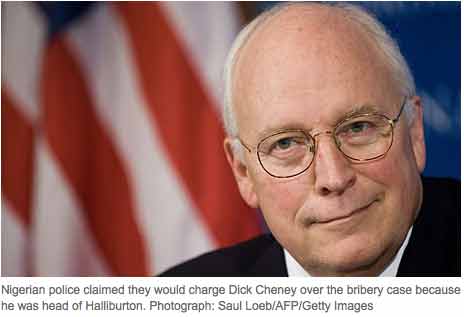
Dick Cheney

Dick Cheney

Before taking office, Cheney was CEO of Halliburton — which patented hydraulic fracturing in the 1940s, and remains one of the three largest manufacturers of fracturing fluids. Halliburton staff were actively involved in review of the 2004 EPA report on hydraulic fracturing.

15 documents

2013

January (2013)

2012

May (2012)

2011

February (2011)

Energy Policy Act of 2005-Critique

Energy Policy Act of 2005-Critique

Critics revisited the Energy Policy Act of 2005, focusing on provisions that limited federal oversight of hydraulic fracturing. The “Halliburton loophole” became shorthand for regulatory exemption. What passed quietly in statute books years earlier now sat at the center of public debate.

Source: Wikipedia, the free encyclopedia (2010) Read More

Halliburton

Halliburton

Halliburton, long associated with hydraulic fracturing technology, became synonymous with the so-called “Halliburton loophole” in the Energy Policy Act of 2005, which exempted most fracking from federal Safe Drinking Water Act oversight. As a global oilfield services leader, the company’s influence extends from well design to policy debate.

Source: Solutions for Today's Energy Challenges - Halliburton (2010) Read More

Tree spiker : from Earth First! to lowbagging: my struggles in radical environmental action

Tree spiker : from Earth First! to lowbagging: my struggles in radical environmental action

In Tree Spiker: From Earth First! to Lowbagging: My Struggles in Radical Environmental Action, Mike Roselle recounts his evolution from Yippie provocateur to cofounder of Earth First! and the Rainforest Action Network, tracing decades of radical environmental activism from street theater to mountaintop-removal protests in Appalachia. Writing against the backdrop of federal drilling exemptions advanced under Vice President Dick Cheney and ongoing battles over hydraulic fracturing disclosure, Roselle situates non-violent civil disobedience as both moral response and strategic necessity in confronting coal, oil, and gas power structures.

Source: St. Martin's Press (2009) Read More

January (2011)

Opinion: Avoiding America’s next drilling disaster

Opinion: Avoiding America's next drilling disaster

In the wake of the BP Gulf oil disaster, U.S. Sen. Robert Casey of Pennsylvania and U.S. Rep. Diana DeGette of Colorado warned in the Philadelphia Inquirer that hydraulic fracturing posed a parallel onshore risk, urging federal disclosure of fracking chemicals under the Safe Drinking Water Act. Challenging exemptions advanced during Vice President Dick Cheney’s 2005 energy legislation, Casey and DeGette argued that energy companies should disclose the ingredients in fracking fluids—diesel fuel, benzene, methanol, and formaldehyde among them—while preserving proprietary formulas, countering industry claims that state regulation alone was sufficient.

Source: Philadelphia Inquirer (2010) Read More

2010

December (2010)

Exxon Confronts Nuns, Calpers Over Global Warming Plans, Boskin

Exxon Confronts Nuns

Exxon confronted shareholder resolutions from Catholic nuns and the California Public Employees’ Retirement System (CalPERS) over climate disclosure and long-term strategy. The religious orders argued that the company’s global warming plans failed to account for environmental and moral risk, while CalPERS — one of the nation’s largest public pension funds — framed climate exposure as a material financial concern. The pressure signaled a shift: climate risk had moved from protest lines into boardrooms and proxy votes.

Source: Bloomberg.com (2007) Read More

November (2010)

Halliburton’s Interests Assisted by White House – Los Angeles Times

Halliburton's Interests Assisted by White House - Los Angeles Times

In 2005, Congress amended the Safe Drinking Water Act, carving out a controversial exemption for hydraulic fracturing. The move—later dubbed the “Halliburton loophole”—removed federal oversight of underground injection practices central to the shale boom. Supporters framed it as regulatory clarity for domestic energy development; critics saw it as a quiet rollback of environmental protection with national consequences.

Source: Los Angeles Times (2004) Read More

Colorado GOP to EPA: Keep your noses out of our fracking fluid

Colorado GOP to EPA: Keep your noses out of our fracking fluid

In July 2010, eighteen Republican members of the Colorado State Legislature sent a formal letter to the U.S. Environmental Protection Agency demanding that the agency refrain from regulating hydraulic fracturing, regardless of what its two-year study might conclude. The dispute, reported by The Colorado Independent, revived debate over the “Halliburton loophole” advanced during Vice President Dick Cheney’s 2005 Energy Policy Act, as state lawmakers argued against federal oversight of fracking fluids and disclosure requirements while environmental advocates pressed for stricter Clean Air Act and Safe Drinking Water Act enforcement.

Source: The Colorado Independent (2010) Read More

August (2010)

Editorial – The Halliburton Loophole – NYTimes.com

Editorial - The Halliburton Loophole - NYTimes.com

The so-called “Halliburton Loophole” exempted hydraulic fracturing from key provisions of the Safe Drinking Water Act. Critics argued the exemption shielded industry from meaningful oversight, while defenders insisted state regulation sufficed. At stake: whether federal law should close the gap between energy development and environmental accountability.

Source: The New York Times (2009) Read More

Buried Secrets: Is Natural Gas Drilling Endangering U.S. Water Supplies?

Buried Secrets: Is Natural Gas Drilling Endangering U.S. Water Supplies?

Investigative reporter Abrahm Lustgarten examined whether hydraulic fracturing posed risks to underground water supplies long assumed safe. Internal documents, field reports, and federal hesitations suggested a murkier picture than public assurances implied. At stake: aquifers serving millions. The promise of cleaner-burning fuel collided with a quieter question — what happens if the contamination is slow, invisible, and hard to prove?

Source: ProPublica (2008) Read More

Hydraulic Fracturing of Oil and Gas Wells

Hydraulic Fracturing of Oil and Gas Wells

A nuts-and-bolts explainer of the process: drilling, casing, perforation, high-pressure fluid, sand, and chemical additives — engineered force applied underground to release gas. It’s operational clarity in a debate that often floats above the mechanics. The hook here is not ideology — it’s process: how a well becomes productive, where failures can occur, and why “how it’s done” matters when water, cement, and pressure are the core ingredients.

Source: Earthworks (2010) Read More
Item added to cart.
0 items - $0.00