
Garrett Hardin. “The Tragedy of the Commons.” Science. 162(1968):1243-1248
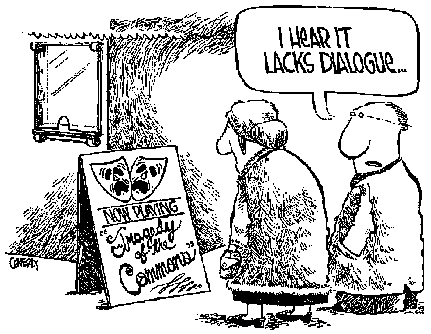
Garrett Hardin’s “Tragedy of the Commons” (1968) is heavily criticized for being applied to justify the privatization of common-pool resources and state-managed enclosures. Critics argue his work incorrectly assumes all shared resources inevitably lead to destruction, ignoring sustainable, long-term communal management, while fostering Western economic, pro-privatization agendas.
The tragedy of the commons is the concept that, in a system where individuals benefit from the use of a shared resource while the cost of that use is shared by all users, it is rational for individuals to overuse the resource, even though collectively this will likely lead to the depletion of the resource.
The concept has been widely discussed and criticized in economics, ecology, and other sciences under the terminologies and consequences of environmental pollution.
Pollution is the introduction of contaminants into the natural environment that cause harm.
Wikipedia: Pollution
The metaphorical term is the title of a 1968 essay by ecologist Garrett Hardin. Versions of this concept extend back to classical antiquity, being discussed by Aristotle. The principal concern of Hardin’s essay was overpopulation of the planet. To prevent the inevitable tragedy (he argued) it was necessary to reject the principle (supposedly enshrined in the Universal Declaration of Human Rights) according to which every family has a right to choose the number of its offspring, and to replace it by “mutual coercion, mutually agreed upon”.
More significantly, criticism has been fueled by the “application” of Hardin’s ideas to current policy issues. In particular, some authorities have read Hardin’s work as specifically advocating the privatization of commonly owned resources.
Consequently, resources that have traditionally been managed communally by local organizations have been enclosed or privatized. Ostensibly, this serves to “protect” such resources, but it ignores the pre-existing management, often appropriating resources and alienating indigenous (and frequently poor) populations. In effect, private or state use may result in worse outcomes than the previous management of commons.
Another example of a typical commons is groundwater. Nobody really owns the groundwater; it is technically up for grabs. However, individual pumping of too much groundwater can result in the depletion of the resource, to say nothing of other related effects or losses, such as land subsidence and salt-water intrusion...Eventually, depletion by a few means depletion for all.
Victor L. Ponce. Hardin’s “Tragedy of the Commons” Revisited or We Are All In the Same Boat. San Diego State University. (archive.org)
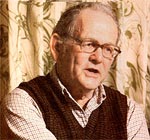
Victor Ponce is a Professor of Civil, Construction and Environmental Engineering at San Diego State University.
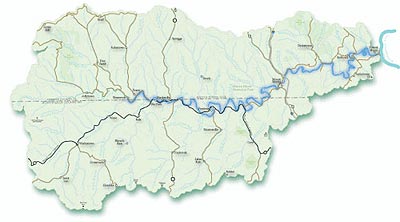
See also: Marcellus-Shale.us. December 2, 2009. “Dunkard Creek Fish Kill.”
See also: U.S. Geological Survey. U.S. Department of the Interior. Water Resources Mission Area. Land Subsidence. 2 Mar 2019. USGS.
See also: Ostrom, E., J. Burger, C. B Field, R. B Norgaard, and D. Policansky. 1999. Revisiting the commons: local lessons, global challenges. Science 284, no. 5412: 278.
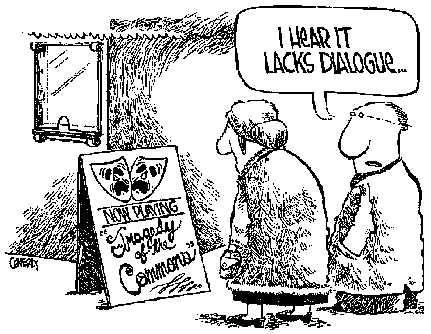
The Tragedy of the Commons
Adding together the component partial utilities, the rational herdsman concludes that the only sensible course for him to pursue is to add another animal to his herd. And another… But this is the conclusion reached by each and every rational herdsman sharing a commons.
Therein is the tragedy. Each man is locked into a system that compels him to increase his herd without limit — in a world that is limited. Ruin is the destination toward which all men rush, each pursuing his own best interest in a society that believes in the freedom of the commons. Freedom in a commons brings ruin to all.
I would like to focus your attention not on the subject of the article (national security in a nuclear world) but on the kind of conclusion they reached, namely that there is no technical solution to the problem.
An implicit and almost universal assumption of discussions published in professional and semipopular scientific journals is that the problem under discussion has a technical solution. A technical solution may be defined as one that requires a change only in the techniques of the natural sciences, demanding little or nothing in the way of change in human values or ideas of morality…
…It is our considered professional judgment that this dilemma has no technical solution.
Garrett Hardin. “The Tragedy of the Commons.” Science. 162(1968):1243-1248
See also: J. B. Wiesner and H. F. York. “National Security and the Nuclear-Test Ban.” Sci. Amer. 211 (No. 4), 27 (1964).
See also: The Tragedy of the Commons. Food and Agriculture Organization of the United Nations (FAO).
See also: Jean-Marie Baland and Jean-Phillipe Plateau. (1996). “Halting degradation of natural resources”. Food and Agriculture Organization of the United Nations. Rome, Italy.
Is there a Role for Rural Communities?
The present work is concerned with the topical issue of natural resource management. It does not deal, however, with broad-spectrum environmental concerns such as protection of wilderness areas (for example, the south pole), air or water pollution, etc., but focuses on local ecosystems. What distinguishes local-level resources from larger ecosystems is that:
(1) they are susceptible of appropriation by relatively small units (including individuals) and
(2) they can lead to rivalry in consumption in so far as yields of these resources are clearly perceived as subtractable. This book thus addresses the question as to how these local or village-level natural resources (as contrasted with global commons) can be most efficiently and equitably managed. In other words, can we find guidelines or sound theoretical principles for an optimal long-term exploitation of local resources (forests, irrigation water, pastures, lakes and rivers, sea areas, etc.)?
Disturbing evidence highlighting rapid processes of resource depletion, particularly so in developing countries, has stimulated a lot of theoretical and empirical works during the last decades. Moreover, relevant theoretical tools (such as game theory) have been developed independently of environmental concerns which have potential applications to this field.
See: Flow – The War Between Public Health and Private Interests
See: Climate Co-benefits and Child Mortality Wedges
See: West Virginia Blue: Dunkard Creek fish kill
See: Marcellus-Shale.us: Our look at the Halliburton Loophole – 2005 Energy Act
See: Rainforest Action Network
See: Natural Gas Drilling Threatens Communities in Northeastern United States