Big Oil has some big plans to put America’s clean energy future in jeopardy by expanding the production of tar sands oil – one of the most destructive, dirty, and costly fuels in the world.
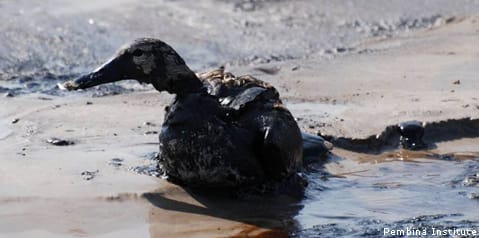
In 2008, 1,600 ducks drowned in toxic tailing ponds created to produce dirty tar sands oil.
In July, 2010, 1 million gallons of oil gushed into a Michigan river from a pipeline owned by a tar sands company.
Photo: Pembina Institute
And now, tar sands oil companies want to pump this dangerous and dirty fuel right through America’s heartland, putting our public water supplies, crop lands, and wildlife habitats at risk of tar sands oil leaks.
The largest tar sands reserves in the world are located beneath the boreal forest in Alberta, Canada. This forest provides critical habitat for about 50 percent of North America’s migratory birds and some of the world’s largest populations of wolves, grizzly bears, lynx and moose.
Oil companies are digging up this pristine forest to extract the tar sands, leaving behind huge toxic wastelands. To remove the thick black oil from the sand, they heat it using natural gas and wash it using enormous volumes of freshwater. This process creates toxic lakes that are so large they are visible from space. In 2008 alone, 1,600 migrating ducks drowned after landing in the toxic sludge.
More than two years after 1,600 ducks died in Syncrude’s Aurora tailings lake, the oilsands operator has been found guilty in a high-profile court case that almost never happened. Since the incident, the amount of tailings (the toxic liquid waste produced by the oilsands extraction process) has steadily increased in volume by 200 million litres, or 80 Olympic-sized swimming pools, every day to now cover an area of 170 km2.
It raises the question: Did the ducks die in vain?
Checks and balances left unchecked
The Edmonton Journal’s Darcy Henton summarized the evidence on just how those 1,600 ducks died in the first part of his three-part series looking at the case. Here are the highlights from what he found: Syncrude failed to depl
Dead ducks from Syncrude’s Aurora tailings lake
Dead ducks from Syncrude’s Aurora tailings lakeoy duck deterrents despite reports 11 days prior to the incident that migratory birds had arrived. The head of their bird and ecology team had no training in wildlife management. That team was called into work two weeks later than usual. The team only worked four days out of what should have been seven-day-a-week bird deterrent coverage, and that reduction of staff and workdays wasn’t reported to Alberta Fish and Wildlife. The equipment required to deploy duck deterrents — adequate number of trucks, a fleet of operational boats and the batteries (nine-volt available in any convenience store) — was not available. While Syncrude claimed it was an act of God that caused the duck deaths, other oilsands operators, like Suncor, began to operate their bird deterrent systems for the 2008 migration two weeks before Syncrude workers were even called into work.