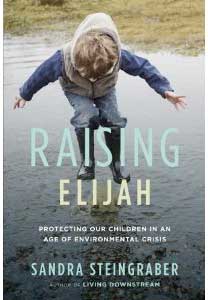
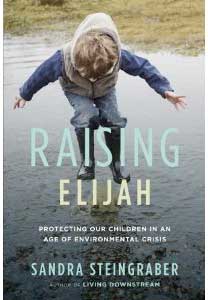
In the absence of federal policies that are protective of child development and the ecology of the planet on which our children’s lives depend, we serve as our own regulatory agencies and departments of the interior…
Thoughtful but overwhelmed parents correctly perceive a disconnect between the enormity of the problem and the ability of individual acts of vigilance and self-sacrifice to fix it.
Environmental awareness without corresponding political changes leads to paralyzing despair…We feel helpless in our knowledge, and we’re not sure we want any more knowledge.
You could call this well-informed futility syndrome. And soon enough, we are retreating into silent resignation rather than standing up for abolition now.
—Sandra Steingraber. Raising Elijah. 2011.
“We shouldn’t wreck this place down, right, Mom?”
—Elijah, age six,the author’s son.
“Eco-biologist, cancer survivor, activist, mother of two, and author of books about environmental hazards and their effects (including Living Downstream and Having Faith), Steingraber applies her knowledge and philosophy to the challenge of raising children in our toxic, climate-threatened world. She connects many child health issues, including asthma, behavioral problems, intellectual impairments, and pre-term birth to hormone-disrupting, brain-damaging, and otherwise dangerous environmental factors.
Chapters tackle weighty problems–diminished fertility; how chemicals infiltrate mothers’ milk; air quality and the ozone hole; neurotoxicology; hydraulic fracturing–and how they affect children and families. Two major themes emerge: first, current environmental policies must change to safeguard and support the health of children and, second, we must end our dependence on toxic fossil fuels. Less a guidebook for conscientious parents than an alarming and sobering human rights polemic, the book’s narrative is nevertheless a persuasive, personal call to action.” —Publisher’s Weekly
See also: Wikipedia. Sandra Steingraber.
.JPG)
Sandra Steingraber (born 1959) is an American biologist, author, and cancer survivor. Steingraber writes and lectures on the environmental factors that contribute to reproductive health problems and environmental links to cancer.
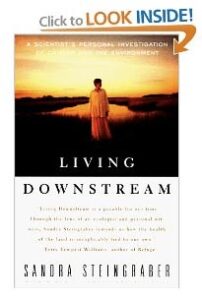
Her work Living Downstream: An Ecologist Looks at Cancer and the Environment, reflects the ideals that Rachel Carson expressed in her seminal book, Silent Spring. Carson discusses a woman with bladder cancer and investigates research on how and why cancer is linked to the environment. Steingraber stresses issues such as how chemical pesticides find their way into human bodies. She states, “in 1996 a study investigated six-fold excess of bladder cancer among workers exposed years before to o-toluidine and aniline in the rubber chemicals department of a manufacturing plant in upstate New York. Levels of these contaminants are now well within their legal workplace limits and yet blood and urine samples collected from current employees were found to contain substantial numbers of DNA adducts and detectable levels of o-toluidine and aniline.”
“To the 89 percent of Illinois that is farmland, an estimated 54 million pounds of synthetic pesticides are applied each year. Introduced into Illinois at the end of World War II, these chemical poisons quietly familiarized themselves with the landscape. In 1950, less than 10 percent of cornfields were sprayed with pesticides. In 1993, 99 percent were chemically treated,” (page 5).
Living Downstream is the basis for a documentary by The People’s Picture Company[7] that chronicles Steingraber’s struggles as a cancer survivor and her contributions as an ecologist and cancer prevention activist.
On March 18, 2013, Steingraber was arrested along with nine other protesters for blocking the entrance to the Inergy natural gas facility near Ithaca to protest “the industrialization of the Finger Lakes.” After refusing to pay a fine, Steingraber and two other members of the “Seneca Lake 12” received 15-day sentences. Steingraber served 10 days in the Chemung County jail in the city of Elmira before her release.
On October 29, 2014, while participating in the civil disobedience campaign, called We Are Seneca Lake, Steingraber was arrested again with nine other protestors at the gates of Crestwood Midstream (formerly Inergy) for trespassing and blocking a chemical truck, which resulted in an additional charge of disorderly conduct. On November 19, in the Town of Reading Court, she was sentenced to 15-days in jail after refusing to pay her fine. She served 8-days in the Chemung County jail and was released. Steingraber detailed her experience in an Ecowatch article, “Why I am in Jail.”[8]
See also: Mira’s Story: My Amazing Daughter’s Fight Against Cancer
See: Living Downstream: An Ecologist’s Personal Investigation of Cancer and the Environment
See: Poisoned profits : the toxic assault on our children
See: The Case for a Truth and Reconciliation Commission on Toxic Hazards
See: Fracking: Implications for Human and Environmental Health
See: Food and Water Watch