

Editor’s Note: RAN (The Rainforest Action Network) is still going in 2025!
The Rainforest Action Network and its blog, The Understory, have focused on issues that will intersect the concerns people have about gas drilling.
Their campaign to end mountaintop removal in West Virginia and their demands to protect Appalachia’s drinking water in the face of the pressure of the mega-business in coal production, signals that the post-Bush era EPA may still be in the pockets of the Oil and Gas Industry. RAN activists Sit Down so EPA Will Stand up to King Coal.
With the nation’s eyes on the BP disaster, the EPA, without publicly announcing the action, recently gave the green light for a major new mountaintop removal coal mining permit in Logan County, West Virginia. The permit would allow the destruction of nearly three miles of currently clean streams and 760 acres of forest, in a county where at least 13 percent of the land has already been permitted for surface coal mining. This was despite EPA Administrator Lisa Jackson’s promise last April to enforce new rules to end the reckless practice of mountaintop removal mining.

Joanne Fiorito, acting as the eyes of the DEP, recently discovered a waste spill at a drilling site just off RT 29 and upon reporting the spill was warned not to trespass.
“If the DEP can’t monitor these sites on their own,” said Ms.Joanne Fiorito “and then the DEP tells us that we cannot trespass after we found a spill on the Grimsley well pad site that wasn’t reported to the DEP by Cabot, well then, where does this leave the citizens of PA who are dependent on the DEP doing its job?
Nastassja Noell. Natural Gas Drilling Threatens Communities in Northeastern United States. 28 Sep 2009. Philadelphia Independent Media Center.
It has gotten to the point where I and others will have to do it ourselves, and I personally don’t care if they arrest me for civil disobedience, because this land, air and water is what keeps us all alive.”
People Feel Threatened
Chesapeake Energy reports that citizens in Wetzel County, West Virginia have placed spikes along RT 89.
Pittsburgh Post Gazette reports that 161 species found killed along 38 miles of Dunkard Creek — “Sudden death of ecosystem ravages long creek ‘Everything is being killed’: 161 aquatic species have died along Dunkard Creek” by Don Hopey, Pittsburgh Post-Gazette; September 20, 2009.
See also: Ken Ward Jr. EPA: Mine discharges killed Dunkard Creek. 2 Dec 2009. Coal Tattoo. West Virginia Gazette Mail.
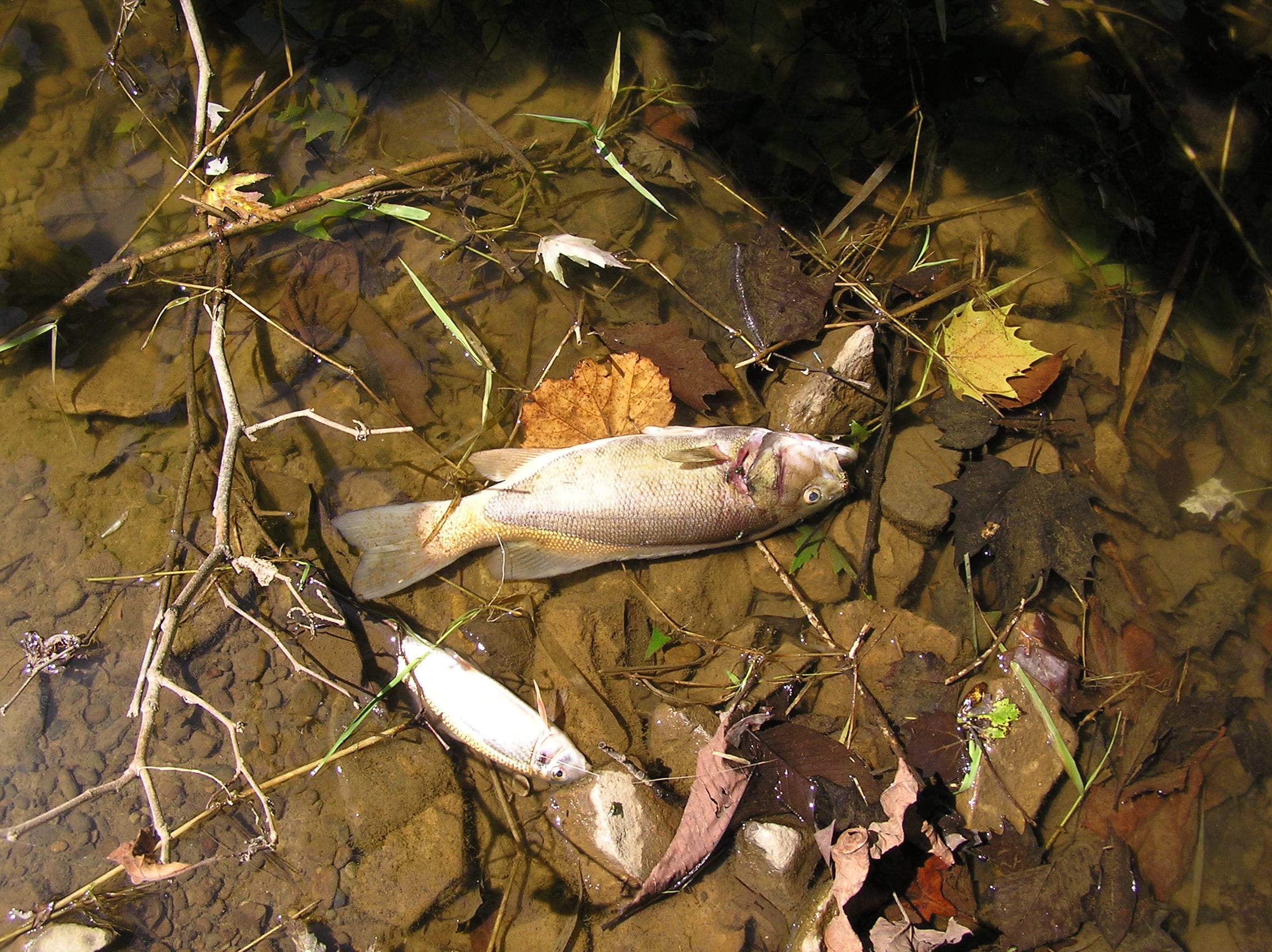
A new federal government report blames coal-mining discharges for creating the conditions that allowed an exotic algae to bloom, killing all aquatic life in Dunkard Creek, the scenic stream along the West Virginia-Pennsylvania border.
My buddy Don Hopey at the Pittsburgh Post-Gazette had the first story on this here, and you can read the report for yourself here.
As Don reported, the EPA report agrees with previous West Virginia Department of Environmental Protection conclusions that the toxic Golden Algae was responsible for killing thousands of fish, mussels, salamanders and other aquatic life in Dunkard Creek in September. It’s not clear exactly how the algae got there in the first place.
But, the 17-page EPA report also notes that high conductivity and dissolved solids in the creek — coming from coal-mine discharges — created conditions favorable to the algae’s growth to toxic levels. Normally, this particular algae is confined to brackish waters, mostly in the southwestern U.S.
Interestingly, the EPA report notes that federal officials previously (on Sept. 30 — in the midst of the investigation of the fish kill) approved the WVDEP’s cleanup plan for some pollution problems in Dunkard Creek. EPA notes that the cleanup plan, called a TMDL, would deal with some of the “stressors” on Dunkard Creek’s water quality.
But, the EPA report didn’t really make clear that the TMDL does nothing about the central causes of the fish kill — the high conductivity in the stream, an indication of high dissolved solids such as chlorides coming from the area’s coal-mine discharges. There have been some indications that Dunkard Creek might be a wake-up call for WVDEP about these problems.
And in its Sept. 30 letter approving the state’s cleanup plan, EPA said “additional action may prove necessary.” The EPA letter continued:
EPA anticipates that information developed as a result of the investigation may necessitate development of new TMDLs and/or other actions, such as enforcement. EPA intends to coordinate closely with WVDEP to evaluate new information generated by the investigation into this fish kill and to devise an appropriate and timely response.
Don Hopey. “Sudden death of ecosystem ravages long creek ‘Everything is being killed’: 161 aquatic species have died along Dunkard Creek”. 20 Sep 2009. Pittsburgh Post-Gazette.
Meanwhile, Betty Wiley, president of the Dunkard Creek Watershed Association, told Hopey that a preliminary estimate put the cost of restoring Dunkard Creek at $30 million.
See: West Virginia Blue: Dunkard Creek fish kill
See: Frack Check WV (West Virginia)
See: Society of Environmental Journalists (SEJ) Members’ Blogs and Websites
See: Poisoned profits : the toxic assault on our children
See: With Natural Gas Drilling Boom, Pennsylvania Faces an Onslaught of Wastewater