Editor’s Note: The original report posted at Common Cause can no longer be located. Dale Eisman, director of communications at Common Cause, a non-profit working towards government accountability, told ThinkProgress that his organization takes specific issue with how ALEC crafts their legislation at meetings like the upcoming one.
Dale Eisman. Nice Try, ALEC. 7 Apr 2015. Common Cause.
We’ve exposed them for running a tax scam and a secretive “war on democracy.” We’ve documented how their “scholarship” program works as a slush fund to cover the cost of trips to luxury resorts for state legislators and how their corporate members ghostwrite legislation. We’ve worked with allies to successfully encourage dozens of corporations to abandon them.
But it wasn’t until Common Cause tackled the American Legislative Exchange Council’s (ALEC) attempts to frustrate state clean energy initiatives and undercut the scientific consensus linking man-made carbon emissions to climate change that we really got their attention.
As The Washington Post reported on Monday, ALEC’s lawyers have delivered “cease and desist” letters demanding that Common Cause and the League of Conservation Voters stop referring to ALEC as a climate change denier. The letters warn that ALEC may take legal action – a defamation suit – unless Common Cause and LCV retract the charge.
Common Cause and LCV aren’t backing down, both told the Post. Common Cause President Miles Rapoport says ALEC is trying to strong-arm its critics into silence. Common Cause’s lawyers have sent ALEC a lawyerly reply that can be boiled down to two words: Forget it!
You can read the back and forth documents here and here and a Common Cause fact sheet on ALEC and climate denial here.
Keep this in mind while you’re reading. In claiming that it has been defamed, ALEC delivered a second, unspoken message: the “debate” over climate change is over and the deniers have lost. Let me explain.
According to Webster, to be defamatory a statement must be false AND must “make people have a bad opinion of someone or something.” So ALEC is saying that claims it is a climate denier are a stain on its reputation.
Now the only way that being a climate denier could damage your reputation is if the science behind climate change is so solid, so accepted, that in denying it you invite ridicule from pretty much everyone. If there was any legitimate uncertainty about the science, denial would be perfectly reasonable – and thus an accusation that one was a denier could not be defamatory.
So there you have it. After repeatedly hosting presentations that spotlighted the views of climate science skeptics, backing “model” bills aimed at undercutting the development of clean energy, and in 2014 choosing a national chairman who has called global warming “bad science,” ALEC wants a public make-over so that its more responsible corporate members will stop running for the exits..
Nice try ALEC. But until you stop blowing smoke to obscure science, pushing legislation from the fossil fuel industry’s playbook, and valuing profits more than the planet, nobody will be fooled.
See also: Ari Phillips. Legislators, Corporations Gather For Secret Meeting Against Clean Energy And You’re Not Invited. Think Progress. 28 Jul 2014.
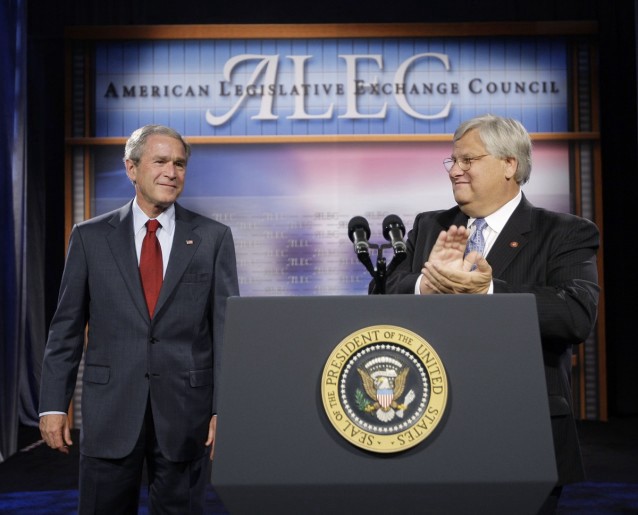
Dale Eisman, director of communications at Common Cause, a non-profit working towards government accountability, told ThinkProgress that his organization takes specific issue with how ALEC crafts their legislation at meetings like the upcoming one.
“The secrecy of it through closed meetings, they are masquerading as a charity while operating as a lobby,” said Eisman. “Whatever the issue – labor, schools, climate, or energy — they are drafting bills to advance corporate interests that don’t necessarily coincide with the public interest.”
This past year [2014] ALEC’s influence contributed to the ongoing battles between solar customers and utilities in Arizona and a Kansas Republican lawmaker’s ostracization from the state Chamber of Commerce after he refused to support an ALEC-backed measure designed to weaken Kansas’s successful renewable energy standard. ALEC, which does not publish a full list of all dues-paying members, includes some 2,000 state legislators, corporate executives, and lobbyists. Many of the state legislators have gone on to become members of Congress.
It is well-documented that most of ALEC’s revenue comes from corporations and corporate foundations, including those associated with petrochemical billionaires Charles and David Koch, rather than legislative dues. An analysis by the Energy & Policy Institute found that between 1998 and 2012 ALEC’s membership fees totaled just over $1 million while gifts, grants, and contributions were just over $78 million. ALEC received $500,000 in funding from various Koch foundations from 2005–2011 and $1.4 million from ExxonMobil this past decade.
They are drafting bills to advance corporate interests that don’t necessarily coincide with the public interest.
Dale Eisman
Eisman said that at meetings where task forces ratify model legislation, public officials from legislatures and corporate representatives vote as equals. Then the lawmakers take the legislation back to their states or districts and introduce it as their own, even when oftentimes it was drafted word-for-word by corporate interests.
“Corporations provide travel and lodging for members of public bodies at private resorts,” he added. “Then they vote as equals with legislative members when drafting bills at these meetings.”
State lawmakers are often overburdened sifting through legislation, Eisman explained, and welcome ALEC’s model legislation as a way to gain a foothold in their respective legislatures. ALEC also finds other ways to curry favor with the politicians.
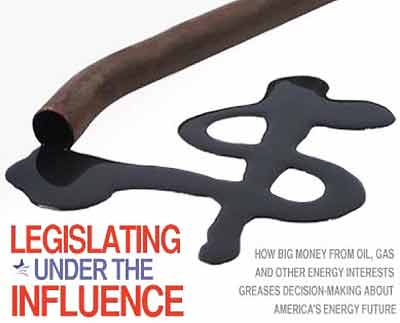
The energy industry’s money floods Congress and regulatory agencies.
Executive Summary
Long before BP’s Deepwater Horizon well began belching oil into the Gulf of Mexico, BP and the rest of the energy industry had turned loose a gusher of cash in Washington, saturating Congress and the federal government’s regulatory apparatus.
In the last decade alone, big energy has pumped more than $2.9 billion into electing and lobbying federal officials and candidates, according to campaign finance and lobbying disclosure reports.
That’s about $5.5 million for each of the 535 seats in the House and Senate.
As energy dollars flow freely in Washington, the development of alternative energy sources proceeds slowly, at best, and the nation’s reliance on energy produced overseas grows deeper. Meanwhile, at the industry’s urging, a 27-year moratorium on oil and gas drilling off the east coast has been allowed to expire and legislation to cap carbon emissions, pushing oil-gulping industries to find new energy sources and use petroleum more efficiently, has stalled in Congress.
See: Dirty Energy Money
See: Big Money Drives Up the Betting on the Marcellus Shale
See: Opponents to Fracking Disclosure Take Big Money From Industry
See: Fueling Washington