Laura Legere. Hazards posed by natural gas drilling are not limited to below ground. 2o Jun 2010. Republican Herald.
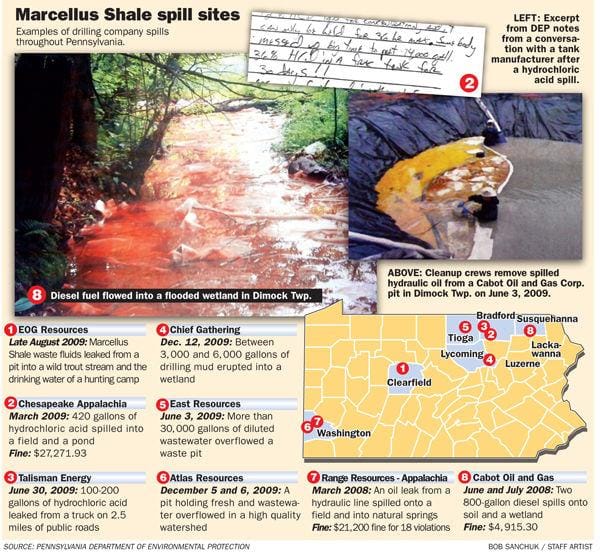
Fear about environmental damage from Marcellus Shale natural gas drilling is often trained on what could happen deep underground, but some of the gravest hazards posed by the process are driven in trucks, stored in tanks, carried through hoses and left in surface pits at natural gas well sites.
Concentrated chemicals, as well as wastewater containing toxic levels of salts and metals, are stored, produced or transported in large quantities at each well site, creating the potential for tainting drinking water or seeping into ponds and streams.
While recent enforcement action against Cabot Oil and Gas Corp. – the company deemed responsible for methane leaks and nearly two dozen spills in Susquehanna County in the last two years – has drawn attention to the danger of spills, information about the industry-wide frequency and impact has not been reported publicly.
While recent incidents at Marcellus Shale wells involving explosions, blowouts and methane-contaminated drinking water have drawn attention to the dangerous potential of the activity, information about the industrywide frequency and impact of spills and leaks has not been reported publicly.
Department of Environmental Protection files made available to The Times-Tribune through a Right-to-Know request reveal hundreds of examples of spills at natural gas drilling sites in the state during the last five years, recorded by at least 92 different drilling companies.
The documents show that many of the largest operators in the Marcellus Shale have been issued violations for spills that reached waterways, leaking pits that harmed drinking water, or failed pipes that drained into farmers’ fields, killing shrubs and trees.
The frequency of violations has kept the state’s gas inspectors on the run.
After a Marcellus Shale hearing last week, DEP produced a list for state legislators of 421 violations found by inspectors at Marcellus Shale wells this year through June 4.
At least 50 of the violations – recorded by 15 different Marcellus operators – involved a spill to soil or water. Generic descriptions used by the department to characterize the violations make it impossible to determine the exact number of spills.
“It goes from an accident to negligence,” DEP Secretary John Hanger said at the hearing, and attributed the problems to “poor management” and “not proper oversight” by the companies.
Laura Legere. Hazards posed by natural gas drilling are not limited to below ground. 2o Jun 2010. Republican Herald.
Click here for a PDF of this article.
See also: Cabot Oil & Gas’s Marcellus Drilling to Slow After PA Environment Officials Order Wells Closed, Lustgarten, Abrahm . ProPublica. (2010).
See also: Commonwealth of Pennsylvania DEP takes aggressive enforcement action against Cabot Oil.
See: Fracking and the Environment: Natural Gas Drilling, Hydraulic Fracturing and Water Contamination
See: Pennsylvania Orders Cabot Oil and Gas to Stop Fracturing in Troubled County – ProPublica
See: Buried Secrets: Is Natural Gas Drilling Endangering U.S. Water Supplies?